
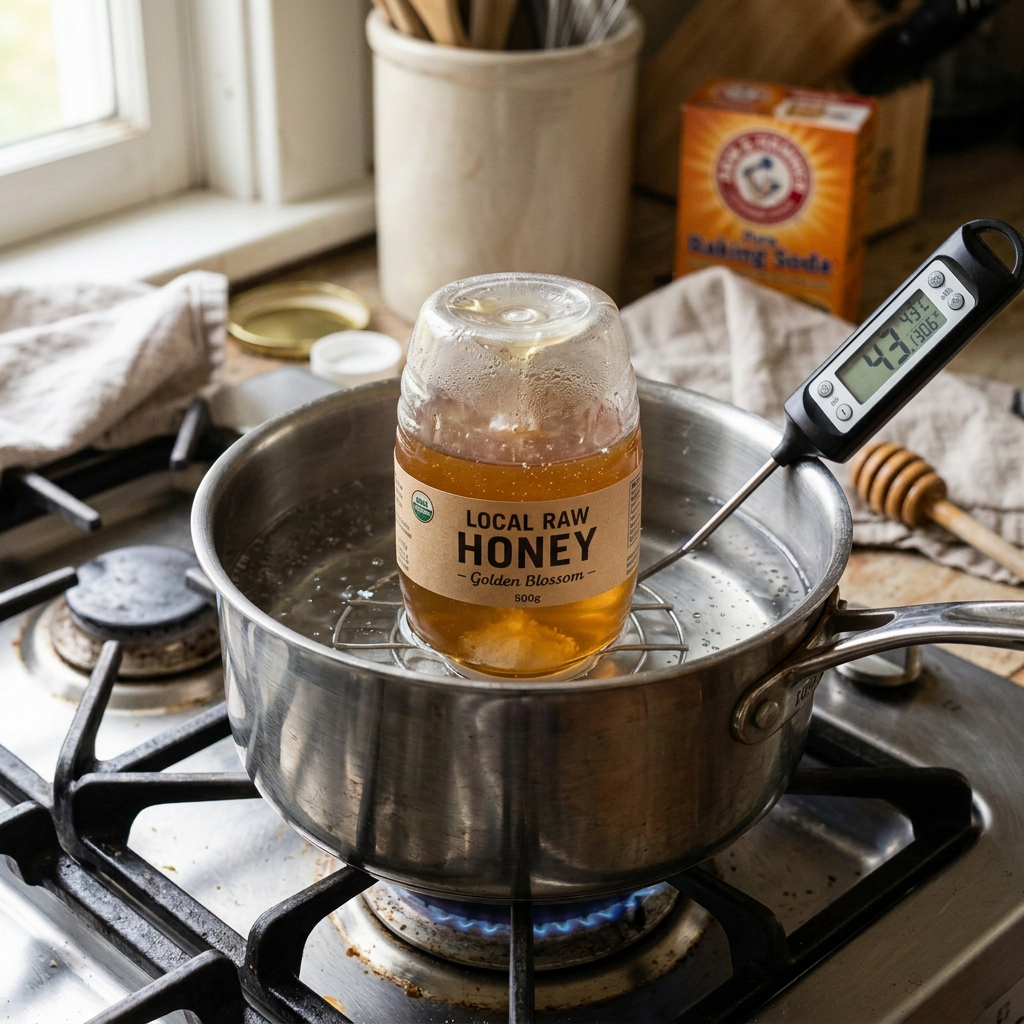
How to Decrystallize Runny Honey
Honey is a natural sweetener that can gradually change from a smooth, runny liquid into a thick, grainy, or almost solid substance. This process is called crystallization, and it is completely normal. However, when honey hardens inside a plastic bottle, squeezing it out or measuring it for recipes can become difficult.
The good news is that you can usually restore crystallized honey to a smooth, pourable consistency without transferring it to another container. The safest and simplest method is to place the plastic bottle in warm water and allow the gentle heat to dissolve the sugar crystals.
This guide explains how to decrystallize honey in a plastic container, how to soften hard honey in a plastic bottle, and how to prevent crystallization from happening too quickly. It also covers raw honey, glass jars, microwave safety, crystallized honey benefits, and other common questions about honey storage.
Why does honey crystallize?
Honey contains a high concentration of natural sugars, mainly glucose and fructose, dissolved in a relatively small amount of water. Over time, glucose can separate from the liquid and form tiny crystals. As these crystals grow, the honey becomes cloudy, thick, grainy, or solid.
Several factors influence how quickly this happens:
- Glucose content: Honey with more glucose relative to fructose generally crystallizes faster.
- Temperature: Many honeys crystallize more readily at cool room temperatures, particularly around 10–15°C. Refrigeration can also make honey crystallize faster.
- Natural particles: Pollen, tiny wax particles, and other microscopic material can provide surfaces on which crystals begin to form.
- Storage conditions: Repeated temperature changes and exposure to moisture can affect honey’s consistency and quality.
- Type of honey: Some varieties remain liquid for a long time, while others crystallize relatively quickly.
Crystallization does not automatically mean that honey is old, adulterated, or spoiled. It is a natural change in texture that can occur in both raw and commercially processed honey.
1. How to decrystallize honey in a plastic container
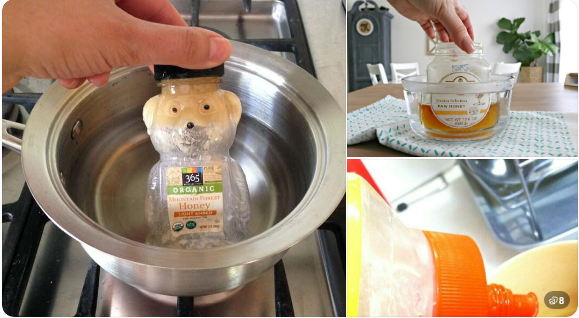
The easiest way to decrystallize honey in a plastic container is to use a warm-water bath. This method gradually warms the honey, allowing the glucose crystals to dissolve without exposing the plastic bottle to direct heat.
What you will need
- The plastic bottle or container of crystallized honey
- A bowl or saucepan large enough to hold the bottle
- Warm tap water
- A clean, dry spoon, if the container has a wide opening
- A towel for drying the bottle afterward
Step-by-step instructions
Step 1: Check the plastic container.
Make sure the bottle is food-grade, undamaged, and suitable for warm-water contact. Remove any cardboard labels or packaging that could become soggy. If the bottle is brittle, cracked, or not intended for warm liquids, transfer the honey to a heat-safe container instead.
Step 2: Prepare warm water.
Fill a bowl with warm tap water, ideally around 35–40°C (95–104°F). The water should feel comfortably warm, not scalding. Avoid boiling water because high temperatures may deform the plastic and unnecessarily heat the honey.
Step 3: Place the bottle in the water.
Stand the bottle upright in the bowl. Add enough water to surround the crystallized portion of the honey, while keeping the cap and opening above the waterline. This helps prevent water from entering the honey.
Step 4: Let the honey warm gradually.
Leave the bottle in the warm water for about 15–30 minutes, depending on its size and how firmly the honey has crystallized. Gently rotate or tilt the bottle occasionally if the container allows it. Do not squeeze a very hard bottle forcefully.
Step 5: Check the consistency.
Gently tilt the bottle to see whether the honey flows. If it remains grainy or solid, replace the cooled water with fresh warm water and repeat the process. Thick honey may need several warming sessions.
Step 6: Dry and store the bottle.
Remove the bottle, dry its exterior, and close the cap securely. Store it in a dry cupboard away from direct sunlight and major temperature fluctuations.
Important tip: If the bottle contains very hard honey, do not try to force it through a narrow nozzle. Warm the entire crystallized portion gradually instead. This reduces the risk of damaging the bottle or creating a mess.
The time required depends on the amount of honey, the size and shape of the bottle, and the degree of crystallization. Warm-water treatment is recommended for plastic containers because it avoids the direct heating associated with microwaving.
2. How to soften honey in a plastic container
If your honey is thick but not completely solid, you may not need to dissolve every crystal. A short warm-water bath can make it easier to squeeze, drizzle, or stir into food.
Start by placing the bottle in warm water for 10–15 minutes. Check its consistency and extend the warming time if necessary. If the honey is only slightly thickened, a single session may be enough.
For best results:
- Keep the water warm rather than hot.
- Ensure that the bottle is suitable for contact with warm water.
- Keep the cap above the water to prevent moisture from entering.
- Avoid placing the bottle on a hot stove or in a pan that is being heated.
- Allow the honey to warm evenly instead of trying to soften only the top layer.
If the bottle has a narrow nozzle, warm the honey until it becomes sufficiently fluid to move naturally. Never push a knife, metal skewer, or other sharp object into a plastic squeeze bottle to break up the crystals.
A warm-water bath is also useful when you only need to soften honey for tea, baking, toast, marinades, or salad dressings. You can warm the whole bottle or use a clean, dry spoon to remove a portion and warm only that amount in a suitable container.
3. How to soften hard honey in a plastic bottle in the microwave
Microwaving honey in its plastic bottle is not recommended.
Although a microwave may soften honey quickly, the results can be uneven. Some areas may become excessively hot while other areas remain crystallized. The plastic bottle may also warp or be unsuitable for microwave heating.
Microwaving can create additional problems:
- The container may soften, melt, or leak.
- Localized hot places can burn the honey or cause dangerous splashes.
- The honey may become darker or develop a different flavour if overheated.
- Excessive heat can reduce some heat-sensitive compounds in honey.
Even if the plastic bottle is labelled microwave-safe, that does not mean microwaving the honey itself is the best approach. For this task, a warm-water bath is gentler and easier to control.
What if you want to use a microwave anyway?
The safer alternative is to transfer a small amount of honey into a clean, microwave-safe glass or ceramic container. Remove any metal components and heat the honey in very short intervals at low power, checking and stirring between intervals.
However, this approach is less suitable when your priority is preserving the original flavour and minimizing heat exposure. It is also unnecessary for most household situations.
Best recommendation: Keep the honey in its plastic bottle and use warm water. There is no need to risk overheating the honey or damaging its packaging.
4. How to decrystallize honey in a glass jar
Glass jars are generally more convenient for warming crystallized honey because glass can tolerate controlled warm-water treatment better than many plastic squeeze bottles. However, sudden temperature changes can cause glass to crack.
Follow these steps:
- Fill a saucepan or heatproof bowl with warm water.
- Place the glass jar upright in the water.
- Keep the water below the lid and jar opening.
- If the jar is tightly closed, loosen or remove the lid as appropriate to prevent pressure buildup and to allow stirring.
- Leave the jar in the warm water until the honey begins to soften.
- Stir with a clean, dry spoon when the honey is accessible.
- Replace the water as it cools, if necessary.
- Continue until the crystals have dissolved to the consistency you want.
Avoid pouring boiling water directly onto a cold glass jar. Do not place an ordinary glass jar directly over a flame or on a hot burner.
For a large jar, the honey may soften around the edges first while the centre remains solid. Stirring helps distribute the heat more evenly and speeds up the process.
A glass jar can also make it easier to see whether crystals remain at the bottom or around the sides. Once the honey is smooth, allow the jar to cool naturally before closing it and returning it to storage.
5. How to decrystallize raw honey in a plastic container
Raw honey can crystallize just like other honey. Depending on the nectar source and how it has been handled, it may crystallize more quickly because it can contain microscopic particles that help crystals form.
If you want to restore raw honey to a pourable consistency while limiting unnecessary heating, use a warm-water bath.
The best method for raw honey
- Keep the honey in its original plastic container if it is suitable for warm-water contact.
- Use comfortably warm water rather than boiling water.
- Warm it gradually and replace the water as needed.
- Avoid prolonged or excessive heating.
- Stop once the honey reaches your preferred consistency.
Raw honey is not necessarily more nutritious simply because it is raw, and the precise composition varies by product. However, if you have chosen raw honey because you prefer its minimally processed character, gentle warming is a sensible approach.
There is no need to boil, cook, or microwave raw honey to remove its crystals. Heating it excessively may change its aroma, colour, flavour, and some heat-sensitive components.
Also, do not add water directly to the bottle to loosen the honey. Extra moisture can dilute honey and create conditions that encourage fermentation.
6. How to decrystallize raw honey in a plastic bottle
The process is essentially the same as for ordinary honey, but the aim is to use enough gentle heat to dissolve the crystals without unnecessarily exposing the raw honey to high temperatures.
For a narrow plastic squeeze bottle, stand it in warm water and allow heat to reach the crystallized honey through the bottle walls. Turn the bottle gently from time to time, provided the contents have softened enough to move.
If the honey is completely solid, allow extra time rather than using hotter water. Replace the water as it cools and continue until the honey becomes pourable.
If the bottle contains a large amount of honey, warming only the exposed nozzle will not be enough. The crystals throughout the container must soften for the honey to flow properly.
Once the honey is liquid again, remember that crystallization may return. This is not a failure of the process; it is a natural property of honey. The aim is to restore the texture you want, not to permanently change the honey’s composition.
7. How to decrystallize honey permanently
There is no practical household method that will keep every type of honey permanently liquid without affecting its natural characteristics or processing it in a way that changes its properties.
When honey is warmed and the crystals dissolve, it returns to a liquid state. However, if conditions again favour crystallization, new crystals can form. Even a bottle that has been completely liquefied may gradually become grainy or solid.
How to keep honey liquid for longer
Although permanent prevention is unrealistic, you can slow crystallization by following a few simple practices.
- Warm the honey thoroughly enough to dissolve the existing crystals. Residual crystals can serve as starting points for further crystallization.
- Store it in a consistently suitable location. Avoid repeatedly moving the bottle between warm and cool places.
- Keep the container sealed. This helps prevent moisture from entering and protects the honey from outside contaminants.
- Avoid refrigeration for ordinary pantry storage. Refrigeration often accelerates crystallization.
- Choose honey varieties that crystallize slowly. The natural sugar composition of different honeys affects how quickly crystals form.
Some commercial honey producers use controlled processing to delay crystallization. However, that is different from a simple home remedy.
If your main concern is having honey that stays easy to pour, buying a variety known for remaining liquid for longer may be more practical than repeatedly warming a crystallized bottle.
Remember: Decrystallizing honey can restore its liquid consistency, but it cannot guarantee that the honey will stay liquid forever.
8. How to stop honey from crystallizing naturally
If you want to reduce crystallization without using additives or unnecessary processing, focus on storage and handling.
Store honey at a stable room temperature
A dry cupboard away from direct sunlight is a good place to keep honey. Avoid leaving the bottle near an oven, on a hot windowsill, or beside appliances that produce fluctuating heat.
The exact temperature that best slows crystallization varies with the type of honey. Consistency is important, and extremely cold storage is not the best choice if your priority is keeping honey easy to pour.
Keep the lid tightly closed
Honey naturally attracts moisture from its surroundings. If water enters the container, the honey may become diluted in certain areas, increasing the risk of fermentation.
Close the cap after every use, and avoid storing honey in a container with a damaged seal.
Use clean, dry utensils
Never put a wet spoon into the honey bottle. Avoid dipping a spoon into honey after it has been used in tea, juice, jam, or another food.
These habits help keep the honey clean and reduce the risk of introducing moisture or food particles.
Avoid frequent temperature changes
Moving honey between a cold refrigerator and a warm kitchen can create less favourable storage conditions. Keeping it in one suitable location is simpler.
Choose a naturally slow-crystallizing variety
Honey with a higher proportion of fructose relative to glucose tends to stay liquid longer. Other varieties, especially those with higher glucose content, may crystallize quickly even when stored carefully.
No storage method can guarantee that natural honey will never crystallize. The goal is to slow the process while preserving the honey’s original character.
9. How to stop runny honey crystallizing
Runny honey is not necessarily more refined or better than crystallized honey. It may simply have a sugar composition that makes crystallization slower, or it may have been processed to remain liquid.
If you have just bought a bottle of runny honey and want to keep it that way, follow this routine:
- Store it in a dry cupboard at a reasonably stable room temperature.
- Keep the original lid tightly closed.
- Do not refrigerate it unless there is a specific product-related reason to do so.
- Use a clean, dry spoon whenever you need to measure honey.
- Avoid exposing the bottle to unnecessary heat or direct sunlight.
- If you notice a few crystals forming, use a warm-water bath before the honey becomes completely solid.
You do not need to warm honey regularly as a preventative measure. Warm it only when crystallization affects the consistency you want.
If you prefer a product that stays liquid for a long time, consider choosing honey known for slower crystallization. Even then, some crystal formation over time is normal.
10. How to decrystallize honey quickly
The fastest sensible method for a plastic bottle is usually a warm-water bath. The exact time depends on the size of the bottle, the starting temperature, and how firmly the honey has crystallized.
For a small bottle with partial crystallization, begin with 10–15 minutes in warm water. A larger bottle or a completely solid container may require 30 minutes or longer and several changes of water.
To speed up the process without using excessive heat:
- Use a bowl that allows the warm water to surround most of the crystallized honey.
- Ensure the bottle is standing securely.
- Replace cooled water with fresh warm water.
- Gently rotate the bottle as the contents soften.
- If possible, warm a smaller quantity rather than the entire bottle.
Avoid boiling the bottle, placing it directly on a stove, or using very hot water in an attempt to finish more quickly. These methods can damage the packaging or overheat the honey.
If you only need a spoonful for breakfast or a recipe, it is often quicker to remove that amount and soften it separately in a heat-safe container. There is no reason to liquefy an entire bottle for one serving.
11. Crystallized honey benefits
Crystallized honey has several practical advantages, and its change in texture does not automatically mean it has lost its usefulness.
It is easier to spread
Thick, crystallized honey can be spread on toast, bread, pancakes, and crackers without running off the edges. Fine crystals may create a texture similar to a soft spread.
It works well in cooking and baking
Crystallized honey can be stirred into batters, sauces, marinades, and dressings. If a recipe requires liquid honey, you can gently warm the quantity needed before measuring or mixing it.
It can be eaten without being liquefied
There is no need to restore every jar to a liquid state. If the honey smells normal and has no signs of spoilage, it can generally be eaten in its crystallized form.
It can have a pleasant texture
Some people enjoy the fine, grainy texture of crystallized honey. Creamed honey, also called whipped honey, is intentionally processed to produce a smooth, spreadable consistency through controlled crystallization.
Does crystallized honey have more health benefits?
Not necessarily. Crystallization is primarily a physical change in the arrangement of sugars. It does not establish that honey has more antioxidants, more vitamins, or greater medicinal value than liquid honey.
Honey’s composition varies according to its floral source and processing. Both liquid and crystallized honey should be treated as sources of sugar and consumed in moderation.
One important safety reminder: never give honey to a child under 12 months of age, regardless of whether it is raw, liquid, crystallized, or processed. Honey can contain spores that cause infant botulism.
12. Honey crystallized: Is it bad?
In most cases, no. Crystallization is a natural process and is not, by itself, a sign that honey has gone bad.
Honey can become cloudy, develop crystals around the edges, form a grainy texture, or turn almost solid. These changes are normal for many varieties of honey.
Signs that are generally normal
- The honey has become thicker.
- Small white or golden crystals have appeared.
- The honey has turned cloudy.
- The texture has become grainy or creamy.
- The honey no longer pours easily.
The colour may also vary naturally between different honeys, so colour alone is not a reliable indicator of spoilage.
When should you be concerned?
Honey can spoil if moisture enters it or if it is contaminated. Check for unusual signs such as:
- Persistent bubbling or foaming that suggests fermentation.
- A sour, alcoholic, or otherwise abnormal smell.
- Unexpected changes accompanied by signs of contamination.
If you notice signs of fermentation or suspect that the honey has been contaminated, discard it rather than attempting to fix it by heating.
Keep in mind that crystals and fermentation are different things. Crystals are solid sugar; fermentation involves microbial activity and may produce gas and unusual odours.
Properly stored honey can remain usable for a long time, but storage conditions matter. Keep the container sealed, dry, and protected from contamination.
13. How to make crystallized honey runny again
To make crystallized honey runny again, the main objective is to dissolve the glucose crystals through gentle, even warming.
The most convenient method depends on the container.
| Container | Recommended method |
| Plastic squeeze bottle | Place it in warm water and allow it to soften gradually. |
| Glass jar | Use a warm-water bath and stir when possible. |
| Small amount of honey | Transfer it to a heat-safe bowl and warm gently. |
| Large, solid container | Use several rounds of warm water and allow extra time. |
| Raw honey | Use gentle warming and avoid prolonged high temperatures. |
What if the honey becomes liquid but turns solid again?
This can happen when crystals remain or when the storage conditions favour crystallization. Warm the honey again until it reaches the desired consistency, then store it in a suitable location.
If you do not mind the texture, you can also leave it crystallized and scoop it out with a clean, dry spoon. There is no nutritional requirement to make honey runny again.
14. How to dissolve crystallized honey
Dissolving crystallized honey is a straightforward process, but patience is often more effective than intense heat.
The warm-water method works because heat increases the ability of the honey’s liquid phase to accommodate dissolved sugar. As the honey warms, the glucose crystals gradually dissolve back into the mixture.
For best results:
- Use warm water rather than boiling water.
- Allow sufficient time for the heat to reach the centre of the container.
- Stir gently if the honey is in a wide-mouthed jar.
- Replace the water if it becomes cool.
- Stop when the crystals are gone or when the texture is suitable for your needs.
Do not add ordinary tap water directly to the honey to dissolve the crystals. Although water can dissolve sugar, adding it changes the honey’s moisture content and can increase the risk of fermentation.
If you only need a small amount for a hot drink, you can simply stir the crystallized honey directly into the drink. The heat and liquid will help it dissolve, making it unnecessary to decrystallize the whole container.
For honey used in cold drinks, salad dressings, or uncooked recipes, softening it first may make mixing easier.
15. How to thicken runny honey
Sometimes the goal is the opposite: you may want honey that is thicker and easier to spread rather than honey that pours quickly.
The most natural way to achieve a thicker consistency is to allow controlled crystallization. As glucose crystals form, the honey becomes less fluid and may develop a soft, spreadable texture.
Methods for thickening honey
1. Allow natural crystallization. Store the honey in a sealed container and allow it to crystallize naturally. Depending on the honey variety and storage conditions, this may take days, weeks, or longer.
2. Try creamed honey. Creamed honey is made by encouraging the formation of small, uniform crystals. The result is generally smoother and more spreadable than honey that develops large, coarse crystals.
3. Use a naturally thicker variety. Some honey varieties are naturally more viscous or crystallize more quickly than others. Choosing a suitable variety is often easier than trying to change the consistency of a particular batch.
What should you avoid?
Do not add flour, cornstarch, sugar, or other ingredients to a bottle of honey simply to thicken it. Adding water is also not a good solution. These additions change the product and may affect its storage stability.
Refrigerating honey is not a reliable way to achieve a pleasant, thick texture because it can encourage crystallization without guaranteeing a smooth result.
If you want thick honey for spreading, creamed honey is usually the most predictable option. If you want a thicker version of your existing honey, natural crystallization is a reasonable alternative.
16. How to decrystallize honey powder
Honey powder is different from crystallized liquid honey. It is a dried product made from honey, often with a carrier ingredient such as maltodextrin or another food-grade ingredient to help the powder retain its form.
Because the product is designed to be dry, you should not automatically treat it like ordinary honey in a plastic bottle.
If your honey powder has formed lumps
Powder can clump when it absorbs moisture from the air. This is different from the normal crystallization of liquid honey.
To deal with clumped honey powder:
- Check the packaging instructions and ingredient list.
- If the powder is dry and otherwise normal, break up soft lumps using a clean, dry spoon.
- Sift the powder if the product instructions permit it.
- Store it in a tightly sealed, moisture-resistant container in a cool, dry place.
Do not heat a plastic package in hot water or microwave it unless the manufacturer specifically confirms that the packaging and product are suitable for that treatment.
How to turn honey powder into liquid honey
If the product is intended to be reconstituted, follow the manufacturer’s instructions for the amount of water to add. Different products contain different proportions of honey and carrier ingredients, so there is no single water-to-powder ratio that works for all brands.
Reconstituted honey powder may not have the same consistency, composition, or storage life as ordinary liquid honey. Adding water can also make the product more susceptible to spoilage, so prepare only the amount you need and follow the product’s storage directions.
Important distinction: If you have actual dried honey powder, you generally do not need to decrystallize it. If you have ordinary honey that has hardened into crystals, use the warm-water method described earlier.
Frequently asked questions
Can I put a plastic honey bottle in hot water?
Yes, provided the container is suitable for warm-water contact. Use warm rather than boiling water, keep the bottle opening above the waterline, and allow the honey to soften gradually.
How long does it take to decrystallize honey?
A small bottle with partial crystallization may soften in 10–20 minutes. A large bottle or completely solid honey may take 30 minutes or longer, sometimes requiring several rounds of warm water.
Can crystallized honey be eaten without heating?
Yes. Crystallized honey is generally safe to eat if it has been stored properly and shows no signs of spoilage.
Why does raw honey crystallize so quickly?
The rate depends on its sugar composition, temperature, and the presence of microscopic particles that help crystals form. Raw honey can crystallize quickly, but this is not proof of superior quality or a problem with the product.
Does heating honey destroy its benefits?
Excessive heat can change honey’s flavour, colour, aroma, and some heat-sensitive compounds. Gentle warming is preferable when you want to restore liquid consistency while minimizing unnecessary heat exposure.
Can I prevent honey from crystallizing forever?
No ordinary household storage method can guarantee permanent prevention. You can slow crystallization by keeping honey sealed at a stable temperature and choosing a variety that crystallizes slowly.
Should I throw away honey that has become completely solid?
Not just because it is solid. If it has crystallized naturally and has no signs of fermentation or contamination, you can generally eat it or gently warm it to restore its liquid texture.
People also ask:
*** What can I do if my honey wont crystallize?
If your honey will not decrystallize with a quick warm-up, the heat or time was likely insufficient to melt the stubborn micro-crystals, or the container is blocking proper heat transfer.
Steps to Fix Stubborn Honey
- Transfer to Glass: If your honey is in a plastic bottle, move it to a heat-safe glass jar. Plastic traps heat poorly and can warp or leach if overheated.
- Use a Silicone Barrier: Place a cloth, silicone trivet, or pad at the bottom of your pot. This stops the glass jar from resting directly on hot metal, which can cause the glass to crack.
- Raise the Water Temperature Gradually: Warm tap water is often not hot enough to dissolve persistent crystals. Heat a pot of water on the stove until it is warm to the touch (around 100°F to 110°F / 38°C to 43°C)—do not let it boil, as high heat destroys beneficial enzymes and changes the flavor.
- Soak Longer and Stir: Submerge the jar (with the lid off or loosened) so the water line is near the top of the honey. Let it sit for 20 to 30 minutes, remove it, stir thoroughly to break up clumps, and return it to the warm water. Repeat this cycle until every single microscopic crystal is gone. (If even a few crystals remain, the honey will quickly re-crystallize as it cools).
- Alternative Uses: If it still will not turn completely liquid, you do not need to throw it out. Crystallized honey is completely safe to eat and works great stirred into hot tea, spread on warm toast, or used in baking.
Conclusion
Decrystallizing honey in a plastic container is simple when you use gentle heat and give the crystals enough time to dissolve. A warm-water bath is the most practical method for most plastic squeeze bottles because it avoids the uneven heating and potential packaging damage associated with microwaving.
Store the honey in a sealed container, use clean and dry utensils, and keep it away from unnecessary moisture and temperature fluctuations. Remember that crystallization is a natural characteristic of honey rather than a sign that it has gone bad.
Whether you prefer honey runny, thick, raw, or crystallized, the best approach is to preserve its quality while choosing the consistency that works for you.
References and further reading
The following sources provide additional information about honey crystallization, storage, food safety, and methods for restoring liquid consistency.
1. North Carolina State Beekeepers Association — Honey Frequently Asked Questions. Includes guidance on storing honey, warming plastic containers, and avoiding microwave heating. https://www.ncbeekeepers.org/resources/honey-faq
2. Purdue University Extension — Honey. Explains crystallization, honey varieties, storage, and food safety. https://extension.purdue.edu/foodlink/food.php?food=honey
3. University of Arkansas Division of Agriculture — Honey. Discusses why natural honey crystallizes and how to return it to a liquid state. https://www.uaex.uada.edu/farm-ranch/special-programs/beekeeping/honey.aspx
4. Oregon State University Extension Service — Infusing Honey Safely. Provides information about honey storage, moisture, and restoring crystallized honey. https://extension.oregonstate.edu/catalog/pub/em9885
5. Ohio State University Extension — Ask Extension: Crystallized Honey. Offers practical advice on warming honey and preventing unnecessary crystallization. https://ask.extension.org/kb/faq.php?id=299672
6. Food Network — How to Soften Honey in a Bottle. Demonstrates a practical warm-water approach for softening honey in its container. https://www.foodnetwork.com/how-to/packages/help-around-the-kitchen/how-to-soften-honey-in-a-bottle
7. European Commission, CORDIS — Why Did My Honey Crystallise? Explains the roles of glucose, fructose, temperature, and microscopic particles in crystallization. https://cordis.europa.eu/article/id/444911-why-did-my-honey-crystallise
8. Cleveland Clinic — The Benefits of Honey. Discusses honey’s nutritional properties, consumption, and whether crystallized honey is safe. https://health.clevelandclinic.org/the-benefits-of-honey-how-to-incorporate-it-into-your-diet
Other reads:
A useful youtube video:
A useful pinterest pin:

Linkedin -- www.linkedin.com/in/shishir-bhargava-68a8b4257
- I Found a Way to Avoid Overpaying Federal Income Taxes in 2027. Check This Before Filing! - November 6, 2026
- Can the Apple iMac M6 Open 5,000 Windows at Once? Here’s the Truth - November 3, 2026
- Final Fantasy Resonance Problems and Solutions: Complete Walkthrough - October 26, 2026
⚠️ Most People Discover Trends When It's Too Late
Join the Trends Goldmine Insider List and get emerging AI tools, future products, viral keywords, and hidden opportunities before they hit the mainstream.
While everyone else is chasing yesterday's trends, you'll be spotting tomorrow's opportunities first.
🚀 Free Weekly Trend Alerts • No Spam • Unsubscribe Anytime
SIGN UP NOW & RECEIVE A SHORT REPORT ON HOW TO MAKE FORTUNE WITH TRENDS.Trusted by readers who want to discover opportunities before the crowd.