

Image credit — AI generated by Gemini AI
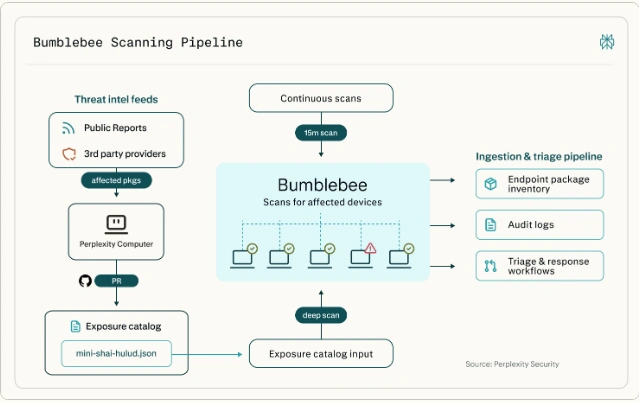
Image credit — Official website of Perplexity
A new emerging tool..
The world of AI research is changing rapidly. AI has been boon for mankind. No doubt.
But I feel that we should have a look from overall 360 degrees. So, we may understand better what’s it bringing with it.
Just think of any big revolution, take for instance the development of smartphones. The whole communication industry flipped and was changed quickly.
But the consequences which we it had bought along with it like problems related to health, well being and purpose of usage has gained a spike.
The thing to mean here is technology should be used judiciously with patience. Remember the story of the Golden eggs laid by the hen. How the negligence and carelessness made the owner deprived of the fortune.
The same is with technology. Using it properly with rules and regulations will keep us safe and happy for ever.
Coming to Perplexity bumblebee. For years, researchers, developers, students, employees, and businesses relied on a painful workflow: open dozens of browser tabs, manually compare sources, verify information, track citations, and organize scattered notes. As AI tools became mainstream, another problem emerged — trust and security.
You saw how new problems come up with the new things.
Think of it like raw petroleum which is unfiltered and not ready to use. You need to carry out the fractional distillation process to uncover various useful products and separate the waste.
Problems are like such waste which needs to be removed so that we can fully use the gems that are being ready to use. Especially to improve our lives.
Isn’t it?
That is where Perplexity’s new project, Bumblebee, enters the conversation.
Built as an internal security and research-support tool by Perplexity AI, Bumblebee was designed to solve a growing issue in modern AI-powered workflows: unsafe developer environments, vulnerable packages, malicious extensions, and inefficient research systems.
You can see in the above image a flowchart type image. It has been taken from the official website.
Now In this guide, I will explain you about:
- Why Bumblebee was created
- The research and engineering decisions behind it
- How it works
- Common problems and fixes
- Real-world use cases
- Case studies
- Faster AI research workflows
- Security insights most users miss
- Advanced troubleshooting strategies
If you want to understand how AI-powered research is evolving beyond simple chatbots, this article will give you a complete foundation.
The Foundation: Why Perplexity Needed Bumblebee
Generated by chatgpt.
I was just going through forums and news articles to know more about this perplexity AI. Can you guess what did I find?
Simple. But a very powerful insight.
Modern AI systems are no longer simple chat interfaces. They are not now restricted to just talking or chatting.
The capability lies beyond are imagination and we are tapping into it. Just have a look below.
But before that let me define you what actually a humanoid robot is?
A robotic machine that closely resembles a human is called a Humanoid Robot.
Such are the possibilities and it is coming true.
You may not believe but Today’s AI tools interact with:
- Browsers
- Code editors
- APIs
- Plugins
- AI agents
- Local files
- Developer environments
- Cloud systems
- MCP configurations
- Browser extensions
- Package managers
As AI research accelerated, Perplexity engineers noticed something important:
The biggest vulnerabilities were no longer only inside production servers.
They were appearing earlier in the software supply chain.
A single compromised package, malicious browser extension, or infected AI plugin could silently affect developer systems before the product even reached users.
They thought early of the consequences with all degrees for their product and then decided to bring something new.
As they checked, This created a serious challenge:
How do you quickly detect risks across hundreds or thousands of developer machines without creating more security problems during scanning?
Traditional security tools often run commands like:
- npm ls – Displays the installed Node.js packages and their dependency tree in a project.
- pip show – Shows detailed information about an installed Python package, such as version and location.
- go list – Lists Go packages or modules available in a Go project or workspace.
But modern malware can trigger during these commands.
That meant many scanners were ironically increasing exposure while trying to detect it.
Perplexity engineers wanted a safer approach.
The result was Bumblebee.
According to Perplexity, Bumblebee is a read-only scanner for macOS and Linux that inventories risky packages, extensions, browser add-ons, and AI tool configurations during supply-chain incidents.
How Bumblebee Improves AI Research Speed
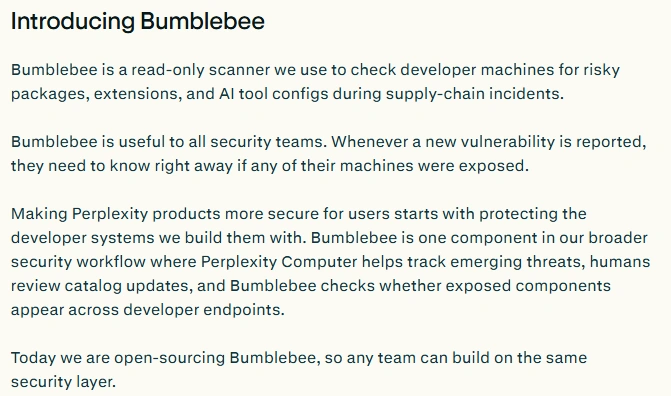
Image credit — Official source of the perplexity
At first glance, Bumblebee looks like a security tool. Just like monitoring your system 24 cross seven. But What I found was something very peculiar.
It also indirectly improves AI research workflows. Check the references at the end.
How is this possible? Here is why.
FASTER TRUST VERIFICATIONS
Researchers job is very responsible. They need enormous time for verifying sources and environments.
So, When development environments are safer and cleaner:
- AI agents behave more predictably
- Plugin conflicts decrease
- Browser instability drops
- Research sessions become faster
REDUCED WORKFLOW FRAGMENTATIONS
Now, the times has changed. There are number of tools available at your finger tips to get your work done. Modern AI research involves:
- Multiple tabs
- Browser tools
- Citation systems
- PDFs
- Extensions
- AI copilots
A compromised extension or overloaded setup can silently destroy productivity. After all it’s a machine and it is prone to errors.
This is where Bumblebee helps researchers maintain cleaner environments and do their tasks easily.
BETTER RESEARCH RELIABILITY
Perplexity itself already emphasizes citations and source-backed answers.
Many users praise its citation-focused workflow for making research faster and more trustworthy.
Bumblebee strengthens the infrastructure layer behind that philosophy.
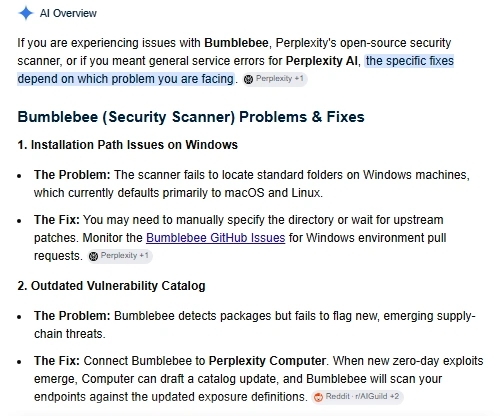
Common Bumblebee Problems and Fixes
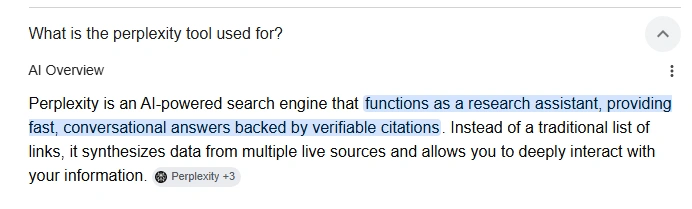
Even lightweight tools encounter challenges and problems which may become obstacle in doing your tasks. I have listed the common problems that you might face and possible solution that might fix it in the situation.
Here are the most common issues users may face.
PROBLEM 1 – LINUX PERMISSIONS ERRORS
Here in this situation users report in the form following symptoms:
Scan incomplete. Missing directories. Access denied messages.
The cause actually is restricted file permissions. Restricted file permissions are security settings that limit who can read, write, or execute a file to protect it from unauthorized access or modification.
The popular fix is
— Run scans with appropriate read permissions.
— Avoid unnecessary root access unless required.
— Also ensure development directories are readable.
PROBLEM 2 – SLOW DEEP SCANS
Now, can you guess what are the possible symptoms?
High scan duration. CPU spikes. Large filesystem traversal.
High scan duration, CPU spikes, and large filesystem traversal together describe a process that takes a long time because it is scanning through many files, causing sudden increases in CPU usage while the system works through the entire filesystem.
I found the cause of it and it is Deep mode scans extensive directories.
So, the fixes to solve the issues will be :
— Limit scan scope to targeted project directories.
— Use baseline mode for routine monitoring.
— Reserve deep mode for active incidents only.
PROBLEM 3: FALSE POSITIVES
In this situation, the symptoms observable are Safe packages, flagged Harmless extensions identified.
You may ask what do they mean?
Well, first you should know the cause and that is Exposure catalogs may include broad matching rules.
So, the possible fix will be:
— Cross-check findings manually.
— Use version verification before removing dependencies.
— Maintain updated allowlists.
PROBLEM 4: BROWSER EXTENSION CONFLICTS
This is a very common issue and you will find it very often.
You may observe Browser slowdown, Crashes, Unexpected alerts.
The possible cause may be Large extension ecosystems often contain overlapping permissions.
So, to fix that you can do the below needful:
— Remove unused extensions.
— Limit AI browser plugins.
— Audit extension permissions monthly.
PROBLEM 5: AI TOOL CONFIGURATION LISTS
This is frequently observed by the users as I read their comments in the forum. Possible symptoms that are reported are Strange AI behavior, Unauthorized prompts, External calls.
The most possible cause is Compromised MCP or AI config files.
MCP (Model Context Protocol) is a standard way for AI applications to connect to external tools, data sources, and services in a structured and consistent format. It acts like a “bridge” that lets an AI model safely and predictably access things like databases, APIs, file systems, or apps without custom integrations each time.
In simple terms:
👉 MCP tells an AI how to talk to external systems in a common language.
REAL WORLD CASE-STUDIES

A freelance content creator on forums explained how Perplexity transformed research workflows. It literally saved much time and the output was massively astounding.
Usually, the content creator Previously did following things:
- 15+ tabs open
- Manual comparison
- Source confusion
- Hours of organization
After switching to Perplexity:
- AI-generated summaries
- Source citations
- Faster verification
- Cleaner workflow
Now imagine adding security-aware infrastructure like Bumblebee underneath this workflow.
The result becomes:
- Faster AI research
- Lower browser instability
- Fewer malicious extensions
- Cleaner environments
- Reduced cognitive overload
This is where the future of AI research is heading.
Just think like a assistant that monitors your work with full automation and provide your work full safety.
Now, I want you to imagine this.
If you can think of Large engineering organizations, they face a difficult problem during security incidents.
When a new vulnerability appears, they must immediately answer:
“Which machines are going wrong?”
Traditional approaches can take hours or days.
Bumblebee changes this by enabling quick metadata scanning across developer endpoints.
Because the output is structured NDJSON, teams can integrate it into existing security pipelines easily.
That significantly improves incident response speed.
NDJSON (Newline Delimited JSON) is a data format where each line in a file is a separate, valid JSON object, making it easy to stream and process large datasets line by line.
MY UNIQUE INSIGHTS
| Most people think AI research problems are intelligence problems. They are not. They are made for anyone to use. They are workflow problems. If we talk about the perplexity ai tool, Researchers lose time previously due to: — Tab overload — Poor organization — Unsafe extensions — Conflicting AI tools — Unverified sources — Cognitive switching This is why Perplexity gained popularity. Instead of just generating answers, it reduces research friction. Bumblebee extends this philosophy into security and infrastructure. That is the deeper strategic insight many people miss. Bumblebee represents a larger industry shift. Traditional cybersecurity tools were designed before AI agents existed. Now systems must protect: AI copilots Agent frameworks AI browser extensions Local AI memory AI configuration layers The future belongs to AI-native security tools. Perplexity recognized this early. |
FASTER AI RESEAARCH WORKFLOW USING PERPLEXITY PLUS BUMBLEBEE
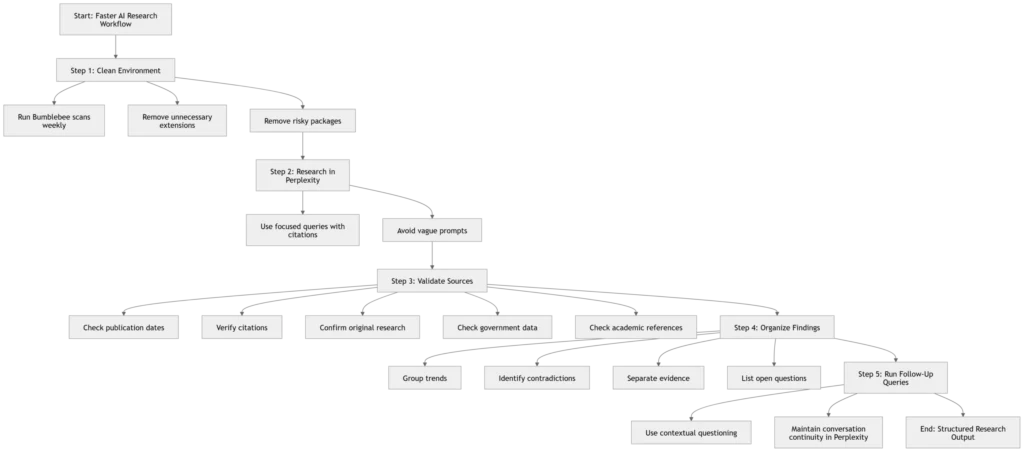
Image credit — AI generated by chatgpt
FINAL THOUGHTS
Perplexity Bumblebee may initially appear like a niche developer security utility.
But its importance is much larger.
It highlights three major realities about the future of AI:
- AI research is becoming infrastructure-dependent
- Developer environments are now primary security targets
- Faster research requires cleaner, safer workflows
The most interesting part is not the scanner itself.
It is the philosophy behind it.
Perplexity understood that AI productivity is not only about generating smarter answers.
It is about reducing friction, increasing trust, and protecting the environments where modern research actually happens.
That combination of research acceleration and security awareness could become one of the defining themes of the AI industry over the next few years.
REFERENCES:
OTHER READS:
A useful Youtube video:
A fact check about perplexity bumblebee:

Linkedin -- www.linkedin.com/in/shishir-bhargava-68a8b4257
- 2026 Lexus IS 350 F Sport: Shocking review - August 22, 2026
- Why Global Markets Can Turn Nervous Overnight | How to prepare for it - July 9, 2026
- Why Countries Are Competing for Rare Earth Minerals | Shocking Details Revealed - July 6, 2026
⚠️ Most People Discover Trends When It's Too Late
Join the Trends Goldmine Insider List and get emerging AI tools, future products, viral keywords, and hidden opportunities before they hit the mainstream.
While everyone else is chasing yesterday's trends, you'll be spotting tomorrow's opportunities first.
🚀 Free Weekly Trend Alerts • No Spam • Unsubscribe Anytime
SIGN UP NOW & RECEIVE A SHORT REPORT ON HOW TO MAKE FORTUNE WITH TRENDS.Trusted by readers who want to discover opportunities before the crowd.