
The complete tax guide
Imagine earning $85,000 in 2027 and discovering that you have been calculating your federal income tax incorrectly. You look at your tax bracket, see a rate of 22%, and assume that the IRS will take 22% of your entire income.
That assumption could lead you to misunderstand your tax bill.
There is an important distinction between your tax bracket and your actual effective tax rate. Understanding this difference, checking your deductions, and claiming the tax credits you qualify for can help you avoid paying more federal income tax than necessary.
The good news? You do not need a complicated tax strategy to start. A few checks before filing could make a meaningful difference.
The IRS announced its 2027 federal income tax brackets and inflation adjustments on November 5, 2026. These changes generally apply to income earned during 2027, with tax returns filed in 2028.
Here is what you should check.
1. First, understand the 2027 IRS federal income tax brackets
The United States uses a progressive federal income tax system. This means different portions of your taxable income are taxed at different rates.
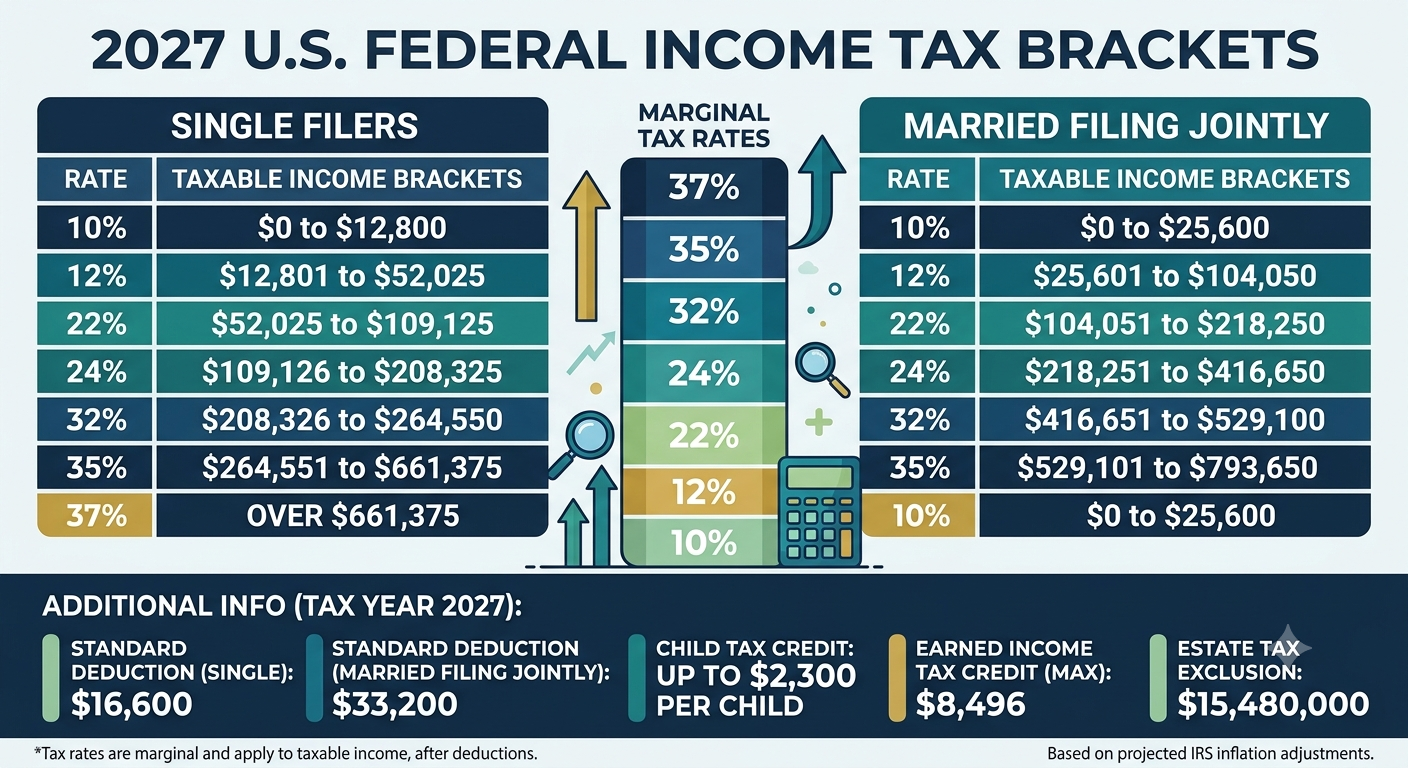
For the 2027 tax year, the federal income tax rates remain 10%, 12%, 22%, 24%, 32%, 35%, and 37%.
Here are the published thresholds for the two most common filing statuses:
| Tax rate | Single filers | Married filing jointly |
|---|---|---|
| 10% | $0–$12,800 | $0–$25,600 |
| 12% | $12,801–$52,025 | $25,601–$104,050 |
| 22% | $52,026–$109,125 | $104,051–$218,250 |
| 24% | $109,126–$208,325 | $218,251–$416,650 |
| 32% | $208,326–$264,550 | $416,651–$529,100 |
| 35% | $264,551–$661,375 | $529,101–$793,650 |
| 37% | Over $661,375 | Over $793,650 |
These are marginal tax brackets, not flat tax rates applied to your entire salary. Your actual tax calculation depends on taxable income, filing status, and other applicable rules.
Important: These figures are for tax year 2027, not the 2027 filing season. Most people will file their 2027 income tax returns in 2028.
2. The first thing to check: Are you confusing your tax bracket with your actual tax rate?
This is one of the most common misunderstandings about the US federal tax system.
Let’s take an example.
Suppose you are single and earn $85,000 in 2027. You might assume that because your income falls into the 22% tax bracket, the IRS will tax all $85,000 at 22%.
That is not how the system works.
Only the portion of your taxable income within the 22% bracket is taxed at 22%. The earlier portions are taxed at their respective lower rates.
For a simplified illustration, assume your $85,000 salary is your only income and you claim the $16,600 standard deduction.
Your taxable income would be:
$85,000 − $16,600 = $68,400.
The federal income tax calculation would be:
- First $12,800 at 10% = $1,280
- Next $39,225 at 12% = $4,707
- Remaining $16,375 at 22% = $3,602.50
Estimated federal income tax: $9,589.50.
That is approximately 11.28% of your original $85,000 salary, not 22%.
This is a simplified illustration. It excludes tax credits, additional income, special deductions, and other adjustments.
The lesson is simple: Do not multiply your entire salary by your highest marginal tax bracket. Doing so can substantially overstate your estimated tax liability.
3. Check the 2027 standard deduction before calculating your taxes
This is another important place to start.
The standard deduction reduces the amount of income subject to federal income tax. Many taxpayers can claim it without having to list individual deductible expenses.
For tax year 2027, the IRS announced these standard deduction amounts:
| Filing status | 2027 standard deduction |
|---|---|
| Single | $16,600 |
| Married filing jointly | $33,200 |
| Married filing separately | $16,600 |
| Head of household | $24,925 |
For example, if you are single and have $70,000 in qualifying income, claiming the $16,600 standard deduction would generally leave $53,400 before any other applicable adjustments or deductions.
You should compare the standard deduction with the itemized deductions available to you. If your eligible itemized deductions are greater, itemizing may produce a lower taxable income.
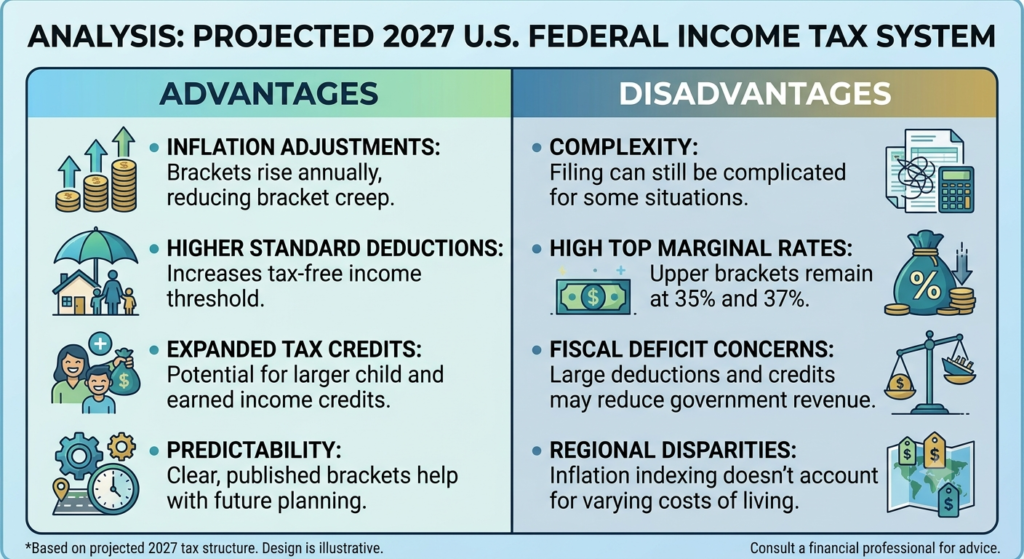
Do not assume that itemizing is automatically better. Compare the two approaches using your actual records.
4. Check whether you qualify for tax credits
Deductions and credits are not the same thing.
A deduction generally reduces taxable income. A tax credit reduces your tax liability directly, subject to the credit’s rules and limitations.
For example, the 2027 maximum Child Tax Credit is $2,300 per qualifying child, with up to $1,800 potentially refundable.
If you have qualifying children, check whether you meet the applicable eligibility requirements.
Other credits may also be relevant, depending on your circumstances:
- Earned Income Tax Credit (EITC)
- Adoption Credit
- Education-related tax credits
- Credits for qualifying energy improvements, where available under applicable law
Eligibility, income limits, qualifying expenses, and other restrictions vary. Do not claim a credit simply because you have an expense that sounds similar to its description.
Check the IRS guidance for the specific credit before including it on your return.
5. Consider whether retirement contributions can reduce your taxable income
Retirement planning is another area worth reviewing.
Eligible contributions to certain traditional retirement accounts may provide a tax deduction or reduce current taxable income, depending on the account, your income, workplace retirement coverage, and applicable rules.
For example, qualifying contributions to a traditional IRA may be deductible. However, the deduction can be limited or phased out depending on your circumstances.
Employer-sponsored plans, such as a traditional 401(k), may also allow eligible pre-tax salary contributions.
Here is why this matters:
Suppose you are earning $90,000 and contribute to an eligible traditional retirement plan through payroll. Your taxable wages for federal income tax purposes may be lower than they would have been without those contributions.
This does not mean every retirement contribution automatically reduces your taxes. Roth contributions, for example, generally do not provide the same current-year deduction.
Check the rules for your specific plan before making a decision.
6. Review your W-4 to avoid unnecessary over-withholding
There is another type of overpayment that many employees overlook.
Your employer generally withholds federal income tax from your paycheck based on the information you provide on Form W-4.
If too much is withheld throughout the year, you may receive a larger refund when you file your return.
That refund is not necessarily extra money from the government. It can simply be your own money that was withheld in excess of your final tax liability.
Use the IRS Tax Withholding Estimator to review your withholding.
If the estimator indicates that your withholding is too high or too low, you can consider submitting an updated Form W-4 to your employer.
The objective is not to eliminate withholding. It is to get it closer to the amount you actually expect to owe.
Remember that insufficient withholding can result in a tax bill or an underpayment penalty.
7. Do not forget the difference between a deduction and a tax credit
This distinction can help you evaluate tax-saving opportunities more accurately.
Consider a simplified example:
You qualify for a $1,000 deduction and your marginal tax rate is 22%. That deduction could reduce your federal income tax by approximately $220, assuming the full deduction is usable at that marginal rate.
Now consider a $1,000 nonrefundable tax credit. It could reduce your tax bill by up to $1,000, subject to your available tax liability and the credit’s specific rules.
This is why it is worth checking both deductions and credits rather than focusing only on your tax bracket.
8. A quick 2027 tax overpayment checklist
Before filing your 2027 federal income tax return in 2028, go through this checklist:
- Confirm your correct filing status.
- Check the official 2027 tax brackets.
- Calculate your taxable income rather than using gross salary alone.
- Compare the standard deduction with eligible itemized deductions.
- Check whether you qualify for tax credits.
- Review eligible traditional retirement contributions.
- Check whether your W-4 withholding is appropriate.
- Include all required income and supporting documentation.
- Check the latest IRS instructions before submitting your return.
A few minutes spent reviewing these details can help you identify mistakes before they become expensive.
9. Where to check your actual 2027 federal income tax liability
Rather than relying on random tax calculators or social media posts, use official IRS resources.
Start with the IRS’s 2027 inflation adjustment announcement and Revenue Procedure 2026-35.
Then use the IRS Tax Withholding Estimator if you are an employee who wants to review paycheck withholding.
For your final tax calculation, use the appropriate 2027 tax forms and instructions when the IRS releases them.
Final thoughts: You do not need to pay more tax than the law requires
Remember that a calculator is only as accurate as the information entered. Filing status, other income, deductions, credits, and special tax situations can all affect the result.
The best way to avoid overpaying federal income taxes in 2027 is not to look for a secret loophole. It is to understand how the tax system works and make sure you are using the deductions, credits, and withholding arrangements that legitimately apply to you.
Start by checking your marginal tax bracket. Then calculate your taxable income after the appropriate deduction. Review eligible credits and retirement contributions, and make sure your paycheck withholding is reasonable.
Most importantly, do not confuse a tax refund with tax savings. A large refund may simply mean you paid too much throughout the year.
The goal is to pay the correct amount—not more, and not less.
Disclaimer: This article provides general educational information about US federal income taxes for tax year 2027. It is not individualized tax, legal, or financial advice. Tax rules and eligibility requirements can change. Consult a qualified tax professional for advice about your circumstances.
References
These are primary government sources, rather than third-party tax blogs.
- IRS – 2027 Tax Inflation Adjustments: Official IRS announcement
- IRS Revenue Procedure 2026-35: 2027 tax brackets and inflation-adjusted provisions (PDF)
- IRS – Tax Withholding Estimator: Calculate and review paycheck withholding
- IRS – Retirement Plan and IRA Information: IRA contribution rules
- IRS – Saver’s Match: Retirement savings matching rules for 2027
A youtube video:
A pinterest pin:
Other reads:

Linkedin -- www.linkedin.com/in/shishir-bhargava-68a8b4257
- I Found a Way to Avoid Overpaying Federal Income Taxes in 2027. Check This Before Filing! - November 6, 2026
- Can the Apple iMac M6 Open 5,000 Windows at Once? Here’s the Truth - November 3, 2026
- Final Fantasy Resonance Problems and Solutions: Complete Walkthrough - October 26, 2026
⚠️ Most People Discover Trends When It's Too Late
Join the Trends Goldmine Insider List and get emerging AI tools, future products, viral keywords, and hidden opportunities before they hit the mainstream.
While everyone else is chasing yesterday's trends, you'll be spotting tomorrow's opportunities first.
🚀 Free Weekly Trend Alerts • No Spam • Unsubscribe Anytime
SIGN UP NOW & RECEIVE A SHORT REPORT ON HOW TO MAKE FORTUNE WITH TRENDS.Trusted by readers who want to discover opportunities before the crowd.