The Silent Chaos Happening Beneath Your Feet
Imagine waking up tomorrow and discovering that your smartphone costs twice as much.
Electric cars disappear from dealerships. Fighter jet production slows. Wind farms stop expanding. Artificial intelligence servers become more expensive. Medical scanners face shortages. Governments declare strategic emergencies—not because of oil, but because of a group of minerals most people have never even heard of.
This isn’t the plot of a Hollywood thriller.
It is already happening.
And emerging on the surface..
A silent geopolitical battle is unfolding across continents. Unlike the Cold War, this conflict isn’t centered around nuclear weapons or ideological differences. Unlike the 20th century, oil is no longer the only strategic resource.
Today, nations are racing to secure something far less visible—but arguably even more important.
They are fighting for rare earth minerals.
Critcal earth elements.
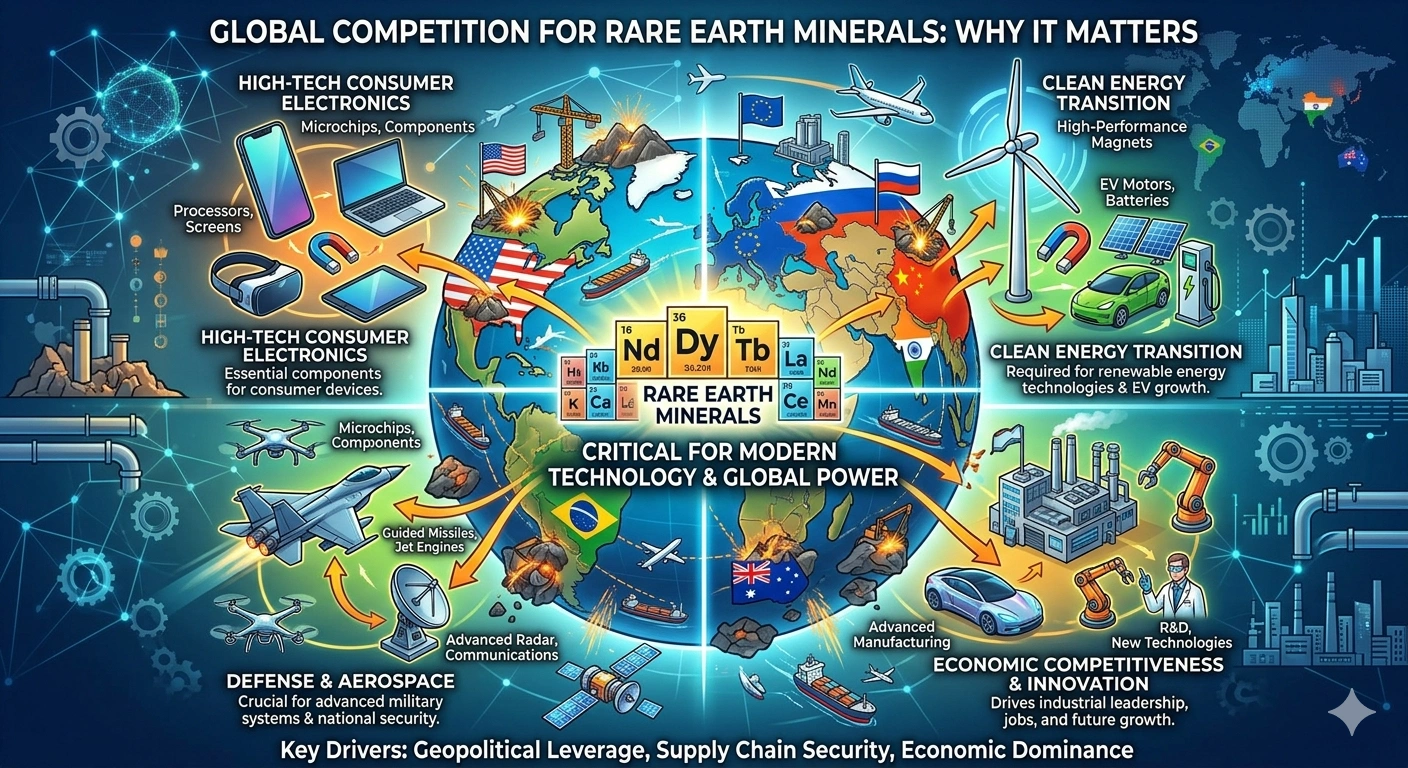
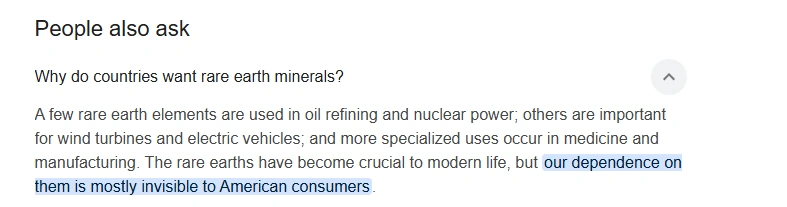
Most people don’t realize that nearly every modern technology depends on these elements. The phone in your pocket. The electric vehicle on the road. The missile systems protecting national borders. Satellites orbiting Earth. Wind turbines generating renewable electricity. AI data centers training large language models.
All rely on rare earth elements.
Without them, modern civilization doesn’t simply slow down.
It begins to fracture.
The Biggest Misconception
Despite their name, rare earth minerals are not actually rare.
This surprises almost everyone.
Many rare earth elements are more abundant in Earth’s crust than gold or silver.
So why are countries competing so aggressively?
Because finding them is only the beginning.
Mining them economically…
Separating them…
Refining them…
Processing them into usable materials…
Manufacturing powerful magnets…
All require decades of technological expertise, massive investment, specialized infrastructure, and strict environmental management.
That is where the real bottleneck exists.
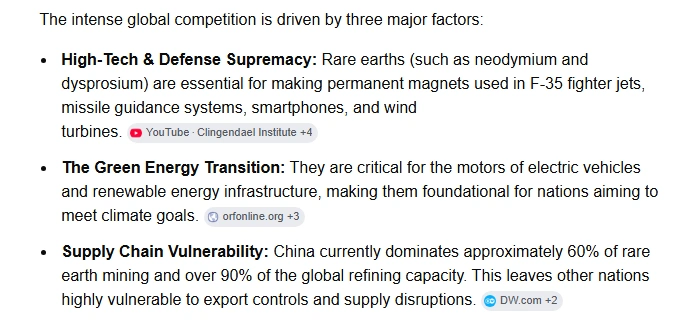
This concentration has transformed rare earths from an industrial commodity into a geopolitical asset.
The Hidden World Most People Never See
Every major technological revolution has depended on one strategic resource.
The Industrial Revolution needed coal.
The Automobile Age needed oil.
The Digital Age needed silicon.
The AI and Clean Energy Age?
It needs rare earth minerals.
Hidden inside your everyday devices are tiny amounts of elements with unfamiliar names:
- Neodymium
- Dysprosium
- Terbium
- Praseodymium
- Samarium
- Europium
Although the quantities are small, their performance is extraordinary.
A single high-performance electric motor depends on magnets made with rare earths.
A wind turbine generating electricity for thousands of homes relies on them.
Modern fighter aircraft use them throughout radar, avionics, and precision guidance systems.
Medical MRI scanners require them.
Lasers depend on them.
Military communications depend on them.
Space exploration depends on them.
Artificial intelligence infrastructure increasingly depends on technologies that require stable critical-mineral supply chains.
Rare earths are no longer just mining products.
They have become the foundation of technological civilization.
Why This Competition Became So Intense
Several global megatrends collided at exactly the same time.
1. Electric Vehicles
Every major automaker is investing billions into EV production.
Many high-performance EV motors use powerful permanent magnets made with rare earth elements.
As EV demand rises…
Demand for rare earths rises too.
2. Renewable Energy
One offshore wind turbine can contain hundreds of kilograms of rare-earth permanent magnets.
Countries promising net-zero carbon emissions suddenly realized they cannot build enough renewable infrastructure without securing these minerals.
3. Artificial Intelligence
AI isn’t only software.
Every AI model runs inside enormous data centers.
Those facilities require advanced electronics, cooling systems, robotics, industrial motors and sophisticated manufacturing—all of which depend on critical minerals in various ways.
4. National Defense
Modern warfare has changed dramatically.
Precision-guided missiles…
Radar…
Submarines…
Stealth aircraft…
Night vision…
Electronic warfare…
Almost every advanced military platform relies on rare earth components.
Military planners increasingly view supply-chain resilience as a issue rather than merely an economic concern.
5. Space Technology
Satellites use lightweight yet powerful components.
Launch systems require advanced materials.
Communication arrays depend upon rare earth applications.
As the global space economy grows, competition for critical minerals intensifies.
The Countries That Saw the Future First
Several decades ago, most countries viewed rare earths as a niche mining business.
Few country saw something much bigger.
Many of them invested heavily not just in mining, but also in chemical processing, refining, magnet production, manufacturing expertise, and industrial ecosystems.
Building this capability took years of sustained investment, policy support, and technical know-how.
This long-term approach helped create today’s concentration in the global supply chain.
The lesson for other nations was stark: controlling raw ore is not enough—you also need the capability to process it into products industries can actually use.
Suddenly, Governments Started Worrying
Imagine building millions of electric vehicles…
Only to discover another country controls much of the supply chain for a crucial component.
Imagine trying to manufacture advanced defense systems…
But waiting months for specialized materials.
Imagine investing billions in renewable energy…
Yet facing shortages of key inputs.
That is why governments now describe rare earths as critical minerals rather than ordinary commodities.
The concern is not only about access to deposits.
It is about strategic dependence.
A New Identity Is Emerging
For decades, countries competed on:
- Cheap labor
- Manufacturing
- Oil
- Natural gas
Now another question is becoming just as important:
Can you secure the materials that power tomorrow’s economy?
Nations that answer “yes” may enjoy greater resilience in clean energy, defense, and advanced manufacturing.
Those that answer “no” risk becoming dependent on external suppliers for technologies central to their economies.
What Exactly Are Rare Earth Minerals?
If someone handed you a piece of neodymium or dysprosium, you probably wouldn’t recognize it.
Unlike gold, diamonds, or platinum, rare earth elements don’t sparkle. They aren’t traded in jewelry stores, and most people will never see them in their raw form.
Yet these obscure materials quietly power the technologies that define the 21st century.
Rare earth elements (REEs) are a group of 17 chemically similar elements on the periodic table. They include the 15 lanthanides, plus scandium and yttrium because they commonly occur in the same mineral deposits.
Scientists divide them into two broad categories:
Light Rare Earth Elements (LREEs)
These are generally more abundant and include:
- Lanthanum
- Cerium
- Praseodymium
- Neodymium
- Samarium
These elements are widely used in:
- Electric vehicles
- Consumer electronics
- Catalytic converters
- Batteries
- Wind turbines
- Industrial machinery
Among them, neodymium has become especially valuable because it is used to manufacture some of the world’s strongest permanent magnets.
Heavy Rare Earth Elements (HREEs)
These are scarcer and often more strategically significant.
They include:
- Dysprosium
- Terbium
- Ytterbium
- Lutetium
- Erbium
- Thulium
Heavy rare earths improve magnets so they can operate reliably at very high temperatures, making them especially important for electric vehicles, military equipment, and aerospace applications.
Because economically viable deposits of heavy rare earths are much less common, governments often consider them among the most strategically important critical minerals.
Tiny Minerals, Massive Importance
One of the biggest misconceptions is that modern devices contain large amounts of rare earths.
They don’t.
In many products, only grams—or even milligrams—are used.
But those tiny quantities enable capabilities that are difficult or impossible to achieve with alternative materials.
For example:
Smartphones
Rare earths help power:
- Speakers
- Vibration motors
- Cameras
- Screens
- Wireless charging components
Without these materials, smartphones would be larger, heavier, less efficient, and potentially more expensive.
Electric Vehicles
High-performance electric motors often rely on neodymium-iron-boron (NdFeB) permanent magnets, which offer an exceptional combination of strength and efficiency.
These magnets help vehicles:
- Accelerate more efficiently
- Reduce energy consumption
- Extend driving range
- Deliver compact motor designs
Some manufacturers are developing motors that reduce or eliminate rare earth usage, but permanent-magnet designs remain widely used in the industry.
Wind Turbines
Offshore wind farms are engineering marvels.
Each turbine may stand over 200 meters tall and operate continuously under harsh conditions.
Permanent-magnet generators containing rare earths can reduce maintenance needs and improve efficiency, particularly for offshore installations where repairs are costly.
As countries expand renewable energy capacity, demand for these materials is expected to remain significant.
Fighter Jets
Modern fighter aircraft contain rare earth elements in:
- Radar systems
- Flight-control electronics
- Laser targeting systems
- Communication equipment
- Precision-guided weapons
These applications have made secure access to rare earth supply chains a growing national security concern.
Artificial Intelligence
AI may seem purely digital, but behind every chatbot, recommendation engine, and image generator lies vast physical infrastructure.
Data centers require:
- Industrial motors
- Cooling systems
- Power electronics
- Robotics
- Advanced manufacturing equipment
Many of these technologies rely on critical mineral supply chains, including rare earth elements.
The Countries Sitting on Hidden Fortunes
Not every nation possesses commercially significant rare earth deposits.
Those that do are increasingly viewed through a strategic lens.
China
China remains the dominant player in rare earth processing and magnet manufacturing. It also has substantial mining capacity and decades of industrial expertise.
Its advantage comes not only from geology but from building an integrated supply chain—from mining to finished products.
Australia
Australia has emerged as one of the largest producers outside China.
The country is investing heavily in expanding mining and processing capabilities, supported by partnerships with allies seeking to diversify supply.
United States
The United States has significant rare earth resources and has been working to rebuild domestic mining, processing, and manufacturing after years of relying heavily on overseas supply chains.
Federal investments and public-private partnerships have accelerated in recent years.
Canada
Canada possesses promising deposits and is investing in exploration, processing, and partnerships aimed at supporting North American supply chains.
India
India holds notable rare earth resources, particularly in coastal mineral sands.
The government has identified critical minerals as an important area for future industrial development, although expanding mining and processing capacity presents technical and regulatory challenges.
Brazil
Brazil has extensive mineral wealth, including deposits containing rare earth elements.
As global demand grows, international interest in developing these resources has increased.
Vietnam
Vietnam has attracted attention because of its geological potential.
While commercial development has progressed more slowly than anticipated, the country remains an important part of discussions about diversified supply chains.
Greenland
Greenland has become a geopolitical focal point due to its significant mineral potential, including rare earth deposits.
Its location, natural resources, and strategic importance have increased international interest in investment and partnerships.
Why Africa Has Suddenly Become So Important
Across several African nations, exploration for critical minerals has accelerated.
Countries including Tanzania, Malawi, South Africa, Madagascar, and Namibia have attracted increasing attention from mining companies and governments.
For many African nations, rare earth development offers opportunities for:
- Employment
- Infrastructure investment
- Export revenues
- Industrial development
However, it also raises important questions about environmental protection, local community benefits, and ensuring that mineral wealth contributes to long-term economic growth.
The New Global Race Isn’t Just About Mining
Here’s what many people miss.
Finding rare earth ore is only the first step.
After mining, the material must go through multiple complex stages before it becomes useful in a product.
These stages include:
- Crushing
- Chemical separation
- Purification
- Refining
- Metal production
- Alloy manufacturing
- Magnet production
- Integration into industrial components
Each stage requires specialized expertise, equipment, and environmental controls.
This is why countries are investing not only in new mines but also in processing plants, research facilities, and advanced manufacturing.
A nation that exports raw ore but imports finished magnets remains dependent on others for key technologies.
The Environmental Challenge Few People Talk About
Rare earth mining presents significant environmental challenges if not managed responsibly.
Depending on the geology and mining methods used, operations may involve:
- Large volumes of waste rock
- Chemical processing
- Water management
- Tailings storage
- Land disturbance
Some deposits are also associated with naturally occurring radioactive elements such as thorium, requiring careful handling and regulation.
Modern mining companies are increasingly adopting cleaner technologies and stricter environmental standards, but the balance between expanding supply and protecting ecosystems remains a major policy challenge.
Why Governments Are Spending Billions
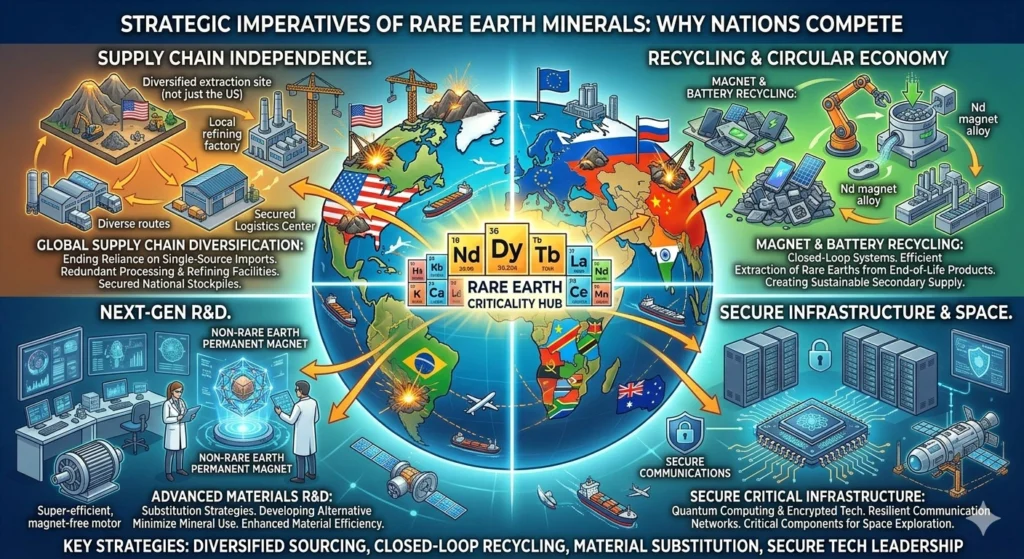
Governments around the world are investing heavily in:
- New exploration projects
- Domestic processing facilities
- Recycling technologies
- Research into substitute materials
- International supply-chain partnerships
The goal is not necessarily to become self-sufficient, but to reduce the risks associated with relying on a small number of suppliers for strategically important materials.
The Question That Changed Global Discussion
Imagine discovering that the future of your country’s economy depends on a resource that another nation largely controls.
Now imagine that this resource is needed for:
- Electric vehicles
- Artificial intelligence
- Military aircraft
- Missiles
- Satellites
- Renewable energy
- Consumer electronics
- Medical equipment
Would you continue relying on another country for it?
This is the uncomfortable question policymakers across the United States, Europe, Japan, India, Australia, and many other nations are trying to answer.
For years, many countries assumed global supply chains would always function smoothly. Rare earths were treated as just another industrial input.
Then reality intervened.
Governments began to recognize that supply chains could become strategic vulnerabilities.
Mining Is Only the Beginning
A common misconception is that the country with the most mines automatically controls the industry.
In reality, mining is only one step.
The journey from rock to finished product includes:
- Exploration
- Mine development
- Ore extraction
- Crushing and concentration
- Chemical separation
- Refining into high-purity oxides
- Metal production
- Alloy manufacturing
- Magnet production
- Integration into motors, electronics, and other products
Each step adds value.
Each step requires expertise.
And each step can become a strategic bottleneck.
This is why governments are increasingly investing not just in new mines, but also in processing plants, research, and advanced manufacturing.
The Export Restriction Wake-Up Call
One of the defining moments in the rare earth story came when export restrictions highlighted how concentrated the global supply chain had become.
The episode prompted governments and industries to reconsider the risks of relying heavily on a limited number of suppliers.
It accelerated efforts to:
- Diversify sourcing
- Build domestic processing
- Develop recycling technologies
- Strengthen partnerships with allied countries
For many policymakers, the lesson was clear: critical supply chains require resilience, not just efficiency.
The Rise of “Friendshoring”
A new concept has entered global economic policy: friendshoring.
Instead of depending on a single dominant supplier, countries are seeking to source critical materials from trusted partners.
Examples include:
- Australia supplying mined materials
- Canada expanding critical mineral projects
- The United States investing in processing capacity
- Japan supporting overseas rare earth partnerships
- The European Union pursuing strategic raw material initiatives
- India increasing exploration and domestic capability
The objective is not complete independence, but a more diversified and resilient network.
Can Recycling Solve the Problem?
Many people assume recycling will eliminate the need for new mining.
The reality is more complex.
Recycling rare earths from:
- Old electronics
- Electric vehicle motors
- Wind turbines
- Industrial equipment
offers significant long-term potential.
However, today’s recycling rates remain relatively low because:
- Products contain very small quantities of rare earths.
- Components are difficult to separate.
- Recovery processes can be technically challenging and expensive.
- Many products remain in use for years before reaching end-of-life.
As technology improves, recycling is expected to play a larger role—but it is unlikely to replace mining in the near future.
The Search for Alternatives
Scientists around the world are also working on:
- Motors that use fewer or no rare earth magnets
- Alternative magnetic materials
- More efficient manufacturing techniques
- Designs that reduce dependence on critical minerals
Some promising advances have emerged, but for many high-performance applications, rare earth magnets continue to offer unmatched performance.
This means demand is likely to remain strong even as innovation progresses.
The Stakes Are Bigger Than Economics
At first glance, rare earths might seem like an issue for mining companies.
In reality, they influence far more.
Reliable access to critical minerals affects:
- Industrial competitiveness
- Energy transitions
- Defense readiness
- Technological innovation
- Economic resilience
Countries are therefore treating rare earth strategies as part of broader national planning rather than simply resource policy.
What This Means for Ordinary People
You may never visit a rare earth mine.
You may never see a processing plant.
But the outcomes of this global competition can affect everyday life through:
- The availability and cost of electronics
- Electric vehicle production
- Renewable energy deployment
- Advanced medical technologies
- Manufacturing jobs
- Investment in new industries
The race for rare earths is, ultimately, a race to shape the technologies that power modern society.
The Next Decade Will Decide the Winners
History often looks obvious in hindsight.
When oil became the lifeblood of the industrial economy, countries that secured reliable supplies gained strategic advantages in transportation, manufacturing, and energy.
Today, a similar shift is taking place with critical minerals—including rare earth elements.
Governments are investing billions of dollars in exploration, processing, recycling, and advanced manufacturing because they see these materials as essential to future economic competitiveness and national security.
Unlike previous commodity booms, however, this competition is not only about owning resources. It is about building complete industrial ecosystems that can transform raw minerals into high-value products.
The New Global Supply Chain
The emerging model is based on cooperation among multiple countries.
For example:
- One country may mine rare earth ore.
- Another may separate and refine it.
- A third may manufacture permanent magnets.
- A fourth may integrate those magnets into electric motors or defense systems.
This distributed approach can improve resilience by reducing dependence on any single source.
However, it also requires close coordination, investment, and long-term partnerships.
Technology Could Change the Equation
Innovation may reshape the rare earth landscape in several ways.
Better Recycling
Recovering rare earths from end-of-life products could reduce pressure on new mining over time.
Advances in recycling technology may make it easier to extract valuable materials from:
- Electric vehicle motors
- Wind turbine components
- Consumer electronics
- Industrial machinery
While recycling alone is unlikely to meet all future demand, it is expected to become an increasingly important source of supply.
New Materials
Researchers are exploring:
- Alternative magnet materials
- Motor designs that reduce rare earth usage
- Improved battery technologies
- More efficient manufacturing methods
Some breakthroughs may lessen dependence on specific rare earth elements, although many high-performance applications still rely on them today.
Smarter Mining
Modern mining techniques increasingly emphasize:
- Improved resource efficiency
- Reduced waste
- Better water management
- Lower environmental impact
- Enhanced worker safety
Technological improvements can help make extraction more sustainable while meeting growing demand.
The Environmental Balancing Act
One of the greatest challenges facing the rare earth industry is balancing two important goals.
On one hand, countries want to accelerate the transition to cleaner energy, electric transportation, and advanced technologies.
On the other hand, mining and processing must be carried out responsibly to protect ecosystems, water resources, and local communities.
This has prompted greater attention to:
- Strong environmental standards
- Responsible sourcing
- Transparent supply chains
- Community engagement
- Circular economy approaches such as recycling and reuse
The future of the industry will depend not only on producing more minerals but on producing them more sustainably.
Why Businesses Are Paying Attention
Rare earths are no longer a niche topic discussed only by geologists.
Manufacturers, automakers, technology companies, and energy firms are all closely monitoring developments because supply disruptions can affect production, costs, and long-term planning.
Many companies are responding by:
- Diversifying suppliers
- Investing in long-term contracts
- Supporting recycling initiatives
- Funding research into alternative technologies
These strategies aim to improve resilience in an increasingly complex global market.
What Does This Mean for Consumers?
Although most people will never buy a bag of rare earth minerals, they may notice the effects of supply chain changes through:
- The price and availability of consumer electronics
- Electric vehicle production and costs
- Renewable energy expansion
- Medical technology innovation
- Industrial investment and job creation
The decisions being made today by governments and industries could influence the technologies available to consumers for years to come.
The Bigger Picture
The competition for rare earth minerals is often described as a “race,” but it is also a story about transformation.
It reflects a world that is:
- Transitioning toward cleaner energy
- Expanding digital infrastructure
- Investing in advanced manufacturing
- Strengthening supply chain resilience
- Reassessing strategic dependencies
Rare earths sit at the intersection of all these trends.
Understanding their role helps explain why governments, businesses, and researchers are dedicating so much attention to these relatively obscure elements.
Looking Ahead
The coming decade is likely to bring:
- New mining projects
- Expanded processing facilities
- Greater international cooperation
- Continued research into recycling and substitutes
- Evolving policies on critical mineral security
Success will depend not only on discovering new deposits but also on developing the technology, workforce, and infrastructure needed to transform those resources into products that power modern life.
Final Thoughts
Rare earth minerals may not receive the same public attention as oil or natural gas, but they have become a cornerstone of the technologies shaping the 21st century.
The competition surrounding them is driven by a combination of economic opportunity, technological innovation, environmental goals, and national security considerations.
As countries seek to build more resilient supply chains and support emerging industries, rare earths will remain an important part of global discussions.
For readers, understanding this topic provides valuable context for many of today’s headlines—from electric vehicles and renewable energy to artificial intelligence and international trade.
The silent race beneath our feet is no longer just about minerals.
It is about the future of technology, industry, and global cooperation.
Frequently Asked Questions
1. What are rare earth minerals?
Rare earth minerals are a group of 17 chemical elements used in many modern technologies, including electric vehicles, wind turbines, smartphones, medical equipment, and defense systems.
2. Why are rare earth minerals important?
They enable high-performance magnets, electronics, lasers, and other advanced components that are difficult to replace with alternative materials.
4. Are rare earth minerals actually rare?
Not necessarily. Many are relatively abundant in the Earth’s crust, but economically extracting and processing them is technically complex.
5. Can rare earth minerals be recycled?
Yes. Recycling is possible and is expected to become increasingly important, although technical and economic challenges currently limit large-scale recovery.
6. Which industries rely on rare earth elements?
Major users include:
- Electric vehicles
- Renewable energy
- Consumer electronics
- Aerospace
- Defense
- Medical technology
- Robotics
- Industrial manufacturing
Other reads:
:A youtube video:
A Pinterest pin:
A research and my original opinion:
Rare earth minerals are becoming one of the world’s most strategic resources because they power electric vehicles, AI, renewable energy, electronics, and advanced defense systems. The real competition is no longer about who has the largest mineral deposits, but who controls the refining, processing, and manufacturing needed to turn these minerals into high-value technologies. In the coming years, countries that build resilient and diversified rare earth supply chains will gain a significant economic and geopolitical advantage.

Linkedin -- www.linkedin.com/in/shishir-bhargava-68a8b4257
- What Would The Batman 2 Story Look Like If Steven Soderbergh Directed It? - October 16, 2026
- How to Organize Digital Receipts and Warranties | A Practical System That Works - October 11, 2026
- How to Live Without AI | 30-Day Experiment Taught Me to Think Again - October 8, 2026
⚠️ Most People Discover Trends When It's Too Late
Join the Trends Goldmine Insider List and get emerging AI tools, future products, viral keywords, and hidden opportunities before they hit the mainstream.
While everyone else is chasing yesterday's trends, you'll be spotting tomorrow's opportunities first.
🚀 Free Weekly Trend Alerts • No Spam • Unsubscribe Anytime
SIGN UP NOW & RECEIVE A SHORT REPORT ON HOW TO MAKE FORTUNE WITH TRENDS.Trusted by readers who want to discover opportunities before the crowd.