Image credit — Gemini
The Interview Question That Quietly Decides Your Future
You spent hours polishing your skills.
You searched for interview questions.
You prepared insights about your strengths.
You researched the company.
You even practiced answers in front of a mirror.
Now, finally the interview day comes.
The interview begins.
The hiring manager smiles.
The atmosphere seems relaxed.
And then comes a question so simple that most candidates underestimate it:
“Tell me about yourself.”
You think how to answer tell me about yourself.
You image the sample answers. In interview,
No technical questions.
No difficult scenarios.
No trick questions.
Just five ordinary words.
Yet this single question has quietly destroyed countless opportunities.
Some candidates talk too much.
Some ramble without direction.
Some repeat their skills word-for-word.
Others become nervous and forget what they wanted to say.
Within the first two minutes, many interviewers have already started forming an impression that becomes difficult to change.
The painful truth?
Most people lose the interview before the interview truly begins.
The Hidden Cost of Getting This Question Wrong
Many job seekers believe hiring decisions are made after technical assessments, skill tests, or detailed discussions.
Those things matter.
But human psychology matters more than most candidates realize.
When an interviewer asks:
“Tell me about yourself.”
They are not simply asking for information.
They are evaluating:
- Confidence
- Communication ability
- Professionalism
- Self-awareness
- Relevance
- Personality
- Career direction
- Cultural fit
In less than two minutes.
Think about that.
A response lasting 60–90 seconds can influence how every future answer is interpreted.
A strong opening creates momentum.
A weak opening creates resistance.
It’s similar to watching the first few minutes of a movie.
The audience quickly decides whether they want to keep paying attention.
Interviewers do exactly the same thing.
Why This Question Is Exploding in Popularity
Searches for interview preparation continue growing year after year.
Several workplace shifts have accelerated interest in this question:
Remote Hiring
Companies now interview candidates from different cities, states, and countries.
The first impression matters even more because interviewers often meet candidates through a screen.
Increased Competition
One role can attract hundreds or even thousands of applicants.
Recruiters need quick ways to identify promising candidates.
And you need to become unique here.
AI-Assisted Applications
More people use AI tools to improve skills.
As a result, interviewers rely more heavily on conversations to evaluate authenticity.
Career Switching
Millions of professionals are changing industries.
Career changers often struggle with introducing themselves effectively.
Economic Uncertainty
When jobs become harder to secure, interview performance becomes increasingly important.
The result?
More people than ever are searching for:
- Tell me about yourself sample answer
- Best interview introduction
- Self introduction for interview
- How to introduce yourself professionally
- Interview opening answer examples
And for good reason so that they secure a good job.
The Secret Most Candidates Never Discover
Most people answer the question incorrectly because they misunderstand what is being asked.
And I do not ever want this to happen for you.
You need to understand this stuff.
They assume:
“Tell me everything about yourself.”
That is not the question.
The interviewer is actually asking:
“Tell me why you are a strong candidate for this position.”
That subtle difference changes everything.
Imagine two candidates.
Candidate A says:
“My name is John. I was born in Texas. I enjoy sports. I graduated in 2021. I worked at two companies…”
Nothing technically wrong.
But there is no story.
No direction.
No relevance.
No connection.
Now listen to Candidate B:
“I’m currently a technical support specialist with three years of experience helping SaaS companies improve customer satisfaction and retention. During that time, I’ve developed strong communication and problem-solving skills, which recently helped my team reduce response times by 25%. I’m now looking to apply those skills in a larger organization where I can continue growing while delivering exceptional customer experiences.”
Notice the difference?
Candidate B immediately creates a professional identity.
The interviewer understands:
- Current role
- Experience
- Achievements
- Direction
- Value
Within minutes.
Within seconds.
A Hidden World Exists Behind Every Great Answer
Most candidates think successful interviews are about saying the right words.
Top performers understand something deeper.
Every strong answer follows a psychological framework.
Whether you realize it or not, exceptional candidates communicate four things:
1. Who They Are
Identity.
Not their life story.
Their professional identity.
2. What They Have Done
Experience.
Achievements.
Relevant accomplishments.
3. What They Can Offer
Value.
Skills.
Results.
4. Where They Are Going
Future direction.
Career goals.
Motivation.
This framework appears repeatedly among successful candidates.
Executives use it.
Managers use it.
Engineers use it.
Sales professionals use it.
Recent graduates use it.
The wording changes.
The structure remains surprisingly similar.
The Career Identity Crisis Nobody Talks About
Many people struggle with this question because they do not know how to define themselves professionally.
Consider these thoughts:
- “I have experience but nothing impressive.”
- “I changed careers.”
- “I don’t have enough accomplishments.”
- “My resume has gaps.”
- “I’m just a fresher.”
- “I worked in several unrelated jobs.”
These concerns are incredibly common.
Yet they often miss the bigger picture.
Interviewers are not searching for perfection.
They are searching for clarity.
Understand this well and you have more likely chances to be selected.
A candidate who communicates clearly often outperforms a more experienced candidate who communicates poorly.
This realization changes everything.
Creating a Professional Identity
Let’s imagine two introductions.
Weak Identity
“I’m looking for a job where I can grow.”
Thousands of candidates say this.
It sounds generic.
Forgettable.
Strong Identity
“I’m a data analyst who enjoys turning complex information into practical business insights.”
Now we understand something.
The candidate has a professional identity.
The statement creates a mental picture.
Strong candidates create these pictures immediately.
Examples:
- “I’m a customer-focused sales professional.”
- “I’m a software developer specializing in mobile applications.”
- “I’m a project coordinator with experience managing cross-functional teams.”
- “I’m a recent graduate passionate about digital marketing.”
Notice how each statement instantly positions the candidate.
That positioning matters.
A lot.
The Aspiration Gap
Most job seekers focus entirely on where they are.
Successful candidates also communicate where they are going.
Humans are naturally attracted to progress.
Interviewers want people who are moving toward something.
Not simply escaping unemployment.
Compare these statements:
Weak
“I need a new job.”
Strong
“I’m looking for an opportunity where I can continue developing my technical skills while contributing to larger strategic initiatives.”
The second answer creates aspiration.
Growth.
Momentum.
Purpose.
Interviewers notice this difference immediately.
The Vehicle That Bridges Opportunity and Success
Now we arrive at something important.
Imagine your career as a destination.
You want:
- Better income
- More opportunities
- Professional growth
- Meaningful work
- Stability
- Recognition
The challenge is getting there.
Many candidates assume skills alone are enough.
But skills hidden behind poor communication remain invisible.
This is where interview communication becomes the vehicle.
The bridge.
The mechanism that allows employers to recognize your value.
Without effective communication:
- Great skills get overlooked.
- Strong achievements remain hidden.
- Potential stays undiscovered.
Learning to answer “Tell me about yourself” effectively isn’t about memorizing a script.
It’s about learning how to present your professional story in a way that others can immediately understand and appreciate.
And that skill continues paying dividends throughout your entire career.
A Story That Illustrates the Difference
Imagine two software developers.
Both have similar experience.
Both have comparable technical skills.
Both apply for the same role.
Developer One spends the first two minutes discussing:
- Childhood interests
- University details
- Random hobbies
- Unrelated experiences
Developer Two says:
“I’m a software developer with four years of experience building Android applications. Most recently, I’ve focused on improving app performance and user experience, including a project that reduced loading times by nearly 40%. What excites me about this opportunity is the chance to work on products at a larger scale while continuing to deepen my mobile development expertise.”
Immediately:
- Relevant experience appears.
- Achievements appear.
- Motivation appears.
- Career direction appears.
The second candidate creates confidence.
The first candidate creates uncertainty.
Often, that difference influences everything that follows.
Imagine Your Next Interview
Picture yourself entering your next interview.
The interviewer smiles.
Introductions are exchanged.
Then the familiar question arrives.
“Tell me about yourself.”
Instead of panic, you feel prepared.
Instead of rambling, you follow a clear structure.
Instead of wondering what to say, you know exactly how to present your story.
Your introduction sounds confident.
Focused.
Professional.
The interviewer becomes engaged.
Questions begin flowing naturally.
The conversation feels easier.
More productive.
More enjoyable.
This is not about becoming someone else.
It is about presenting the best version of who you already are.
And that begins with understanding the structure behind great answers.
The Interviewer Is Not Looking for What You Think
Most candidates hear:
“Tell me about yourself.”
And immediately start thinking:
- Where should I begin?
- Should I mention my family?
- Should I talk about my education?
- How much detail is too much?
- What if I forget something important?
This creates unnecessary stress.
The reality is surprisingly simple.
The interviewer is not trying to learn everything about you.
They are trying to answer one question:
“Is this person likely to succeed in this role?”
Everything else is secondary.
This means your answer should act as a bridge between your background and the company’s needs.
Not your entire life story.
Not a chronological autobiography.
Not a verbal version of your resume.
A strategic introduction.
Nothing more.
Nothing less.
What Happens Inside the Interviewer’s Mind
When an interviewer meets you for the first time, their brain begins making rapid assessments.
Research consistently shows that first impressions influence future judgments.
Human beings naturally create mental shortcuts.
This isn’t necessarily fair.
But it is reality.
Within the first minute, interviewers often begin forming opinions about:
- Confidence
- Communication ability
- Professional maturity
- Energy level
- Preparation
- Leadership potential
- Credibility
This means your opening answer has a disproportionate impact on the rest of the interview.
A strong introduction creates positive momentum.
A weak introduction creates doubt that later answers must overcome.
Think of it as starting a race.
Everyone must finish.
But some candidates begin with a significant head start.
Why Most Online Sample Answers Fail
If you’ve searched online before, you’ve probably seen examples like this:
“My name is Robert. I am 28 years old. I completed my degree in business administration and enjoy reading books and spending time with friends.”
Technically acceptable.
Practically useless.
Why?
Because it doesn’t answer the hidden question.
Remember:
The interviewer isn’t asking:
“Who are you as a human being?”
They’re asking:
“Why should we continue considering you for this role?”
Many online examples fail because they focus on facts rather than value.
Facts are forgettable.
Value is memorable.
Compare these two openings:
Candidate A
“I graduated from State University in 2023.”
Candidate B
“Since graduating in 2023, I’ve focused on applying my analytical skills through internships and freelance projects that helped businesses improve customer engagement.”
Which candidate sounds more compelling?
The second.
Not because they’re necessarily better.
Because they communicate value.
The Most Effective way to answer tell me about yourself Ever Created
After analyzing thousands of successful interview introductions, a simple pattern appears repeatedly.
The formula is:
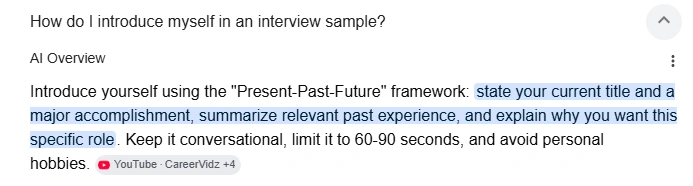
Present → Past → Future
Let’s break it down.
Step 1: Present
Start with where you are today.
Answer:
- What do you currently do?
- What is your professional identity?
- What are you known for?
Examples:
“I’m currently a marketing coordinator specializing in content strategy and social media growth.”
“I’m a recent computer science graduate with a strong interest in software development.”
“I’m a technician service professional with five years of experience helping clients solve complex problems.”
The Present establishes your identity.
It tells interviewers how to think about you.
Step 2: Past
Next, explain how you got here.
Highlight:
- Relevant experience
- Key accomplishments
- Important skills
- Notable achievements
Examples:
“Over the last three years, I’ve managed campaigns that increased website traffic by more than 60%.”
“During college, I completed multiple internships where I developed skills in data analysis and reporting.”
“In my previous role, I consistently ranked among the top performers for customer satisfaction.”
The Past provides evidence.
Claims become believable when supported by results.
Step 3: Future
Finally, explain where you’re heading.
This is where many candidates fail.
They stop too early.
The Future section shows:
- Career direction
- Motivation
- Interest in the position
- Long-term thinking
Examples:
“I’m now looking for an opportunity where I can contribute those skills at a larger scale while continuing to grow professionally.”
“What attracted me to this role is the chance to work on innovative products while expanding my technical expertise.”
“I’m excited about joining an organization that values customer experience as much as I do.”
The Future creates momentum.
Interviewers don’t just hire your past.
They hire your future potential.
The 90-Second Rule
One of the biggest mistakes candidates make is talking too long.
Many introductions become:
- 3 minutes
- 5 minutes
- Sometimes 10 minutes
This is dangerous.
A strong answer typically lasts:
Ideal Length
60–90 seconds
Maximum
2 minutes
Anything longer risks:
- Losing attention
- Repeating information
- Sounding unfocused
- Creating confusion
The goal is to create curiosity.
Not exhaustion.
A great introduction makes the interviewer want to ask more questions.
The Seven Deadly Mistakes
Mistake #1: Starting from Childhood
Example:
“I was born in Chicago and so on …”
The interviewer doesn’t need your biography.
Start where your professional story becomes relevant.
Mistake #2: Reading Your Resume
Interviewers already have your data.
Repeating every line adds no value.
Instead, summarize and interpret.
Connect the dots.
Tell the story behind the experience.
Mistake #3: Being Too Generic
Examples:
“I’m hardworking.”
“I’m a team player.”
“I like challenges.”
Why to select you?
Millions of candidates say these things.
Few prove them.
Show evidence.
Mistake #4: Sharing Too Much Personal Information
Avoid discussing:
- Family drama
- Financial struggles
- Political opinions
- Religious beliefs
- Personal conflicts
Keep the answer professionally relevant.
Mistake #5: Sounding Rehearsed
Many candidates memorize every word.
The result?
They sound robotic.
Interviewers want preparation.
Not recitation.
Know the structure.
Speak naturally.
Mistake #6: Talking Without Direction
Some candidates jump randomly between topics.
Education.
Then work.
Then hobbies.
Then achievements.
Then education again.
The interviewer struggles to follow.
Use a logical structure.
Present.
Past.
Future.
Mistake #7: Ending Abruptly
Many answers stop suddenly.
Example:
“And that’s basically it.”
Weak ending.
Instead, finish with enthusiasm and direction.
Example:
“That’s why I’m excited about this opportunity and believe my background aligns well with the role.”
Much stronger.
The Confidence Secret Nobody Mentions
Most candidates think confidence comes from personality.
Not true.
Confidence often comes from clarity.
When you know:
- What to say
- Why you’re saying it
- What structure you’re following
Nervousness decreases naturally.
The best interviewers are not always the most charismatic.
Often they’re simply the most organized.
Their thoughts flow logically.
That creates confidence.
The Story Framework That Makes You Memorable
Facts fade.
Stories remain.
Instead of listing experiences, connect them.
Example:
Weak:
“I worked at Company A, then Company B, then Company C.”
Better:
“My career started in technical support, where I discovered how much I enjoyed solving problems. That led me into account management, where I could build longer-term relationships with clients. Most recently, I’ve combined both skills in a customer success role focused on retention and growth.”
Notice the difference?
The second version creates a narrative.
People remember narratives.
How Different Generations Should Answer
Gen Z / New Graduates
Focus on:
- Education
- Projects
- Internships
- Learning ability
- Enthusiasm
Do not apologize for limited experience.
Highlight potential.
Early Career Professionals
Focus on:
- Recent achievements
- Skill development
- Growth trajectory
Show momentum.
Mid-Career Professionals
Focus on:
- Results
- Leadership
- Expertise
Show proven value.
Senior Professionals
Focus on:
- Strategic impact
- Team leadership
- Business outcomes
Show influence.
What If You Have No Experience?
This is one of the most searched interview concerns.
The answer:
Focus on transferable experiences.
Examples:
- School projects
- Volunteer work
- Freelance work
- Certifications
- Leadership positions
- Personal projects
Employers understand that everyone starts somewhere.
What matters is demonstrating initiative and capability.
What If You Are Changing Careers?
Career changers often panic.
They assume their previous experience is irrelevant.
Usually, that’s false.
Skills transfer more often than people realize.
Examples:
A teacher may possess:
- Communication skills
- Presentation skills
- Leadership skills
- Organization skills
A retail worker may possess:
- Customer service skills
- Sales skills
- Conflict resolution skills
A military veteran may possess:
- Discipline
- Leadership
- Problem-solving abilities
Focus on transferable strengths.
Not differences.
The Interview Landscape Is Changing
The future of interviews is evolving rapidly.
Several trends are emerging.
AI Screening
More companies use AI-assisted hiring tools.
Clear communication becomes even more important.
Video Interviews
Remote interviews continue growing.
Strong introductions become increasingly valuable.
Skills-Based Hiring
Many employers now prioritize capability over traditional credentials.
Global Talent Competition
Candidates increasingly compete internationally.
Communication skills become a differentiator.
The ability to introduce yourself effectively will likely become more valuable—not less—in the coming years.
A Quick Self-Assessment Exercise
Before building your answer, ask yourself:
- What is my professional identity?
- What achievement am I most proud of?
- What skills create value?
- Why am I interested in this role?
- What direction is my career heading?
Your answers become the foundation of a compelling introduction.
Complete Sample Answers for Freshers, Graduates, Career Changers, Experienced Professionals
At this point, you understand the process.
You understand the Present → Past → Future formula.
Now comes the part most job seekers are actually searching for:
Real sample answers.
But before copying any answer, understand something important.
The goal is not memorization.
The goal is customization.
Think of these examples as blueprints.
You can adapt them to your own background, experience, and career goals.
The candidates who perform best are not those who memorize every word.
They are the ones who understand the structure and make it sound natural.
Sample Answer #1: Fresher With No Work Experience
This is one of the most common situations.
Many freshers believe they have nothing valuable to say.
That couldn’t be further from the truth.
Employers understand that fresh graduates may lack professional experience.
What they want to see is:
- Potential
- Learning ability
- Initiative
- Communication skills
- Enthusiasm
Sample Answer
“Thank you for the opportunity. I’m a recent graduate with a degree in Business Administration, and throughout my studies I developed a strong interest in marketing and customer behavior. During college, I worked on several academic projects that involved market research, data analysis, and campaign planning, which helped me strengthen both analytical and communication skills.
One project I’m particularly proud of involved creating a digital marketing strategy for a local business, where our team identified opportunities to increase customer engagement through social media. That experience showed me how much I enjoy solving business problems and working collaboratively.
I’m now looking for an opportunity where I can apply what I’ve learned in a professional environment, continue developing my skills, and contribute to a team while growing my career.”
Why This Works
The answer avoids apologizing for lack of experience.
Instead, it focuses on:
- Education
- Relevant projects
- Transferable skills
- Future ambition
The candidate sounds capable rather than inexperienced.
Sample Answer #2: College Student Seeking Internship
Internship interviews require a slightly different approach.
The focus should be on learning and curiosity.
Sample Answer
“I’m currently pursuing a degree in Computer Science and have developed a strong interest in software development, particularly mobile applications. Over the past year, I’ve worked on several personal projects, including a task management application and a budgeting tool, which allowed me to improve my programming and problem-solving skills.
Outside academics, I’ve participated in coding competitions and collaborated with classmates on group projects, where I learned the importance of teamwork, communication, and meeting deadlines.
What excites me about this internship is the opportunity to learn from experienced professionals, contribute to real-world projects, and gain hands-on experience that will help me become a stronger developer.”
Why This Works
Employers hiring interns expect limited experience.
What impresses them is initiative.
The candidate demonstrates:
- Self-learning
- Practical projects
- Teamwork
- Motivation
Sample Answer #3: Recent Graduate Applying for First Full-Time Job
Sample Answer
“I’m a recent graduate in Information Technology with a strong foundation in software development and data analysis. During university, I completed multiple projects involving web development, database management, and application design, which strengthened both my technical and problem-solving abilities.
In my final year, I led a project team responsible for building an online inventory management system. Through that experience, I gained leadership skills while also learning how to coordinate tasks, solve challenges, and deliver results under deadlines.
I’m now excited to begin my professional career and contribute my technical skills while continuing to learn from experienced colleagues in a growth-oriented environment.”
Sample Answer #4: Career Changer
Career transitions can feel intimidating.
The secret is connecting old experience to new opportunities.
Example: Teacher Transitioning
“I’m currently an educator with several years of experience helping students learn complex concepts and achieve measurable improvements. Throughout my teaching career, I’ve developed strong communication, presentation, and coaching skills while designing engaging learning experiences for diverse audiences.
Over time, I became increasingly interested in employee development and professional training. To prepare for this transition, I’ve completed courses in instructional design and learning management systems while researching best practices in corporate training.
I’m excited about the opportunity to apply my teaching and communication background in a corporate environment where I can help employees develop skills, improve performance, and contribute to organizational success.”
Why This Works
The candidate never apologizes for changing careers.
Instead, they highlight transferable strengths.
The focus remains on value.
Sample Answer #5: Retail Worker Moving Into Sales
Sample Answer
“I’ve spent the last four years working in retail, where I developed strong customer management and relationship-building skills. My role involved understanding customer needs, recommending products, and consistently helping customers find solutions that matched their goals.
During that time, I discovered that I particularly enjoyed the sales aspect of the job. I frequently exceeded store targets and became one of the team’s top performers in customer satisfaction and product recommendations.
I’m now looking to transition into a dedicated sales role where I can build on those strengths, develop professionally, and contribute to revenue growth while creating positive customer experiences.”
Sample Answer #6: Experienced Professional
Candidates with several years of experience should focus heavily on achievements and results.
Sample Answer
“I’m a project manager with over seven years of experience leading cross-functional teams and delivering complex projects across technology and operations environments. Throughout my career, I’ve been responsible for planning, execution, stakeholder management, and ensuring projects are completed on time and within budget.
Most recently, I led a process improvement initiative that reduced project delivery times by nearly 20%, resulting in increased efficiency and customer satisfaction. These experiences have strengthened my leadership, communication, and strategic planning abilities.
What attracted me to this opportunity is the chance to contribute those skills within a larger organization while continuing to lead impactful projects and drive business results.”
Why This Works
The answer demonstrates:
- Expertise
- Quantifiable achievements
- Leadership
- Future ambition
Interviewers immediately understand the candidate’s value.
Sample Answer #7: Software Developer
Technology interviews often require balancing technical and business value.
Sample Answer
“I’m a software developer with five years of experience building web and mobile applications. My primary focus has been creating scalable, user-friendly solutions using modern development frameworks while collaborating closely with product and design teams.
In my current role, I’ve contributed to several major projects, including an application redesign that improved user engagement and reduced load times significantly. Beyond technical development, I enjoy understanding business objectives and translating them into practical software solutions.
I’m particularly interested in this role because it offers the opportunity to work on innovative products, solve challenging technical problems, and continue growing as a developer while contributing meaningful value to users.”
Sample Answer #8: Data Analyst
Sample Answer
“I’m a data analyst with three years of experience helping organizations make data-driven decisions. My work involves collecting, cleaning, analyzing, and visualizing data to uncover insights that support business objectives.
One project I’m especially proud of involved identifying customer behavior patterns that helped improve marketing performance and increase conversion rates. Experiences like that reinforced my passion for transforming raw data into actionable recommendations.
I’m now seeking an opportunity where I can continue applying analytical skills to solve business challenges while expanding my expertise in advanced analytics and business intelligence.”
Sample Answer #9: Customer management Representative
Sample Answer
“I’m a customer management professional with over four years of experience helping customers resolve issues, answer questions, and build positive relationships with organizations. Throughout my career, I’ve focused on delivering exceptional service while maintaining efficiency and professionalism in high-volume environments.
In my current position, I’ve consistently achieved high customer satisfaction ratings while handling complex situations that required patience, empathy, and problem-solving skills. I genuinely enjoy helping people and creating positive experiences.
I’m excited about this opportunity because it allows me to continue using those strengths while contributing to an organization that values customer success and long-term relationships.”
Sample Answer #10: Administrative Assistant
Sample Answer
“I’m an administrative professional with several years of experience supporting teams, managing schedules, coordinating meetings, and ensuring daily operations run smoothly. My background has helped me develop strong organizational, communication, and multitasking abilities.
In previous roles, I’ve managed executive calendars, coordinated travel arrangements, and implemented organizational systems that improved efficiency and reduced administrative bottlenecks. I enjoy creating structure and helping teams stay productive.
I’m now looking for an opportunity where I can contribute those organizational strengths while continuing to grow professionally in a dynamic environment.”
The Universal Formula Behind Every Great Sample
Notice something interesting.
Every strong answer follows a nearly identical structure.
Step 1: Professional Identity
Who are you?
“I’m a software developer…”
“I’m a project manager…”
“I’m a recent graduate…”
Step 2: Supporting Experience
What have you done?
Projects
Achievements
Responsibilities
Results
Step 3: Future Direction
Where are you going?
Growth
Contribution
Opportunity
Excitement
The Golden Rule
Interviewers do not remember every detail.
They remember impressions.
A great answer leaves them thinking:
- This person is competent.
- This person is relevant.
- This person communicates well.
- This person knows where they’re going.
That is the real objective.
Not perfection.
Clarity.
Confidence.
And relevance.
Industry-Specific Sample Answers for Professionals, Managers, Executives, Healthcare, Sales, HR, Marketing, Cybersecurity, and Remote Roles
At this stage, you understand something that most job seekers never fully grasp:
The best answer is not the longest answer.
It is not the most impressive answer.
It is not the most complicated answer.
It is the most relevant answer.
The closer your introduction aligns with the employer’s needs, the stronger your first impression becomes.
This is why generic interview advice often fails.
A software engineer should not introduce themselves the same way a sales representative would.
A nurse should not sound like a marketing manager.
A CEO should not answer like a recent graduate.
Every profession has its own language.
Its own priorities.
Its own version of value.
In this section, you’ll discover exactly how successful professionals from different industries position themselves.
Sample Answer #11: Software Engineer
Sample Answer
“I’m a software engineer with over six years of experience designing and developing scalable applications for both web and mobile platforms. Throughout my career, I’ve worked across the full software development lifecycle, from requirements gathering and architecture planning to deployment and ongoing optimization.
In my current role, I’ve contributed to several high-impact projects, including the development of a customer-facing platform that improved user engagement while reducing operational costs. I particularly enjoy solving complex technical problems and collaborating with cross-functional teams to build solutions that create measurable business value.
What attracted me to this opportunity is the chance to work on larger-scale systems, tackle challenging engineering problems, and continue growing my technical expertise while contributing to innovative products.”
Why This Works
Engineering managers care about:
- Problem solving
- Scalability
- Collaboration
- Technical impact
The answer addresses all four.
Sample Answer #12: IT Support Specialist
Sample Answer
“I’m an IT support specialist with four years of experience helping users resolve technical issues while maintaining reliable system performance. My work has involved troubleshooting hardware and software problems, managing user accounts, supporting network infrastructure, and ensuring minimal downtime for business operations.
One accomplishment I’m particularly proud of was helping streamline our support processes, which reduced ticket resolution times and improved overall user satisfaction. I enjoy combining technical knowledge with customer service to help people stay productive and confident with technology.
I’m now looking for an opportunity where I can continue supporting users, expand my technical skills, and contribute to a team that values both service excellence and continuous improvement.”
Sample Answer #13: Cybersecurity Professional
Sample Answer
“I’m a cybersecurity analyst with five years of experience helping organizations identify, assess, and mitigate security risks. My background includes vulnerability management, incident response, security monitoring, and compliance initiatives designed to strengthen organizational resilience.
Most recently, I played a key role in implementing security improvements that enhanced threat detection capabilities and reduced response times during security incidents. What I enjoy most about cybersecurity is staying ahead of emerging threats while helping organizations protect critical systems and data.
I’m excited about this opportunity because it offers the chance to work in a dynamic environment where I can continue strengthening security operations while contributing to a proactive security culture.”
The New Reality of Technology Careers
Technology hiring has changed dramatically.
Years ago, technical skills alone could secure opportunities.
Today employers increasingly evaluate:
- Communication skills
- Team collaboration
- Business awareness
- Adaptability
The strongest candidates demonstrate both technical competence and professional maturity.
Sample Answer #14: Digital Marketing Specialist
Sample Answer
“I’m a digital marketing professional with experience developing and executing campaigns across content marketing, SEO, social media, and paid advertising channels. Throughout my career, I’ve focused on understanding customer behavior and creating strategies that drive engagement, leads, and measurable business results.
In my most recent role, I helped increase organic website traffic and improve campaign performance through data-driven optimization and audience-focused content strategies. I enjoy combining creativity with analytics to solve marketing challenges and identify growth opportunities.
What excites me about this role is the opportunity to contribute to a brand with strong growth potential while continuing to expand my expertise in digital strategy and customer acquisition.”
Sample Answer #15: SEO Specialist
Sample Answer
“I’m an SEO specialist focused on helping businesses improve online visibility, organic traffic, and search performance. Over the past several years, I’ve worked on technical SEO, content strategy, keyword research, and link-building initiatives designed to support long-term growth.
One of my most rewarding projects involved helping a website significantly increase organic traffic through a combination of content optimization and technical improvements. Experiences like that reinforced my belief that effective SEO combines both analytical thinking and a deep understanding of user intent.
I’m particularly interested in this opportunity because it would allow me to apply my SEO expertise on a larger scale while continuing to adapt to the evolving search landscape.”
Sample Answer #16: Sales Representative
Sales interviews require confidence without arrogance.
The best sales professionals communicate value naturally.
Sample Answer
“I’m a sales professional with five years of experience helping customers identify solutions that address their specific needs while contributing to revenue growth. Throughout my career, I’ve worked in both inbound and outbound sales environments, developing strong relationship-building, negotiation, and communication skills.
In recent roles, I’ve consistently met or exceeded performance targets by focusing on understanding customer challenges and providing meaningful solutions rather than simply selling products. I enjoy building trust, creating long-term relationships, and helping customers achieve successful outcomes.
What attracted me to this opportunity is the chance to represent a strong product while contributing to a high-performing team and continuing to grow as a sales professional.”
Why Top Salespeople Introduce Themselves Differently
Average salespeople talk about products.
Exceptional salespeople talk about customer outcomes.
The same principle applies during interviews.
Focus on the value you create.
Not simply the tasks you perform.
Sample Answer #17: Human Resources Professional
Sample Answer
“I’m an HR professional with experience supporting talent acquisition, employee relations, onboarding, and performance management initiatives. Throughout my career, I’ve focused on helping organizations attract, develop, and retain talented employees while creating positive workplace experiences.
One area I particularly enjoy is building strong relationships with both employees and leadership teams to support organizational goals and address workplace challenges effectively. My experiences have strengthened my communication, problem-solving, and conflict-resolution abilities.
I’m excited about this opportunity because it allows me to continue contributing to people-focused initiatives while helping support a strong organizational culture.”
Sample Answer #18: Healthcare Administrator
Sample Answer
“I’m a healthcare administration professional with experience supporting operational efficiency, compliance, and patient service initiatives within healthcare environments. My background includes coordinating administrative processes, improving workflows, and supporting teams in delivering quality patient experiences.
One of my strengths is balancing organizational objectives with patient-centered priorities, ensuring both operational effectiveness and service quality. I enjoy solving process challenges and helping healthcare organizations operate more efficiently.
I’m looking forward to contributing those skills within an organization committed to delivering outstanding healthcare services.”
Sample Answer #19: Project Manager
Sample Answer
“I’m a project manager with experience leading cross-functional teams and delivering projects across multiple business functions. My responsibilities have included planning, budgeting, stakeholder communication, risk management, and ensuring projects remain aligned with organizational objectives.
Throughout my career, I’ve developed a reputation for bringing structure to complex initiatives while maintaining strong relationships with stakeholders and team members. I enjoy solving challenges, coordinating resources, and helping teams achieve successful outcomes.
What attracted me to this opportunity is the chance to lead impactful initiatives while continuing to grow as a strategic project leader.”
Sample Answer #20: Customer Success Manager
Sample Answer
“I’m a customer success professional focused on helping clients achieve measurable value from the products and services they use. My experience includes onboarding, relationship management, account growth, and proactive customer engagement strategies designed to improve retention and satisfaction.
One of the most rewarding aspects of my work is partnering with customers to understand their goals and help them achieve meaningful results. My background has strengthened both my relationship-building and strategic problem-solving skills.
I’m excited about this role because it combines customer advocacy, business growth, and long-term relationship development—areas I’m passionate about.”
Sample Answer #21: Business Analyst
Sample Answer
“I’m a business analyst with experience identifying opportunities to improve processes, enhance operational efficiency, and support data-driven decision-making. Throughout my career, I’ve worked closely with stakeholders to understand business challenges, gather requirements, and translate complex needs into actionable solutions.
I enjoy connecting business objectives with practical execution and helping organizations make informed decisions through analysis and collaboration. One of my strengths is communicating effectively with both technical and non-technical stakeholders.
I’m particularly interested in this opportunity because it offers the chance to contribute strategic insights while helping drive meaningful business outcomes.”
Sample Answer #22: Manager
Sample Answer
“I’m a people-focused manager with experience leading teams, improving performance, and delivering results across operational and strategic initiatives. Throughout my career, I’ve prioritized creating environments where employees can perform at their best while aligning team efforts with broader organizational goals.
One of my greatest strengths is developing talent and helping individuals grow professionally while maintaining accountability and performance standards. I enjoy balancing people leadership with business objectives to achieve sustainable success.
I’m excited about this role because it presents an opportunity to lead larger initiatives, develop high-performing teams, and contribute to organizational growth.”
Sample Answer #23: Executive Leader
Sample Answer
“I’m an executive leader with extensive experience driving business growth, leading organizational transformation, and developing high-performing teams. Throughout my career, I’ve focused on aligning strategy, operations, and talent to achieve measurable business outcomes and long-term success.
One of the most rewarding aspects of leadership is creating clarity and direction while empowering teams to execute effectively. My experience spans strategic planning, operational excellence, financial management, and stakeholder engagement.
What attracts me to this opportunity is the ability to contribute at a strategic level while helping shape the organization’s future growth and success.”
Sample Answer #25: Remote Worker
Remote interviews continue becoming more common every year.
Sample Answer
“I’m a professional with experience working effectively in remote and hybrid environments, where strong communication, self-management, and collaboration skills are essential. Throughout my career, I’ve successfully coordinated projects, managed priorities, and maintained productivity while working with distributed teams.
One thing I’ve learned from remote work is the importance of proactive communication and accountability. I enjoy creating structure, maintaining transparency, and ensuring projects continue moving forward regardless of location.
I’m excited about this opportunity because it combines flexibility, collaboration, and meaningful work while allowing me to contribute effectively within a remote-first environment.”
Advanced Personalization Strategy
The strongest candidates customize answers around three factors:
Company
Research:
- Mission
- Values
- Culture
- Industry
Mention relevant connections.
Role
Emphasize:
- Relevant skills
- Relevant achievements
- Relevant experience
Not everything you’ve ever done.
Future Direction
Connect your goals with the company’s goals.
This creates alignment.
And alignment creates confidence.
The Secret Shared by Exceptional Candidates
Across industries, the highest-performing candidates understand one truth:
Interviewers are not hiring a candidate.
They are hiring a future colleague.
Someone they trust.
Someone they can imagine working with.
Someone who communicates clearly.
Someone who appears capable of creating value.
Your introduction is your first opportunity to create that image.
Make it count.
Recruiter Mindset, Interview Statistics, Future Hiring Trends, User Reactions, and Advanced Differentiation Strategies
By now you’ve learned the the whole scenario.
You’ve seen examples.
You’ve studied industry-specific answers.
But there is a deeper layer that separates average candidates from exceptional candidates.
Understanding human mindset.
Most candidates prepare answers.
Top candidates prepare impressions.
And impressions are often what determine who gets hired.
The surprising truth is that many interviews are not won because of superior qualifications.
They are won because of superior communication.
The candidate makes the interviewer feel confident.
Safe.
Optimistic.
Excited.
And those emotions influence decisions far more than most people realize.
The Invisible process Happening During Every Interview
Imagine you’re one of 300 applicants.
The recruiter has reviewed hundreds of resumes.
Many candidates have similar education.
Similar experience.
Similar technical skills.
From the recruiter’s perspective, everyone begins looking alike.
This creates a problem.
How do they differentiate people?
The answer is surprisingly human.
They look for validation.
Validation of:
- Confidence
- Clarity
- Competence
- Professionalism
- Potential
This is exactly why the “Tell me about yourself” question matters so much.
It immediately reveals those validations.
Without requiring technical expertise.
Without requiring extensive discussion.
Without requiring complicated assessments.
Within 90 seconds, recruiters often gain insights they cannot easily obtain from a database.
What Recruiters Notice
Most candidates focus on words.
Recruiters focus on patterns.
They notice:
Energy
Does the candidate sound interested?
Or exhausted?
Structure
Can the candidate organize thoughts effectively?
Relevance
Do they understand what matters?
Confidence
Can they communicate without excessive hesitation?
Authenticity
Do they sound genuine?
Or scripted?
These observations happen automatically.
Often subconsciously.
Yet evaluation is already occurring.
Statistics That May Surprise You
While hiring varies across industries, studies and recruiter surveys consistently reveal several things.
First Impressions Matter
Many recruiters report forming preliminary impressions within the first few minutes of interaction.
Those impressions are not always final.
But they influence the remainder of the conversation.
Communication Skills Remain a Top Hiring Factor
Across industries, employers repeatedly rank communication among the most valuable professional skills.
Technical expertise opens doors.
Communication often determines who walks through them.
Soft Skills Continue Growing in Importance
Employers increasingly prioritize:
- Adaptability
- Collaboration
- Emotional intelligence
- Critical thinking
- Communication
Why?
Because technical skills can often be trained.
Professional behavior is harder to teach.
Why Some Candidates Get Hired Despite Weaker Resumes
This frustrates many job seekers.
They think:
“I had more experience.”
“I had better qualifications.”
“I knew more about the job.”
Yet another candidate receives the offer.
Why?
Often because employers hire future potential.
Not just historical achievements.
Imagine two candidates.
Candidate A
Excellent data.
Poor communication.
Low enthusiasm.
Weak interpersonal skills.
Candidate B
Good expereince.
Strong communication.
Positive attitude.
Clear direction.
Most employers choose Candidate B.
Not because experience doesn’t matter.
Because performance requires more than knowledge.
Organizations hire people.
Not documents.
The Emotional Side of Hiring
Humans like to believe decisions are entirely logical.
Research suggests otherwise.
Emotions frequently influence decisions.
Including hiring decisions.
Recruiters ask themselves questions like:
- Would I enjoy working with this person?
- Would I trust this person?
- Could they represent our company well?
- Will they fit the team?
These questions are emotional as much as rational.
Your introduction contributes heavily to those perceptions.
User Reactions: What Candidates Usually Experience
After improving their introduction, candidates often report similar experiences.
Reaction #1
“The interview felt smoother.”
A strong opening creates momentum.
Questions become easier to answer.
Reaction #2
“I felt more confident.”
Preparation reduces anxiety.
Clarity reduces nervousness.
Reaction #3
“The interviewer became more engaged.”
Good introductions create curiosity.
Interviewers ask deeper questions.
Reaction #4
“I finally sounded professional.”
Many candidates know they have skills.
They simply struggle to articulate them.
A structured answer solves this problem.
The Rise of AI Hiring
A major transformation is already underway.
Artificial intelligence increasingly influences recruitment.
Companies now use:
- Data screening
- Candidate matching
- Assessment tools
- Video interview analysis
Some candidates fear this trend.
But there is an important opportunity hidden inside it.
As AI handles repetitive screening tasks, human communication becomes even more valuable.
Why?
Because relationships still matter.
Leadership still matters.
Trust still matters.
Influence still matters.
The candidates who communicate clearly will continue gaining advantages.
Future Prediction #1: Communication Will Become More Valuable
Technology can automate many tasks.
But it cannot fully replace:
- Human trust
- Human persuasion
- Human leadership
Professionals who combine technical ability with communication skills will likely remain highly competitive.
Future Prediction #2: Personal Branding Will Matter More
Increasingly, employers evaluate:
- LinkedIn profiles
- Professional presence
- Thought leadership
- Online reputation
The ability to communicate your story effectively will become increasingly important.
Your interview introduction is essentially your personal brand condensed into 90 seconds.
Future Prediction #3: Storytelling Will Become a Competitive Advantage
Information is abundant.
Attention is scarce.
People remember stories.
Not bullet points.
Candidates who communicate through narratives often become more memorable.
And memorable candidates frequently receive more opportunities.
Why Storytelling Works So Well
Consider these two answers.
Candidate One
“I increased sales by 15%.”
Good.
Candidate Two
“When I joined the team, we were struggling to retain customers. After analyzing customer feedback and adjusting our outreach strategy, we increased retention and ultimately improved sales by 15%.”
Same result.
Completely different impact.
The second answer creates a story.
Stories create emotion.
Emotion creates memory.
Memory influences decisions.
The Interviewer’s Dream Candidate
Every recruiter has a mental picture.
Not necessarily of a perfect person.
But of a low-risk hire.
Someone who appears:
- Competent
- Reliable
- Professional
- Positive
- Coachable
Your introduction should reduce uncertainty.
The less risk employers perceive, the more comfortable they become moving forward.
The Confidence Loop
Most people think:
Confidence creates success.
But another dynamic exists.
Success creates confidence.
Preparation creates success.
Therefore:
Preparation → Better Performance → Better Results → More Confidence
This is why practicing your introduction is so powerful.
You’re not memorizing words.
You’re creating familiarity.
And familiarity reduces fear.
Advanced Technique: The Achievement Anchor
Top candidates often include one memorable accomplishment.
Example:
“Most recently, I helped reduce customer response times by 30%.”
Or:
“I led a project that saved the company thousands of dollars annually.”
Or:
“I helped increase organic traffic by over 100%.”
This achievement acts as an anchor.
Something recruiters remember.
A memorable detail can dramatically increase recall.
Advanced Technique: The Future Connection
Many candidates discuss only the past.
Elite candidates connect the past to the future.
Example:
“Those experiences strengthened my analytical skills, which is one reason I’m excited about this role’s focus on data-driven decision-making.”
This creates alignment.
Alignment reduces hiring friction.
Advanced Technique: Professional Enthusiasm
Notice the difference.
Weak
“I need a job.”
Strong
“I’m excited about opportunities where I can continue solving meaningful business challenges.”
One sounds desperate.
One sounds driven.
Employers are naturally attracted to enthusiasm.
Especially when it feels authentic.
The Candidate Identity Transformation
At the beginning of a job search, many people feel:
- Uncertain
- Overwhelmed
- Rejected
- Frustrated
After enough rejection, confidence often declines.
Candidates begin doubting themselves.
Their abilities.
Their future.
But something changes when communication improves.
Instead of thinking:
“I hope they like me.”
Strong candidates begin thinking:
“Let me show them the value I can bring.”
This shift is powerful.
It changes tone.
Body language.
Confidence.
Presence.
Everything.
The Hidden World Most Applicants Never See
Recruiters rarely talk publicly about one reality.
Many candidates eliminate themselves.
Not because they lack qualifications.
Because they fail to communicate qualifications effectively.
The opportunity exists.
The ability exists.
The experience exists.
But the message gets lost.
Learning how to answer “Tell me about yourself” effectively is really about learning how to communicate your value.
That skill extends far beyond interviews.
It affects:
- Networking
- Leadership
- Promotions
- Business development
- Entrepreneurship
- Public speaking
In many ways, it becomes a career-long advantage.
Imagine Your Future Interview Success
Picture yourself six months from now.
You’ve attended multiple interviews.
Your introduction feels natural.
Confident.
Professional.
Interviewers engage.
Conversations flow.
Opportunities increase.
Rejections decrease.
The anxiety that once accompanied interviews begins fading.
Not because interviews changed.
Because you changed.
You learned how to communicate your value.
And once that ability develops, it continues creating opportunities for years.
Special Situations, Final Framework, Story-Based Proof, Future Pacing
Now let’s solve the remaining challenges that cause candidates to struggle.
Because real interviews are rarely perfect.
People have gaps.
Career changes.
Layoffs.
Failed businesses.
Limited experience.
Unusual backgrounds.
And yet thousands of those candidates still get hired every day.
The difference is often how they tell their story.
Special Situation #1: Employment Gap
Many candidates fear employment gaps.
They imagine interviewers immediately assume the worst.
Usually, that fear is exaggerated.
What matters most is how you explain the gap.
Weak Approach
“I wasn’t doing anything.”
Strong Approach
“After leaving my previous role, I took time to focus on professional development, completed relevant training, and carefully evaluated the next step in my career. During that period I strengthened skills that I’m excited to apply moving forward.”
Keep it brief.
Honest.
Professional.
Then redirect attention toward value.
Special Situation #2: Layoff
Millions of professionals experience layoffs.
It is increasingly common.
The key is avoiding bitterness.
Example
“My previous position was impacted by organizational restructuring. While it wasn’t the outcome I expected, it gave me the opportunity to reflect on my career goals and focus on finding a role where I can contribute my experience and continue growing professionally.”
Professional.
Positive.
Forward-looking.
Special Situation #3: No Experience
Perhaps the most searched interview concern online.
Remember:
Employers hire potential every day.
Focus On
- Academic projects
- Volunteer work
- Certifications
- Personal projects
- Leadership roles
- Transferable skills
The interviewer knows you lack experience.
You don’t need to remind them.
Show initiative instead.
Special Situation #4: Returning to Work After Years Away
Example
“While I stepped away from full-time employment for personal reasons, I remained committed to learning and professional development. During that time I strengthened organizational, communication, and problem-solving skills while staying current with industry developments. I’m excited to bring that perspective and renewed energy back into a professional environment.”
Again:
Positive.
Forward-looking.
Confident.
Good Answer vs Bad Answer
Weak Example
“My name is David. I’m 31 years old. I graduated from college in 2018. I like sports, movies, and traveling. I’ve worked at a few companies and now I’m looking for another opportunity.”
Nothing technically wrong.
But nothing memorable.
Nothing relevant.
Nothing persuasive.
Strong Example
“I’m a technician professional with four years of experience helping clients achieve measurable results through technology solutions. Throughout my career I’ve focused on relationship building, onboarding, and retention initiatives that improved customer satisfaction and long-term engagement. Most recently I helped streamline client onboarding processes, and I’m now excited about opportunities where I can continue driving customer success while growing professionally.”
The difference is dramatic.
One sounds random.
One sounds intentional.
The Ultimate Answer Checklist
Before every interview, ask yourself:
Identity
✔ Have I clearly explained who I am professionally?
Experience
✔ Have I highlighted relevant experience?
Achievement
✔ Have I included at least one accomplishment?
Skills
✔ Have I demonstrated value?
Future
✔ Have I explained why I’m interested in the role?
Length
✔ Can I deliver it in under 90 seconds?
Authenticity
✔ Does it sound natural?
If the answer to all seven questions is yes, you’re already ahead of most candidates.
The One-Minute Sure recipe
If you’re short on time, use this simple structure:
Present
Who are you?
Past
What relevant experience do you have?
Achievement
What result are you proud of?
Future
Why this opportunity?
This recipe works for nearly every profession.
Frequently Asked Questions
How Long Should My Answer Be?
Ideal:
60–90 seconds.
Acceptable:
Up to 2 minutes.
Longer answers often reduce impact.
Should I Mention Personal Information?
Only if it’s relevant.
Professional details should dominate the answer.
Should I Memorize My Answer?
Memorize the structure.
Not every word.
Natural delivery feels more authentic.
Can I Mention Hobbies?
Yes, occasionally.
But only briefly and only if they add value or relate to the company culture.
What If I Get Nervous?
Practice aloud.
Most nervousness comes from uncertainty.
Clarity creates confidence.
What If I Forget My Script?
Return to the framework.
Present.
Past.
Future.
The structure will guide you.
What If The Interview Is Online?
The same principles apply.
In fact, communication often matters even more in virtual interviews.
What If I Have Multiple Career Changes?
Focus on the common thread.
What transferable skills connect your experiences?
Build the story around that theme.
A Story Worth Remembering
Several years ago, two candidates applied for the same position.
Their qualifications were similar.
Their experience was similar.
Their resumes were similar.
The first candidate answered:
“I graduated in 2019 and worked at a few companies.”
Technically correct.
Emotionally forgettable.
The second candidate answered:
“My career began in customer service, where I learned the importance of understanding people. That experience eventually led me into account management, where I discovered I enjoyed helping clients achieve long-term success. Most recently I’ve focused on customer retention strategies, and I’m excited about opportunities where I can continue building strong client relationships while contributing to business growth.”
The second candidate wasn’t necessarily more qualified.
But they told a story.
The interviewer understood:
- Who they were
- What they valued
- Where they were going
And that made all the difference.
The Future Version of You
Imagine the next interview.
The recruiter smiles.
Introductions begin.
Then comes the question.
The same question that once caused anxiety.
The same question that once felt impossible.
“Tell me about yourself.”
But now something is different.
You don’t panic.
You don’t ramble.
You don’t search for words.
You know your story.
You understand your value.
You communicate clearly.
Confidently.
Professionally.
The interviewer leans forward.
Interested.
Engaged.
The conversation flows naturally.
You leave the interview feeling proud.
Not because you were perfect.
Because you represented yourself effectively.
And that confidence follows you into every future opportunity.
The Real Lesson
This guide was never truly about one interview question.
It was about something larger.
Learning how to communicate your value.
People who master this skill often discover benefits far beyond hiring.
They perform better in:
- Networking conversations
- Promotion discussions
- Client meetings
- Leadership roles
- Business presentations
- Entrepreneurial ventures
The ability to explain who you are, what you’ve done, and where you’re going is one of the most valuable professional skills you can develop.
And it starts with five simple words:
“Tell me about yourself.”
A Soft Next Step
Before your next interview, spend 15 minutes creating your own Present → Past → Future answer.
Write it.
Refine it.
Practice it aloud.
Record yourself if possible.
Then adjust until it sounds natural.
Don’t aim for perfection.
Aim for clarity.
Small improvements in communication often create surprisingly large improvements in opportunity.
The next interview could be the one that changes everything.
Make sure your introduction gives it the best possible chance.
Note:
If you are looking for some extra weekend income from your phone, then I have found a useful hustle that you can try to make money.
Part time job. Can be done along with the regular job.
REFERENCES:
OTHER IMP READS:
A useful youtube video:
A useful Pinterest pin:

Linkedin -- www.linkedin.com/in/shishir-bhargava-68a8b4257
- 2026 Lexus IS 350 F Sport: Shocking review - August 22, 2026
- Why Global Markets Can Turn Nervous Overnight | How to prepare for it - July 9, 2026
- Why Countries Are Competing for Rare Earth Minerals | Shocking Details Revealed - July 6, 2026
⚠️ Most People Discover Trends When It's Too Late
Join the Trends Goldmine Insider List and get emerging AI tools, future products, viral keywords, and hidden opportunities before they hit the mainstream.
While everyone else is chasing yesterday's trends, you'll be spotting tomorrow's opportunities first.
🚀 Free Weekly Trend Alerts • No Spam • Unsubscribe Anytime
SIGN UP NOW & RECEIVE A SHORT REPORT ON HOW TO MAKE FORTUNE WITH TRENDS.Trusted by readers who want to discover opportunities before the crowd.