Something Surprising happened…
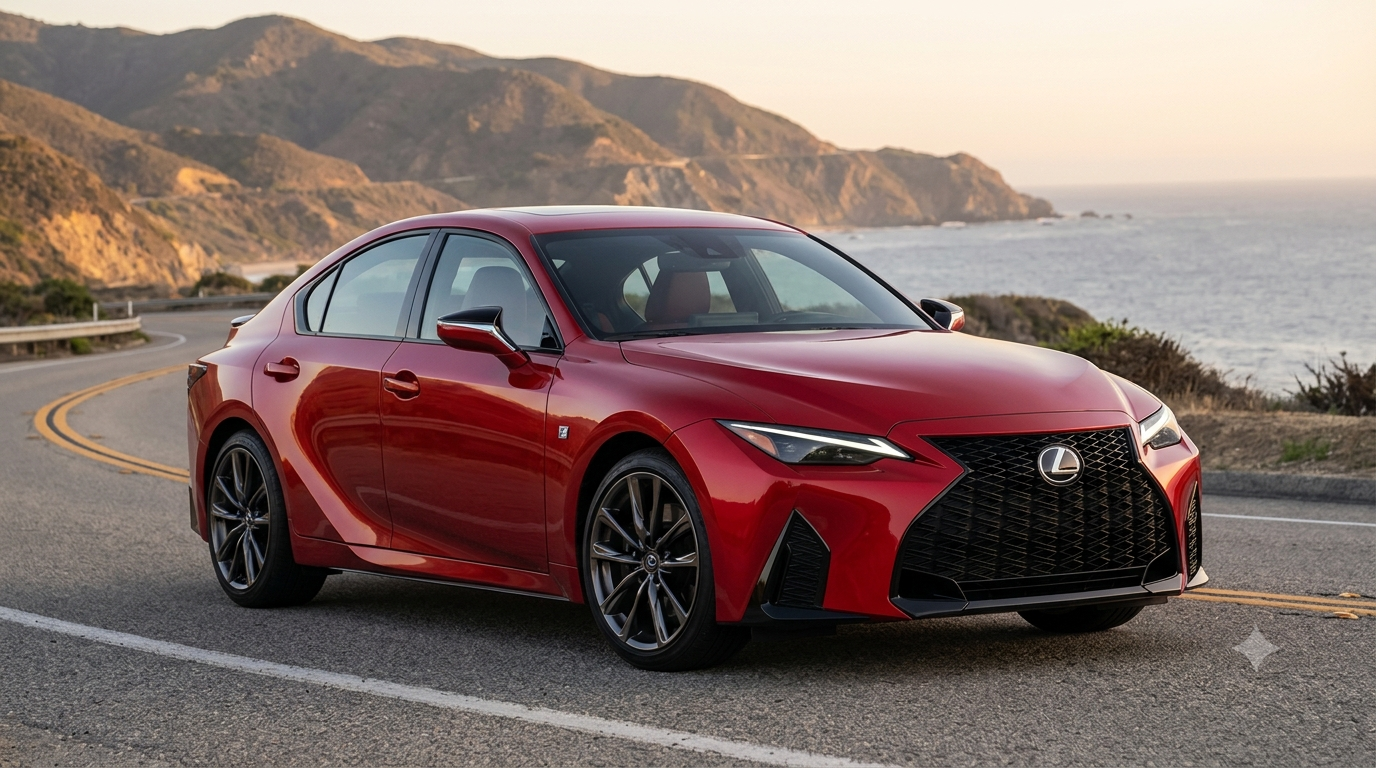
There is something increasingly unusual about the 2026 Lexus IS 350 F Sport.
It has a naturally aspirated V6.
It still sends power to the rear wheels.
It still uses a conventional automatic transmission.
It still has a low-slung body, a proper sport-sedan driving position, aggressive proportions and a personality that does not need a giant electric motor or a turbocharger to feel special.
And in 2026, that makes it almost rebellious.
The world of performance cars is moving rapidly toward turbocharged four-cylinders, hybrids, EVs, enormous touchscreens and acceleration figures that can make your stomach question its life choices. Meanwhile, Lexus has looked at the IS 350 and essentially said: what if we made the old-school sports sedan better instead of making it something completely different?
That decision creates a fascinating car.
The 2026 Lexus IS 350 F Sport is not the fastest compact luxury sedan you can buy. It is not the most technologically advanced. It does not beat every BMW, Cadillac or Mercedes-Benz in a straight line.
But speed is only one part of the sports-sedan experience.
The deeper question is this:
What does it feel like to own one?
Because the IS 350 F Sport is increasingly becoming less about chasing the latest specification sheet and more about preserving a type of driving experience that is disappearing.
For 2026, Lexus has simplified the IS lineup dramatically. The IS 300 is gone. The V8-powered IS 500 is gone. What remains is the IS 350, offered in F Sport Design and F Sport grades, with rear-wheel drive or all-wheel drive.
That makes the IS 350 more important than it may initially appear.
It is now the entire IS story.
And underneath that sharpened exterior sits a 3.5-liter naturally aspirated V6 producing 311 horsepower and 280 lb-ft of torque.
No turbocharger.
No hybrid system.
No artificial attempt to disguise a small engine with a massive electric assist.
Just a six-cylinder engine that likes to rev.
That may sound ordinary on paper.
In the context of 2026, it isn’t.
The Problem With Modern Performance Cars
Imagine walking into a luxury dealership today.
You want something exciting.
Something that looks expensive when you walk away from it.
Something that can make an ordinary commute feel like an event.
Something you can drive to work Monday morning and attack a winding road on Sunday.
You begin comparing specifications.
One car has 400 horsepower.
Another has 450.
Another has an all-wheel-drive launch system capable of producing absurd acceleration.
Another has a turbocharged four-cylinder that makes almost as much power as engines that once required twice the displacement.
The numbers keep climbing.
And yet something strange happens.
You start reading reviews and discover that horsepower isn’t necessarily the thing people remember.
They remember steering.
They remember sound.
They remember the brake pedal.
They remember how the chassis communicated through a corner.
They remember how the car behaved when they were not driving at ten-tenths.
And most importantly, they remember whether they actually enjoyed driving it.
That is where the Lexus IS 350 F Sport enters the conversation.
The IS is not attempting to win the horsepower war.
Instead, Lexus is preserving an increasingly rare formula:
front-engine + rear-drive architecture + naturally aspirated V6 + traditional automatic transmission + compact sedan proportions.
It is an old formula.
But old does not automatically mean obsolete.
Sometimes an older formula survives because it works.
A Different Kind of Performance
The first thing to understand about the 2026 IS 350 F Sport is that it is not a drag-strip specialist.
The 311-hp V6 delivers its power progressively. There is no dramatic turbocharger surge. There is no sudden wall of torque that throws you backward into the seat.
Instead, the engine builds.
You press the accelerator.
The V6 responds.
The revs rise.
The sound becomes more prominent.
And the car gathers speed in a way that feels mechanical rather than digitally manufactured.
That distinction matters.
A turbocharged engine can make astonishing torque at low rpm. An electric motor can deliver nearly instantaneous thrust. The Lexus takes a different route.
Its reward comes from allowing the engine to work.
The 3.5-liter V6 produces 311 horsepower at 6,600 rpm and 280 lb-ft of torque at 4,800 rpm.
Those numbers tell you something important about the personality of this car.
The engine wants revs.
It wants you to explore the upper part of the tachometer.
It wants you to keep accelerating rather than simply relying on a giant wave of low-rpm torque.
That is an increasingly unusual experience.
And for the right driver, it is addictive.
2026 Lexus IS 350 F Sport Specifications at a Glance
The basic mechanical recipe is remarkably straightforward.
Engine: 3.5-liter naturally aspirated V6
Horsepower: 311 hp at 6,600 rpm
Torque: 280 lb-ft at 4,800 rpm
Fuel: Premium gasoline
Transmission: 8-speed automatic with rear-wheel drive; 6-speed automatic with all-wheel drive
Drive: Rear-wheel drive or all-wheel drive
Body: Four-door compact luxury sports sedan
Seating: Five
Wheelbase: 110.2 inches
Length: 185.8 inches
Width: 72.4 inches
Height: approximately 56.7 inches
Trunk: approximately 11 cubic feet
Top speed: manufacturer-claimed 143 mph
RWD EPA economy: approximately 19 mpg city / 27 mpg highway / 22 mpg combined
AWD EPA economy: approximately 19 mpg city / 26 mpg highway / 22 mpg combined
Independent testing puts the AWD IS 350 around the mid-five-second range for 0–60 mph, depending on testing conditions and configuration.
Car and Driver recorded 5.6 seconds to 60 mph for an AWD IS 350, while MotorTrend recorded 5.7 seconds.
Those numbers are respectable.
But they are also revealing.
This is not a car designed to destroy everything beside it at a traffic light.
It is designed to make the next 30 minutes of driving more interesting.
And that distinction becomes increasingly important as performance cars become obsessed with acceleration.
F Sport Is About More Than a Badge
The phrase “F Sport” can sometimes be dismissed as a marketing label.
With the IS 350, that would be too simplistic.
The F Sport philosophy is about creating a sharper version of the standard car through suspension tuning, steering response, wheels, seats, braking hardware and visual details.
The 2026 IS 350 F Sport sits at the more enthusiast-oriented end of the IS lineup.
The F Sport Design is the more accessible entry point.
The full F Sport is where Lexus adds more of the performance-oriented hardware and personality that enthusiasts are looking for, including available or standard equipment depending on configuration and package.
The result is a car that looks as though it is permanently ready for the next road.
That is important because the IS has always possessed one of the most distinctive silhouettes in the luxury-sedan segment.
It is low.
It is compact.
It has a long hood.
The cabin is pushed toward the rear.
The body seems to sit over its wheels rather than hang between them.
And the F Sport treatment adds visual aggression without turning the car into a caricature.
It is the kind of vehicle that can look completely normal from a distance and then become increasingly interesting the closer you get.
The 2026 Redesign: Lexus Sharpens the Formula
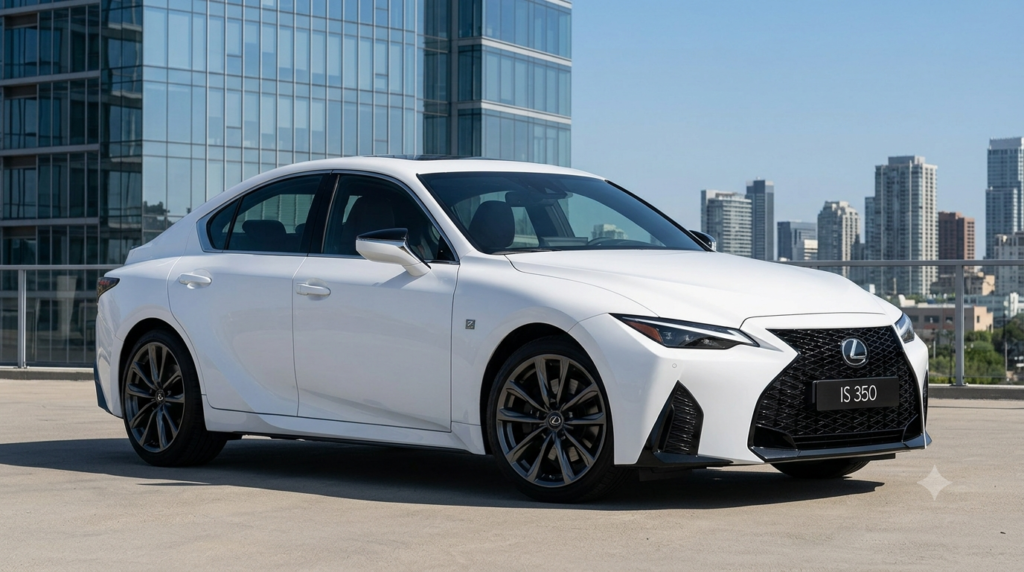
The 2026 model year brings another substantial refresh to the IS.
This is not a completely new generation.
The basic architecture is familiar.
But Lexus has used the latest update to make the car feel fresher both outside and inside.
The front fascia has been redesigned.
The lighting signature has been updated.
The grille and surrounding bodywork have been revised.
The interior receives a more modern dashboard arrangement.
The infotainment system is upgraded.
The instrument display becomes larger and more contemporary.
And the cabin gains a more coherent relationship between traditional physical controls and modern digital interfaces.
That balance is important.
A sports sedan should not force the driver to bury basic functions inside menus.
The IS continues to provide physical controls for important tasks, while its updated multimedia system brings the technology closer to what buyers expect from a modern luxury vehicle.
For 2026, a 12.3-inch Lexus Interface touchscreen is standard.
The digital environment is no longer the obvious weak point it once was.
And that changes the ownership experience significantly.
The Cabin: Where the IS 350 Starts Making Sense Every Day
The biggest mistake would be to think of the IS 350 F Sport only as a weekend toy.
It isn’t.
It is a daily luxury sedan.
That means the interior matters enormously.
You can have the best engine in the world, but if the car becomes irritating every morning, ownership eventually becomes exhausting.
The IS takes a different approach.
You sit relatively low.
The dashboard wraps around the driver.
The front seats are designed to hold you in place without turning every commute into a fitness test.
The steering wheel feels like a control instrument rather than a decorative object.
The overall environment is more cockpit-like than lounge-like.
And that’s exactly what an enthusiast wants.
The F Sport cabin also gives the driver visual reminders that this is not simply an ordinary commuter sedan.
Sport seats, specialized trim, instrumentation and steering-wheel details reinforce the theme.
But Lexus does not abandon luxury.
The cabin remains quiet.
The ride is composed.
The controls feel substantial.
The car can settle into highway cruising without constantly reminding you that it was designed for corners.
That dual personality is one of the strongest reasons to consider the IS.
It can be serious when you want it to be.
It can be comfortable when you need it to be.
Technology Without Losing the Driver
The 2026 IS benefits from a much-needed technology update.
A 12.3-inch touchscreen sits at the center of the updated multimedia experience.
Wireless Apple CarPlay and Android Auto are available, making smartphone integration much easier for everyday driving.
Wireless smartphone charging is also available.
USB-C charging ports are provided for passengers.
Depending on specification and package, buyers can also access features such as a panoramic-view monitor, parking assistance and premium Mark Levinson audio.
The Mark Levinson system is particularly interesting for buyers who intend to use the IS as a long-distance luxury sedan.
Because the best ownership experience isn’t always about driving fast.
Sometimes it is about driving home at night.
The road is empty.
The cabin is quiet.
The V6 is barely audible.
Your favorite music fills the interior.
The headlights illuminate the road ahead.
And suddenly the car stops being a collection of specifications.
It becomes your private environment.
That is what luxury should do.
The Sound of the V6
This deserves its own section.
Because sound is part of why this car exists.
The naturally aspirated V6 does not produce the explosive low-rpm punch of a turbocharged engine.
But it has something different.
It has a rising voice.
At idle, it is relatively restrained.
Open the throttle and the character changes.
The engine climbs through the rev range.
The sound becomes sharper.
The final part of the rev range is where the mechanical personality becomes most apparent.
This matters because sound changes how you perceive speed.
A car that accelerates rapidly but sounds distant can feel strangely detached.
The IS 350’s V6 provides an audible connection between your right foot and the engine.
You hear the engine working.
You hear the transmission respond.
You feel the chassis settle.
Those small interactions create the feeling of driving.
And that is precisely what many enthusiasts fear losing.
Performance: Fast Enough, But Not Obsessed With Being Fastest
Let’s address the obvious criticism.
Is the 2026 Lexus IS 350 F Sport fast?
Yes.
Is it extremely fast?
No.
The difference matters.
At roughly 5.6–5.7 seconds to 60 mph in independent testing, the IS 350 is comfortably quick for everyday driving.
It can merge onto highways without hesitation.
It can overtake confidently.
It can make a back-road drive genuinely entertaining.
But several newer competitors can accelerate significantly faster.
A modern turbocharged performance sedan may reach 60 mph more than a second earlier.
That gap is enormous on paper.
Behind the wheel, however, the Lexus creates a different experience.
The engine encourages you to participate.
The transmission asks for your attention.
The steering and chassis become more rewarding as the road gets interesting.
The car is not simply an acceleration machine.
It is a sports sedan.
And those are not always the same thing.
The Transmission Question
This is one of the most interesting aspects of the 2026 IS 350.
Rear-wheel-drive models use an eight-speed automatic.
All-wheel-drive models use a six-speed automatic.
That distinction can influence how the car feels.
The RWD configuration provides the more enthusiast-oriented mechanical package.
The eight-speed gives the engine more gearing flexibility and contributes to highway efficiency.
The AWD version sacrifices two ratios but adds traction, which can be valuable in rain, snow or poor road conditions.
For buyers in climates where traction matters, AWD is an obvious advantage.
For someone whose priority is driving involvement and traditional sports-sedan character, the RWD configuration deserves serious consideration.
There is something deeply satisfying about a rear-wheel-drive sedan with a naturally aspirated V6.
The front tires steer.
The rear tires drive.
The driver sits in the middle of the mechanical conversation.
It is an old idea.
It still works.
Handling: The IS 350’s Real Party Trick
The IS 350 does not need to be the quickest car on the road to be entertaining.
Its strength is composure.
The chassis has been developed around the concept of predictable behavior.
Turn into a corner.
The front responds.
Increase steering input.
The chassis communicates its attitude.
Apply throttle.
The car begins to rotate and accelerate out.
There is no requirement to drive at suicidal speeds to appreciate this.
In fact, that may be the entire point.
A great sports sedan should be enjoyable at legal road speeds.
It should make an ordinary interchange feel interesting.
It should make a sweeping highway curve feel like something worth noticing.
It should reward smoothness.
That is where the IS shines.
Its relatively compact dimensions help it feel manageable.
Its low roofline gives it a planted appearance.
Its suspension provides a balance between control and ride comfort.
And the F Sport treatment pushes the chassis toward the enthusiast side without turning it into an unbearable daily driver.
The Handling Package: Where Things Get Serious
For buyers who want more from the IS 350 F Sport, Lexus offers a Handling Package.
This is one of the areas where the car becomes significantly more interesting to enthusiasts.
The package can bring performance-focused suspension tuning and additional chassis equipment designed to sharpen the vehicle’s responses.
On appropriate configurations, features such as Adaptive Variable Suspension and performance-oriented differential equipment can further enhance the car’s behavior.
The important thing is not simply that the equipment exists.
It is how the equipment changes the relationship between driver and machine.
A good adaptive suspension allows the car to live two lives.
Comfort mode can make the commute tolerable.
Sport or Sport+ can tighten the experience when the road opens up.
That flexibility is crucial.
A car that is fantastic for 20 minutes on a mountain road but miserable for 300 days of commuting is not necessarily a great ownership proposition.
The Lexus attempts to give you both personalities.
The Steering: Why Feel Still Matters
Modern cars have become extraordinarily capable.
But capability and communication are different things.
The IS 350’s steering is not about creating a videogame-like sensation.
It is about predictability.
You know where the front tires are going.
You can place the car on a narrow road.
You can make small corrections without feeling disconnected.
That confidence builds progressively.
And confidence is one of the most underrated forms of performance.
The best sports cars don’t always make you feel like a professional racing driver.
They make you feel like you could become one.
The IS has that approachable character.
It does not demand perfection from you.
Instead, it rewards smooth inputs.
Braking: Strong Enough for the Real World
Braking performance is another area where the IS 350 shows its priorities.
Independent testing has produced stopping distances that are competent rather than class-leading.
Car and Driver recorded 164 feet from 70 mph to a stop in its AWD test vehicle.
MotorTrend recorded 115 feet from 60 mph in its AWD test vehicle.
Those numbers aren’t record-breaking.
But braking isn’t just a number.
Pedal feel matters.
Consistency matters.
Predictability matters.
A driver who knows exactly how much pressure to apply can extract more confidence from a car than someone staring at a specification sheet.
The IS generally feels composed under braking.
But if your primary mission is track-day performance, you should look carefully at tire and brake specifications before buying.
That is one of the areas where the IS 350’s grand-touring character becomes more obvious.
Fuel Economy: The Price of the V6
Here comes the compromise.
A naturally aspirated 3.5-liter V6 is wonderful.
But physics remains undefeated.
The IS 350 is not a fuel-economy champion.
Rear-wheel-drive models are rated around 19 mpg city and 27 mpg highway, while AWD models are rated around 19 city and 26 highway, with combined economy around 22 mpg.
That is not terrible for a 311-hp luxury sports sedan.
But it is nowhere near what a small turbocharged four-cylinder or hybrid can achieve.
This is one of the decisions you must make before buying.
Do you want maximum efficiency?
There are better options.
Do you want maximum acceleration?
There are faster options.
Do you want an increasingly rare combination of naturally aspirated power, rear-drive dynamics, luxury and reliability-focused ownership?
The IS becomes much more interesting.
The Price Changes the Argument
The 2026 Lexus IS 350 F Sport starts from a surprisingly reasonable position for a luxury performance sedan.
The U.S. manufacturer’s pricing places the IS 350 F Sport Design RWD at $46,895 including destination/processing charges as published by Lexus, while the F Sport RWD starts at $49,345.
AWD increases the entry prices to $48,895 for F Sport Design and $51,345 for F Sport.
That puts the Lexus in an interesting part of the market.
You are not buying an ultra-expensive performance sedan.
You are buying something positioned below the territory occupied by many high-output luxury cars.
And yet you receive a 311-hp V6, a luxury interior, advanced safety technology and a genuine sports-sedan chassis.
The price becomes particularly compelling when you stop comparing the Lexus only against other Lexus vehicles.
Instead, compare what else you can buy for the money.
Suddenly the IS starts looking like an enthusiast’s loophole.
F Sport Design vs F Sport
This is where buyers should slow down.
The cheaper F Sport Design is not a stripped-down embarrassment.
It is actually a well-equipped car.
For many people, it may represent the sweet spot.
The F Sport adds more of the hardware and styling associated with the enthusiast-focused version.
That can include performance-oriented suspension tuning, sport seats, additional chassis equipment and other F Sport-specific upgrades depending on configuration.
The question becomes:
How much do you care about driving involvement?
If you primarily want the appearance, luxury, V6 and daily usability, F Sport Design may be enough.
If you are buying the IS specifically because you want the most engaging version of the car, the full F Sport makes more sense.
And there is another reason.
Cars like this are increasingly about emotion.
You don’t buy an IS 350 F Sport because an accountant told you the depreciation curve is perfect.
You buy it because you walk away from it in a parking lot and turn around to look at it.
That matters.
Safety: Performance Without Anxiety
The 2026 IS comes standard with Lexus Safety System+ 3.0.
This brings a broad collection of active safety and driver-assistance functions.
Depending on operating conditions, the system can help with forward collision detection and mitigation, pedestrian detection, adaptive cruise control, lane departure assistance, automatic high beams, road-sign recognition and proactive driving assistance.
The important point is that these systems are designed to support the driver rather than replace the fundamental driving experience.
That distinction is particularly important in a sports sedan.
You want technology to reduce fatigue on a long highway journey.
You do not necessarily want the car to remove every last piece of involvement.
The IS tries to occupy that middle ground.
Living With the IS 350
Now imagine you actually own one.
Monday morning.
You walk toward the car.
The exterior still looks aggressive after sitting overnight.
You open the door.
The driver’s seat drops you into position.
The V6 starts.
No drama.
You pull out.
The suspension is composed.
The steering is light enough for normal maneuvering.
The cabin is quiet.
Traffic is terrible.
But you don’t hate the car.
That’s the first victory.
Then Friday arrives.
Work ends.
You take the long way home.
The road opens.
You switch into a sportier drive mode.
The throttle becomes more responsive.
The engine climbs through its rev range.
You take the first corner.
Then another.
And suddenly the vehicle that spent the entire week being civilized reveals another personality.
That duality is the real selling point.
The Ownership Emotion
There are two types of automotive excitement.
The first is instant.
You press the accelerator and something violent happens.
The second builds.
You learn the car.
You understand its weight.
You learn where the brakes bite.
You discover how much steering input a particular corner needs.
You learn the engine’s sweet spot.
You begin shifting manually because you know exactly when the next gear should arrive.
The car becomes familiar.
That familiarity turns into confidence.
Confidence turns into attachment.
And attachment is what creates long-term ownership satisfaction.
The IS 350 belongs to the second category.
It is not trying to impress you for five seconds.
It wants to become your car.
The Hidden World of the IS 350
There is a deeper story here.
The IS 350 exists at a strange point in automotive history.
For decades, the recipe for a sports sedan was relatively straightforward.
Six-cylinder engine.
Rear-wheel drive.
Manual or automatic transmission.
Balanced chassis.
Compact dimensions.
Luxury interior.
Today, the recipe is changing.
Performance engines are increasingly downsized and turbocharged.
Hybridization is spreading.
Full electrification is accelerating.
SUVs dominate consumer demand.
Traditional sedans are shrinking in number.
And that makes cars like the IS 350 unusual.
The IS is not technologically primitive.
It has modern driver assistance.
It has a modern infotainment interface.
It has smartphone integration.
It has sophisticated suspension tuning.
It has contemporary safety systems.
But at its heart is an engine concept that has become rare.
That contradiction is fascinating.
The car is simultaneously modern and old-school.
Why Enthusiasts May Appreciate It More Five Years From Now
There is no guarantee that the IS 350 will become a collectible.
That would be speculation.
But there is a reasonable argument that enthusiasts may increasingly appreciate naturally aspirated performance cars as their availability declines.
Think about how automotive enthusiasts look backward.
Certain cars become special not because they were the fastest when new, but because they represented the end of an era.
Manual transmissions.
Naturally aspirated engines.
Rear-wheel drive.
Hydraulic steering.
High-revving engines.
Mechanical differentials.
The IS 350 does not preserve every one of those things.
But it preserves enough of the formula to make it interesting.
That could matter later.
Not because you should buy one as an investment.
But because you may appreciate owning a machine that represents a transition in automotive history.
What the IS 350 Does Better Than You Might Expect
1. It balances comfort and performance
The IS does not force you to choose between a sports sedan and a luxury sedan.
It gives you a credible version of both.
2. The V6 feels special
A naturally aspirated 3.5-liter V6 is increasingly unusual.
Its response and sound are part of the ownership experience.
3. The design has presence
The IS remains visually distinctive without needing enormous dimensions.
4. It has a genuine enthusiast configuration
Rear-wheel drive, the V6 and the F Sport chassis create a combination that enthusiasts can appreciate.
5. Lexus ownership carries a different philosophy
The brand emphasizes refinement, durability and long-term ownership rather than constantly chasing maximum performance.
For some buyers, that matters more than another half-second in a 0–60 test.
What It Does Not Do Well
A serious review should not become an advertisement.
The IS 350 has weaknesses.
And some are significant.
It is not class-leading in acceleration
Several competitors are substantially quicker.
If your primary objective is straight-line performance, shop elsewhere.
The AWD transmission is only six-speed
That is an unusual choice in a segment where eight-speed and even more advanced transmissions are common.
Fuel economy is mediocre
The V6 has a price at the pump.
Rear-seat space is not its strength
The IS is a compact sedan, and its dimensions show.
Adults who frequently occupy the rear seats may want a larger vehicle.
Trunk capacity is modest
With roughly 11 cubic feet of cargo volume, it is not the vehicle for someone who prioritizes maximum practicality.
Technology is improved, but the car is not an electronics showcase
The updated interface is much better, but buyers chasing the most futuristic cabin may prefer newer competitors.
The platform is aging
The current IS architecture has been around for many years.
That can be a disadvantage if you want the newest possible engineering.
But it can also be an advantage if you value a mature, thoroughly developed platform.
The BMW 3 Series Question
Any IS 350 discussion eventually reaches BMW.
The 3 Series remains one of the benchmarks for the compact luxury sports sedan.
BMW offers sharper acceleration, advanced powertrains and sophisticated chassis technology.
Depending on configuration, it can also provide a more modern performance envelope.
So why buy the Lexus?
Because the Lexus has a different personality.
The BMW increasingly feels like a precision instrument.
The Lexus feels like a mechanical companion.
That is not an objective superiority claim.
It is a character difference.
If you want maximum performance, BMW deserves serious consideration.
If you want a more relaxed luxury experience with a naturally aspirated V6 and traditional Lexus ownership philosophy, the IS becomes compelling.
The Cadillac CT4 Question
The Cadillac CT4 is another important comparison.
The CT4 has strong chassis dynamics and an enthusiast-oriented personality.
The higher-performance CT4-V and CT4-V Blackwing occupy an entirely different performance universe.
But the CT4 story is also changing as Cadillac’s sedan lineup evolves.
That gives the Lexus an interesting position.
It is not simply another compact sedan.
It is one of the increasingly small group of conventional luxury sport sedans still offering a naturally aspirated V6.
The Genesis G70 Question
The Genesis G70 is arguably one of the strongest alternatives for buyers seeking performance and luxury.
Its available twin-turbo V6 provides significantly more power than the Lexus.
It can feel more explosive.
Its cabin also offers an appealing combination of technology and premium materials.
So why choose the IS?
Again, character.
The Lexus gives you linear power delivery and a mature chassis.
The Genesis delivers turbocharged aggression.
One feels like a classic sports sedan evolving carefully.
The other feels like a newer competitor attacking the segment.
Both approaches are valid.
The Mercedes-Benz and Audi Alternatives
Mercedes-Benz and Audi take yet another approach.
Their compact luxury sedans increasingly emphasize technology, efficiency, all-wheel-drive capability and modern turbocharged powertrains.
For buyers who prioritize a futuristic cabin, the newest electronic systems and rapid acceleration, these cars may be more attractive.
But if you are someone who walks into a showroom and immediately asks:
“Which one still has a naturally aspirated six-cylinder?”
The answer becomes very simple.
The Lexus.
The Question Nobody Asks: What Happens at 70 mph?
This is where the IS 350 makes sense.
Imagine a 400-mile road trip.
You are not launching the car every five minutes.
You are cruising.
Passing trucks.
Changing lanes.
Listening to music.
Driving through long sweeping curves.
The IS’s quiet cabin and composed suspension become more important than its 0–60 number.
This is where luxury sports sedans earn their money.
The ability to be relaxing without becoming boring.
The IS does that unusually well.
It can spend hours being a comfortable highway companion and then transform into something much more engaging when the road becomes interesting.
That is a difficult balance.
The Emotional Calculation
Buying a car is rarely a purely rational decision.
If it were, most people would drive the same three models.
We buy cars because they say something about us.
A giant SUV says something.
A luxury EV says something.
A sports coupe says something.
The IS 350 F Sport says something different.
It says:
I still care about driving.
Not necessarily about being the fastest.
Not necessarily about showing off.
Not necessarily about having the newest technology.
But about the physical experience of controlling a machine.
That identity is powerful.
And Lexus understands it.
Who Should Buy the 2026 Lexus IS 350 F Sport?
The ideal IS 350 buyer is someone who wants a daily luxury sedan but refuses to give up driving enjoyment.
You probably want:
- A naturally aspirated engine
- A luxury interior
- Sport-sedan handling
- Rear-wheel-drive availability
- A relatively compact exterior
- Strong long-distance comfort
- Modern safety technology
- Smartphone integration
- A distinctive design
- A more traditional mechanical experience
If those things sound appealing, the IS deserves a test drive.
Who Should Not Buy It?
You should probably look elsewhere if your priority is:
- The quickest 0–60 time
- Maximum rear-seat space
- Maximum cargo capacity
- Best fuel economy
- Cutting-edge electric performance
- The newest vehicle architecture
- A highly digital luxury experience
- Track-focused performance straight from the factory
There are better choices for those priorities.
And that’s okay.
The IS does not need to be everything.
Its strength is knowing what it wants to be.
The Best Configuration?
For an enthusiast, the rear-wheel-drive IS 350 F Sport is arguably the most emotionally compelling configuration.
You get the 311-hp V6.
You get rear-wheel drive.
You get the eight-speed automatic.
And you get the traditional sports-sedan layout.
For buyers who live somewhere with difficult weather or simply prioritize all-weather traction, AWD makes more sense.
But AWD comes with the six-speed automatic and slightly worse highway fuel economy.
The right decision therefore depends less on what the internet tells you and more on where and how you drive.
If you live in a warm, dry climate and love driving, test the RWD version first.
If you routinely encounter rain, snow or poor traction, test AWD.
The car’s character changes subtly between them.
The 2026 Special Appearance Package
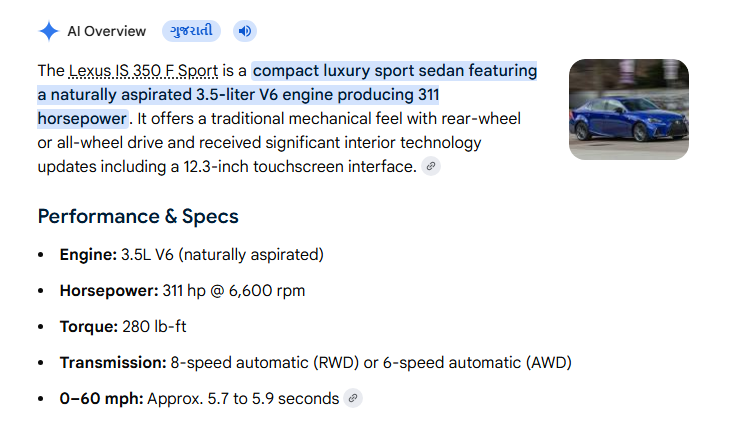
Lexus also offers a limited Special Appearance Package for the IS 350 F Sport.
Only 350 units are allocated for North America.
The package combines a distinctive Hakugin Matte White exterior with a White and Black interior.
It also includes black BBS forged wheels, triple-beam LED headlights and a moonroof.
The package brings additional equipment, including the Handling Package, Mark Levinson audio, parking technology, panoramic-view monitoring and other upgrades.
This is the version aimed directly at the buyer who wants something more exclusive.
But there is an important lesson here.
Do not buy it simply because it is limited.
Buy it if you genuinely love the specification.
Scarcity is only valuable when the underlying product matters to you.
The Lexus Reliability Argument
Reliability is one of the reasons Lexus attracts a different kind of buyer.
The IS’s powertrain is not an experimental arrangement.
The 3.5-liter V6 is a mature design.
The platform has been developed for years.
The transmission technologies are established.
That maturity can be comforting.
There is a psychological difference between buying a vehicle that has just entered its first production year and buying a platform that has already been refined over a long period.
That does not mean the IS is immune from problems.
No car is.
But the mature architecture contributes to its appeal.
For an owner planning to keep a car for many years, that matters.
The Final Verdict
So, is the 2026 Lexus IS 350 F Sport worth buying?
The answer depends on what you expect a sports sedan to accomplish.
If your definition of performance is simply:
“How quickly does it reach 60 mph?”
The IS 350 is not the winner.
If your definition is:
“How much technology does it have?”
Again, it is not the obvious winner.
If your definition is:
“How much space do I get?”
There are better options.
But if your definition of a great car is:
“Does it make me want to drive?”
The answer becomes much more interesting.
The 2026 IS 350 F Sport feels like a vehicle from an automotive world that is slowly disappearing.
A world where the engine matters.
Where the sound of an engine climbing toward redline matters.
Where rear-wheel drive still has emotional significance.
Where a sedan can be both a luxury car and an enthusiast machine.
Where you can leave work on Friday evening, take the long route home and suddenly remember why you enjoy cars.
That is the IS 350’s real achievement.
It does not need to be the fastest.
It does not need to dominate a specification sheet.
It does not need to win every comparison test.
It simply needs to make you care.
And it does.
Future-Pacing the Owner
Picture yourself six months after buying one.
The novelty has disappeared.
The salesman has stopped calling.
The protective plastic is long gone.
The odometer has moved.
And yet, one evening, you walk across a parking lot and see the IS sitting under the lights.
You stop.
You look back.
The low roof.
The sharp front end.
The muscular stance.
The F Sport wheels.
You unlock it.
You sit down.
Your hands fall naturally onto the steering wheel.
You start the V6.
The engine settles.
You pull away.
Nothing spectacular happens.
And that’s exactly the point.
You don’t need a spectacle every time you drive.
You need a machine you enjoy returning to.
The road opens.
You press the accelerator.
The V6 climbs.
The transmission responds.
The chassis settles into the corner.
You exit the bend.
And for a few seconds, the noise of everything else disappears.
That is what the Lexus IS 350 F Sport is selling.
Not merely horsepower.
Not merely luxury.
Not merely transportation.
A relationship with driving.
Bottom Line
The 2026 Lexus IS 350 F Sport is a fascinating contradiction.
It is an aging platform with a fresh face.
It is a modern luxury car with an old-school engine.
It is quick without being brutally fast.
It is sporty without becoming unbearable.
It is technologically updated without becoming entirely digital.
It is luxurious without forgetting the driver.
And most importantly, it is still a proper compact sports sedan at a time when the market is increasingly moving elsewhere.
The 311-hp naturally aspirated V6 will not win every acceleration contest.
The interior will not have the largest rear seat.
The fuel economy will not impress hybrid buyers.
The chassis will not satisfy someone searching for a dedicated track weapon.
But for someone who wants a distinctive, comfortable, naturally aspirated V6 sports sedan that can be enjoyed every day, the 2026 Lexus IS 350 F Sport has something increasingly rare:
character.
And character is one specification that never appears on a window sticker.
2026 Lexus IS 350 F Sport — Quick Scorecard
Engine: ★★★★★
Driving character: ★★★★★
Ride comfort: ★★★★½
Interior: ★★★★
Technology: ★★★★
Fuel economy: ★★★
Straight-line performance: ★★★½
Handling: ★★★★
Daily usability: ★★★★
Uniqueness: ★★★★★
Emotional appeal: ★★★★★
Overall: ★★★★½
The 2026 Lexus IS 350 F Sport isn’t the car for everyone.
That may be precisely why it is worth paying attention to.
In an automotive landscape increasingly dominated by electrification, turbocharging and SUVs, Lexus has kept one door open to the old world.
Behind that door is a naturally aspirated V6.
And for those who still believe the journey should be part of the destination, that may be enough.
A youtube video:
Pinterest:
an useful image:

Linkedin -- www.linkedin.com/in/shishir-bhargava-68a8b4257
- What Would The Batman 2 Story Look Like If Steven Soderbergh Directed It? - October 16, 2026
- How to Organize Digital Receipts and Warranties | A Practical System That Works - October 11, 2026
- How to Live Without AI | 30-Day Experiment Taught Me to Think Again - October 8, 2026
⚠️ Most People Discover Trends When It's Too Late
Join the Trends Goldmine Insider List and get emerging AI tools, future products, viral keywords, and hidden opportunities before they hit the mainstream.
While everyone else is chasing yesterday's trends, you'll be spotting tomorrow's opportunities first.
🚀 Free Weekly Trend Alerts • No Spam • Unsubscribe Anytime
SIGN UP NOW & RECEIVE A SHORT REPORT ON HOW TO MAKE FORTUNE WITH TRENDS.Trusted by readers who want to discover opportunities before the crowd.