
The Story Begins…
There are software updates that are massive… and then there are software updates that quietly change the way your iPhone protects, performs, and serves you every single day.
If you’re staring at the “Download and Install iOS 26.5.2” button right now, you’re probably wondering the same thing millions of iPhone users ask every time Apple releases a new version:
- Should I install it immediately?
- Is it actually worth updating?
- Will it improve my iPhone—or make it worse?
- Could it affect battery life?
- What isn’t Apple telling me?
Those questions are valid.
Because updating your iPhone isn’t just about getting the latest version of iOS. It’s about trusting your most personal device—one that stores your photos, passwords, banking apps, conversations, records, work documents, and years of memories—to software you haven’t experienced yet.
That’s why this guide exists.
Instead of repeating Apple’s release notes or filling pages with technical jargon, this article takes a different approach.
You’ll discover what really matters before installing iOS 26.5.2, why experienced iPhone users don’t blindly install every update the second it appears, what hidden changes often arrive without much attention, and how to decide whether updating today—or waiting a little longer—is the smartest choice for your specific iPhone.
Let’s begin.
Every iPhone User Has Experienced This Feeling.
Now, I want you to imagine this situation.
Your phone vibrates.
A notification appears.
“A new iOS update is available.”
Immediately, dozens of thoughts begin racing through your mind like F1 race each trying to compete for creating impact.
Maybe the update makes your phone faster.
Maybe it drains battery.
Maybe it introduces amazing improvements.
Maybe your favorite app suddenly behaves differently.
Perhaps you’ve experienced this before.
Your iPhone worked perfectly yesterday.
You updated.
Then suddenly…
Battery life seemed different.
Apps felt unfamiliar.
Settings moved.
Features changed.
Even if the update eventually turned out fine, those first few days created uncertainty.
That uncertainty is exactly why millions of people search Google before installing an update.
They aren’t simply looking for release notes.
They’re looking for confidence.
They want someone who’s already explored the update to answer the questions Apple doesn’t always answer directly.
The Hidden Side of Every iOS Update
Here’s something most people never think about. And I want to highlight you this point.
Every iOS update contains two versions. I think you are ignorant about it.
The version Apple announces…
…and the version users slowly discover.
The announced version includes:
- Security improvements
- Performance enhancements
- Bug fixes
- Stability improvements
But the discovered version is different.
Users begin noticing things Apple never highlighted.
Perhaps animations feel smoother.
Battery behavior changes after several charging cycles.
Certain settings move.
Background processes work differently.
App compatibility improves.
Camera processing feels subtly different.
These aren’t necessarily secret features.
They’re simply changes that only become obvious after millions of people begin using the software in real life.
That’s why experienced iPhone owners don’t rely on release notes alone.
They observe.
They compare.
They wait for broader feedback.
And then they decide.
Why This Update Matters More Than Most People Think
Many people assume smaller updates aren’t important. But the great question I assume is Why?
After all…
They’re not introducing an entirely new version of iOS.
No dramatic redesign.
No revolutionary feature.
No flashy keynote presentation.
So they ignore it.
Ironically, that’s exactly why smaller updates deserve attention.
Major yearly updates focus on exciting features.
Smaller updates often focus on something even more valuable:
Reliability.
Performance consistency.
Security.
System optimization.
Long-term stability.
These improvements rarely create headlines.
But they quietly influence how your iPhone behaves every single day.
I will cite you a example here which will help you to gain enough clarity.
Imagine driving the same car.
One version has slightly better brakes.
A more reliable engine.
Improved steering.
More efficient fuel usage.
Nothing looks different.
Yet every drive feels better.
Software updates often work the same way.
What Apple Doesn’t Usually Explain
Apple keeps release notes intentionally concise.
You’ll often see phrases like:
- Bug fixes
- Performance improvements
- Security updates
- Recommended for all users
Those descriptions are technically accurate.
But they don’t explain the experience.
They don’t answer questions like:
“What will I actually notice?”
“Will my iPhone feel different?”
“Should I update today or wait?”
“Does this matter if everything already works?”
That’s where understanding the purpose of maintenance updates becomes important.
Apple isn’t simply fixing visible issues.
They’re continuously strengthening the operating system against newly discovered security vulnerabilities while improving overall system reliability.
Some improvements happen entirely behind the scenes.
You never notice them.
Until one day they protect you from something you never even knew existed.
The real risk is not always you think
Many users worry about updating. This worry creates a obstacle in experiencing the ios 26.5.2
And the other part is Very few worry about not updating.
That’s interesting.
Really, I think that is amazing
Because outdated software creates its own risks.
Every month, security researchers discover new vulnerabilities affecting phones, computers and connected devices.
Technology evolves.
Threats evolve.
Software evolves.
Keeping software current isn’t only about getting new features.
It’s also about reducing exposure to newly discovered security weaknesses.
For most users, these protections remain invisible.
Which is exactly how security should work.
When everything functions correctly, you rarely notice what’s happening behind the scenes.
There’s More Happening Than You Can See
Think about your iPhone for a moment.
Every day it quietly manages thousands of operations.
Face ID authenticates your identity.
Passwords synchronize securely.
Photos process using machine learning.
Apps communicate with Apple’s services.
Wi-Fi connections establish automatically.
Private data remains encrypted.
Background tasks optimize battery life.
Notifications arrive instantly.
All of that depends on software.
Even tiny improvements inside the operating system can create a noticeably smoother experience over time.
Not because of one dramatic feature…
But because hundreds of tiny refinements accumulate together.
Experienced iPhone Users Think Differently
Watch someone who has used iPhones for many years.
They rarely panic when a new update appears.
Nor do they install it blindly within the first minute.
Instead, they ask better questions.
Questions like:
- Is this primarily a security release?
- Is my current version stable?
- Do I rely on mission-critical apps?
- Has Apple addressed known vulnerabilities?
- Are early users reporting positive experiences?
Notice something.
They’re not emotional.
They’re informed.
That’s the mindset worth adopting.
Because software updates aren’t competitions.
There’s no prize for updating first.
Nor is there an award for waiting forever.
The smartest decision is simply the informed one.
The Identity Shift: Becoming the Kind of User Who Stays Ahead
Technology changes quickly. And it can rise and fall quickly.
But confidence doesn’t come from knowing everything.
It comes from knowing what matters.
People who consistently enjoy reliable iPhones usually have one habit in common.
They stay informed before acting. They make informed decisions.
Instead of chasing rumors…
Instead of reacting to social media headlines…
Instead of believing random comments…
They seek trustworthy information.
Then they make their decision.
That single habit separates confident users from frustrated ones.
And over the lifetime of an iPhone, that habit pays off again and again.
Imagine Six Months From Now
Picture yourself using your iPhone months after today.
Everything feels responsive.
Your apps remain compatible.
Security protections stay current.
Performance feels consistent.
You’re not constantly wondering whether you’re missing important updates.
There’s peace of mind in knowing your device is maintained responsibly.
That’s what regular, informed updating is really about.
Not excitement.
Not fear.
Confidence.
And confidence is surprisingly valuable in a device we rely on every hour of every day.
So… Should You Install iOS 26.5.2?
The answer isn’t simply “yes.”
Nor is it automatically “wait.”
The better answer depends on three things:
- Which iPhone you own.
- How critical your daily apps are.
- Whether this release primarily addresses security and stability.
For most users, Apple’s maintenance updates are designed to improve the overall experience rather than fundamentally change it. Understanding what the update contains—and checking for any early reports on compatibility with apps you depend on—helps you make the right decision instead of reacting to speculation.
What iOS 26.5.2 Actually Changes — And Why It Matters More Than You Think
At first glance, iOS 26.5.2 doesn’t look exciting. It’s sounds boring.
There are no flashy wallpapers.
No redesigned Control Center.
No headline-grabbing AI feature.
No major camera overhaul.
In fact, Apple’s official release notes are only one sentence long:
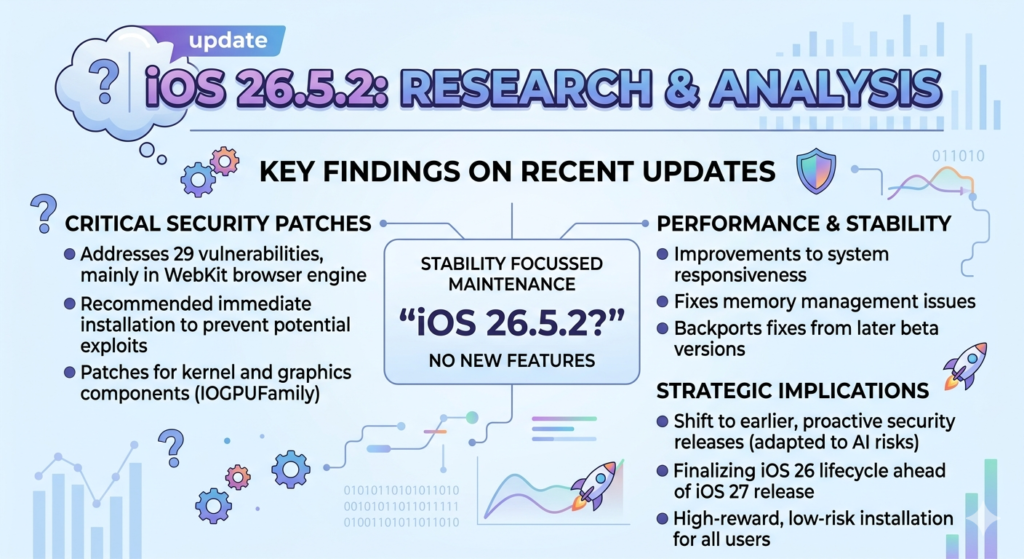
“This update provides security fixes for your iPhone.”
That’s it.
For many people, that sounds like an easy update to ignore.
But here’s what that short sentence doesn’t tell you.
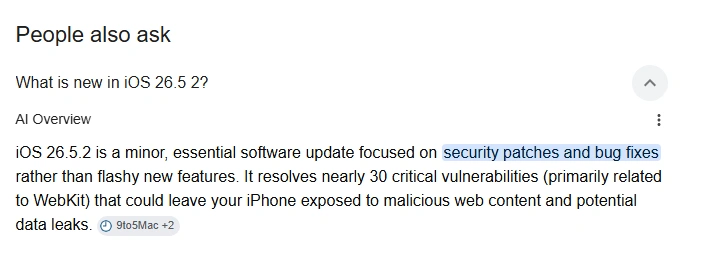
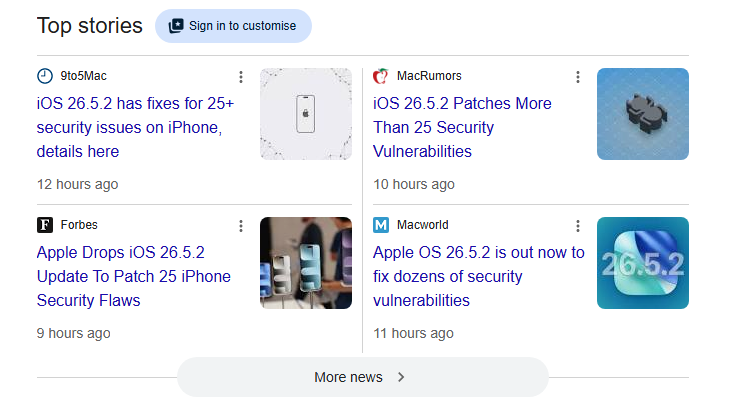
Behind the scenes, iOS 26.5.2 patches more than 25 security vulnerabilities, many involving WebKit (the engine behind Safari and other web content), the iOS kernel, graphics processing, and system memory handling. Apple moved these fixes into iOS 26.5.2 earlier than originally planned instead of waiting for iOS 26.6, shortening the time users remained exposed after the vulnerabilities became known.
That decision alone tells us something important.
Something very crucial that cannot be ignored,
Apple considered these fixes important enough that waiting another few weeks wasn’t the best option.
This Isn’t a Feature Update. It’s a Trust Update.
Many people judge updates by one question:
“What new features do I get?”
That’s understandable and very well justified.
New features are visible.
Security isn’t.
Imagine two houses.
One gets a fresh coat of paint.
The other gets stronger locks, reinforced windows, and a better alarm system.
From the street, the painted house looks more impressive.
But which one is actually safer?
Software works the same way.
The most valuable updates often improve the parts you never notice—until something goes wrong.
Why Apple Released These Security Fixes Early
Normally, security improvements introduced during beta testing become available to everyone when the next public release arrives.
This time, Apple changed course.
According to reports, the company accelerated the release because AI tools are making it easier and faster for attackers to study newly disclosed software weaknesses. By releasing patches sooner, Apple reduces the window in which malicious actors could potentially develop exploits based on publicly known vulnerabilities. Apple also stated it had no evidence these specific flaws were being actively exploited before the release.
That’s a subtle but significant shift.
It shows that software security is changing.
Updates aren’t only about fixing yesterday’s issues.
They’re increasingly about staying ahead of tomorrow’s threats.
What Do These Security Fixes Actually Mean?
If you’ve looked at Apple’s security documentation before, you’ve probably seen terms like:
- Kernel
- WebKit
- Race condition
- Memory corruption
- Input sanitization
- CVE identifiers
To most users…
Those words mean absolutely nothing.
Let’s simplify them.
Imagine your iPhone is a modern city.
The kernel is city hall.
Everything important passes through it.
The WebKit engine is the highway connecting your phone to websites.
Graphics components control how visual information is processed.
When Apple patches these systems, it’s reinforcing the foundations of the operating system—not just repainting the walls.
Most users won’t notice any visible difference.
And that’s exactly the point.
A successful security update is often invisible.
Does iOS 26.5.2 Make Your iPhone Faster?
This is probably the most searched question after every iOS release.
The honest answer?
Don’t expect dramatic performance improvements simply because you installed iOS 26.5.2.
Apple hasn’t advertised any performance enhancements as part of this release. Its focus is security.
However…
Many users report that their devices feel smoother after maintenance updates.
Why?
Several reasons.
Sometimes background processes are optimized.
Sometimes system resources are managed more efficiently.
Sometimes software inconsistencies disappear after restarting and completing post-update indexing.
But these experiences vary from one device to another.
If someone promises that iOS 26.5.2 will make every iPhone dramatically faster, they’re making a claim that Apple itself hasn’t made.
What About Battery Life?
Battery life is the topic that dominates every iOS discussion.
It’s also one of the most misunderstood.
Here’s what usually happens after an update.
For the first day or two, your iPhone may perform background tasks such as:
- Re-indexing photos
- Optimizing Spotlight search
- Updating machine learning models
- Syncing iCloud content
- Completing app maintenance
During that period, battery usage can temporarily appear higher than normal.
That doesn’t necessarily mean the update reduced battery life.
It means your phone is still settling into the new software.
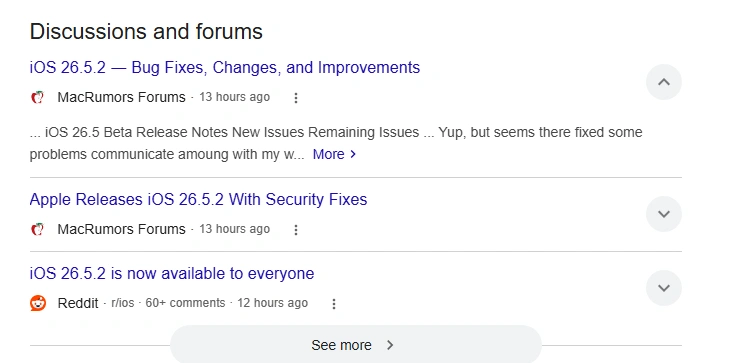
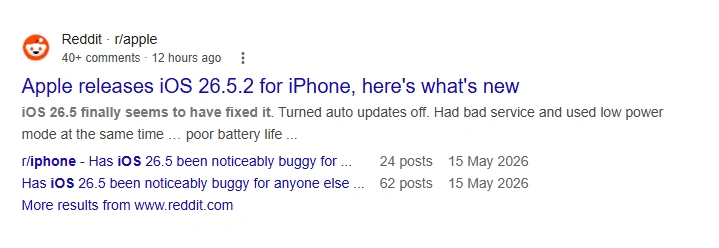
Community reports for iOS 26.5.2 are mixed—as is typical immediately after release. Some users say battery life feels unchanged, while others report improvements or temporary concerns. Early anecdotal reports shouldn’t be treated as definitive evidence because they depend on device models, battery health, installed apps, and individual usage patterns.
The best advice?
Evaluate battery performance after several days, not several hours.
The Biggest Mistake People Make Before Updating
Ironically…
It has nothing to do with the update itself.
It’s failing to prepare.
People tap “Install Now” without asking:
- Do I have enough storage?
- Is my iPhone backed up?
- Am I on reliable Wi-Fi?
- Is my battery charged?
- Do I remember my Apple Account password if verification is needed?
The update isn’t usually what causes stress.
Poor preparation is.
A Five-Minute Checklist Before Installing
Before updating, spend just a few minutes checking these basics:
✅ Back up your iPhone to iCloud or a computer.
✅ Ensure you have sufficient free storage.
✅ Connect to a stable Wi-Fi network.
✅ Charge your battery or keep the phone plugged in.
✅ Update critical apps from the App Store if updates are available.
✅ If you rely on banking, business, or authentication apps, it’s worth checking whether the developer has reported any compatibility notices.
These simple steps dramatically reduce the chances of an inconvenient surprise.
Who Should Install iOS 26.5.2 Right Away?
For most users, installing sooner rather than later makes sense if:
- You use your iPhone daily for personal or work communication.
- You want the latest security protections.
- Your device is already running iOS 26.
- You don’t depend on highly specialized enterprise software that requires certification before OS updates.
Since this release is centered on security rather than major interface changes, it’s generally lower risk than a large annual upgrade.
Who Might Wait a Few Days?
There are situations where waiting briefly is reasonable.
For example:
- Your iPhone is mission-critical for your business.
- You depend on niche professional apps.
- Your organization manages devices through enterprise software.
- You’re waiting for confirmation from your IT department.
Waiting a short period to verify compatibility is different from avoiding updates indefinitely.
The goal is informed timing—not unnecessary delay.
The Hidden Benefit Nobody Talks About
Most people judge an update by what changes immediately.
Experienced users judge it by what doesn’t happen afterward.
No unexpected security incidents.
No compatibility gaps caused by running outdated software.
No missed protection against vulnerabilities that have already been fixed.
That’s the quiet value of a maintenance release like iOS 26.5.2.
It isn’t designed to impress you.
It’s designed to protect you.
And sometimes, the best technology is the technology you never have to think about.
Should You Install iOS 26.5.2 Right Now or Wait? The Answer Isn’t the Same for Everyone
Every time Apple releases an iOS update, two camps emerge almost instantly.
The first group updates within minutes.
The second group refuses to install anything until weeks—or even months—later.
Who’s right? The question has now a very fixed deal.
Surprisingly…
Both can be.
The smartest decision isn’t based on fear, hype, or social media opinions.
It’s based on how you use your iPhone.
If your iPhone is simply a phone, your priorities are different from someone who relies on it for work, content creation, banking, travel, or managing a business.
Instead of asking, “Should everyone install iOS 26.5.2?”, ask a better question:
“Is installing iOS 26.5.2 the right decision for me today?”
That’s a much more useful conversation.
Think about what happens when a new update appears.
Some people immediately search:
- Is iOS 26.5.2 safe?
- Should I install iOS 26.5.2?
- Battery life after iOS 26.5.2
- iOS 26.5.2 review
- Any problems with iOS 26.5.2?
Notice something?
They’re not searching because something is wrong.
They’re searching because they don’t want something to go wrong.
That’s an important difference.
Most people aren’t looking for excitement.
They’re looking for reassurance.
They want someone to answer the questions Apple can’t answer for every individual user.
Why Internet Opinions Can Be Misleading
Here’s something many people don’t realize.
A software update is experienced differently depending on:
- Your iPhone model
- Battery health
- Available storage
- Number of installed apps
- Background activity
- Network conditions
- Personal usage habits
Two people can install the exact same update.
One says:
“Everything feels smoother.”
Another says:
“Battery seems worse.”
A third notices absolutely nothing.
Who’s correct?
Potentially all three.
That’s why reading one Reddit post, one YouTube comment, or one tweet should never be the basis for your decision.
Look for patterns, not isolated opinions.
The Myth of the “Perfect” Update
Many users keep waiting for the perfect update.
The one where:
- Battery becomes amazing.
- Performance dramatically improves.
- Every bug disappears.
- Nothing changes unexpectedly.
The truth?
That update doesn’t exist.
Software is incredibly complex.
Apple develops iOS for hundreds of millions of devices used in completely different ways.
An update that’s fantastic for one user may feel completely neutral for another.
The goal isn’t perfection.
It’s continuous improvement.
The Hidden Cost of Waiting Too Long
There’s another side to this conversation.
People often discuss the risks of updating.
Far fewer discuss the risks of not updating.
Imagine locking your front door every night.
One day, the lock manufacturer says:
“We’ve discovered a weakness. Here’s a stronger lock.”
Would you ignore it simply because your current lock still works?
Probably not.
Software security works similarly.
Many updates aren’t about fixing something you’ve already noticed.
They’re about preventing something you hopefully never experience.
Apple’s security releases are designed with that philosophy in mind.
The value isn’t always visible.
But it’s real.
What Power Users Usually Do
People who understand technology well often follow a simple strategy.
They don’t update blindly.
But they also don’t avoid updates forever.
Instead, they wait just long enough to answer a few practical questions:
- Has Apple published the security details?
- Are major apps working normally?
- Are there widespread reports of serious issues?
- Is this a feature release or a maintenance release?
Once those questions are answered, they update with confidence.
Notice what’s missing from that process?
Panic.
The Battery Anxiety Everyone Shares
Let’s talk honestly about battery life.
Every iPhone user has looked at the battery percentage and wondered:
“Is it dropping faster?”
Sometimes it is.
Sometimes it isn’t.
Human search plays a role too.
When you expect a problem, you notice every percentage point.
A battery dropping from 100% to 97% suddenly feels dramatic.
The same drop before the update probably went unnoticed.
This doesn’t mean battery concerns are imaginary.
It simply means early impressions aren’t always reliable.
The best way to evaluate battery life is:
- Use your phone normally.
- Wait several charging cycles.
- Compare typical daily usage—not isolated moments.
That approach gives you a much clearer picture than checking battery percentage every few minutes.
Storage: The Overlooked Factor
Many people blame updates for making their phones feel sluggish.
Sometimes the real issue is storage.
An iPhone with very little free space has less room for temporary files, indexing, and routine system operations.
Before installing iOS 26.5.2, check your available storage.
Deleting unused apps, duplicate photos, or old downloads can often improve the overall experience regardless of the update.
It’s one of the simplest forms of iPhone maintenance—and one of the most effective.
Why Some Users Think Updates “Slow Down” Older iPhones
This is one of the internet’s longest-running debates.
Here’s the reality.
As operating systems evolve, they support newer hardware capabilities while continuing to work on older devices.
Older iPhones naturally have less processing power and memory than the latest models.
So when new software arrives, the experience may differ across generations.
That doesn’t necessarily mean Apple intentionally slowed your phone.
It often reflects the normal balance between maintaining compatibility and introducing modern capabilities.
If your iPhone is several years old, realistic expectations are important.
A security-focused update like iOS 26.5.2 is less likely to transform performance than a new device would be.
The Quiet Confidence of Being Prepared
Imagine two iPhone users.
The first taps “Install” immediately without checking anything.
The second spends five minutes preparing:
- A fresh backup.
- Enough storage.
- A charger nearby.
- Stable Wi-Fi.
- Updated apps.
Both install the same software.
Who feels more confident?
Preparation doesn’t just reduce technical risk.
It reduces stress.
And that’s often overlooked.
A Story That Happens Every Year
Meet Daniel.
He’s not a tech expert.
He uses his iPhone for everything:
- Banking
- Family photos
- Work email
- Navigation
- Two-factor authentication
- Health tracking
Every update makes him nervous.
One year, he ignored updates for months because of alarming headlines.
Eventually, one of his banking apps required a newer version of iOS.
Now he had no choice.
Instead of one small update, he faced several.
The process took longer.
He worried more.
He spent hours reading conflicting opinions online.
The lesson?
Avoiding updates didn’t make life simpler.
It made updating feel more intimidating.
The following year, Daniel adopted a different approach.
He read Apple’s release notes.
Checked trusted technology publications.
Backed up his phone.
Installed updates within a reasonable timeframe.
The experience became routine instead of stressful.
Nothing dramatic happened.
And that’s exactly what he wanted.
Imagine Yourself One Year From Now
Picture your future self.
Your iPhone is current.
Apps continue to work smoothly.
Security protections are up to date.
You’re not wondering whether you’ve missed an important patch.
You’re not rushing through multiple overdue updates before an important trip.
You’re simply using your device with confidence.
That peace of mind isn’t created by one update.
It’s created by a habit.
A habit of staying informed.
Preparing properly.
And making decisions based on facts—not fear.
The Vehicle: A Smarter Way to Approach Every iOS Update
By now, one thing should be clear.
The goal isn’t to install every update immediately.
Nor is it to avoid updates indefinitely.
The real “vehicle”—the method that consistently leads to the best experience—is a simple three-step approach:
- Understand what the update is for.
- Prepare your device before installing.
- Make your decision using trusted information, not internet noise.
That process works not just for iOS 26.5.2, but for every future update Apple releases.
It’s a strategy you can rely on.
Not because it’s complicated.
Because it’s consistent.
Before You Tap “Install” — The Complete iOS 26.5.2 Preparation Guide
By now, you’ve probably realized something important.
Do let know your comments how it is going till now.
Installing iOS 26.5.2 isn’t simply about downloading a software update.
It’s about preparing one of the most personal devices you own for a new version of the operating system.
Your iPhone isn’t just a phone anymore.
It’s your camera.
Your wallet.
Your password manager.
Your navigation system.
Your work computer.
Your entertainment center.
Your health tracker.
Your connection to family and friends.
That’s exactly why taking five or ten minutes to prepare before installing an update can save you hours of frustration later.
The good news?
Preparing your iPhone is much easier than most people think.
Let’s walk through it step by step.
Step 1: Back Up Your iPhone First
If there is one piece of advice you should never ignore before installing any major or minor iOS update, it’s this:
Always create a recent backup.
Will something go wrong?
Probably not.
Apple’s update process is designed to be reliable.
But backups aren’t created because problems are expected.
They’re created because your data is valuable.
A recent backup means your photos, messages, app data, notes, contacts, and settings have a recovery point if you ever need it.
Think of it like insurance.
You hope you’ll never need it.
But you’re always glad it’s there.
Step 2: Check Available Storage
One of the most common reasons updates become frustrating has nothing to do with the update itself.
It’s storage.
If your iPhone is nearly full, the operating system has less room to work during installation.
Take a few minutes to review what’s consuming space.
You may discover:
- Apps you haven’t opened in months
- Duplicate photos
- Old videos
- Downloaded files
- Offline media you no longer need
Freeing up even a few gigabytes can make your iPhone feel healthier overall—not just during the update process.
Step 3: Charge Your Battery
Apple generally requires your iPhone to have sufficient battery power before installing an update.
The safest approach is simple:
- Plug your iPhone into a charger.
- Connect to a reliable Wi-Fi network.
- Let the installation complete without interruption.
Avoid starting an update when you’re about to leave the house or when your battery is running low.
Patience is part of the process.
Step 4: Update Your Apps
Many people update iOS while forgetting the apps they use every day.
Developers frequently release updates that improve compatibility with the latest version of iOS.
Before installing iOS 26.5.2, open the App Store and check for pending updates.
This small step helps ensure your favorite apps are ready for the latest software.
Step 5: Know Your Apple Account Credentials
Most users stay signed in for months—or even years.
That means it’s easy to forget your Apple Account password until you suddenly need it.
Before updating, make sure you can access your Apple Account if verification is required.
It only takes a minute to confirm, and it can prevent unnecessary stress later.
What Happens During the Update?
If you’ve never paid close attention to the installation process, here’s a simplified overview.
Your iPhone:
- Downloads the update package.
- Verifies its integrity.
- Restarts.
- Installs the new operating system.
- Optimizes system files.
- Rebuilds certain indexes in the background.
- Returns to normal operation.
Even after you see the Home Screen again, your iPhone may continue background tasks for several hours.
That’s perfectly normal.
Don’t Judge the Update Too Quickly
One of the biggest mistakes people make is evaluating the update within the first thirty minutes.
Immediately after installation, your iPhone may still be:
- Indexing photos
- Rebuilding Spotlight search
- Syncing iCloud data
- Updating machine learning models
- Completing app maintenance
During this period:
The phone may feel warmer.
Battery usage may temporarily increase.
Performance may fluctuate slightly.
These effects usually settle once background processing finishes.
The best approach is simple.
Use your phone normally for several days before forming conclusions.
The Questions Everyone Asks
Let’s answer some of the most common questions people search before installing iOS 26.5.2.
“Will My iPhone Become Slower?”
For most users, a maintenance update is intended to improve reliability and security rather than reduce performance.
However, perceived speed depends on:
- Device age
- Battery health
- Available storage
- Running apps
- Overall device condition
An older iPhone naturally performs differently than a newer model.
“Will I Lose My Photos?”
Not if everything goes normally.
Updating iOS does not erase your personal data.
That said, maintaining a recent backup is always the safest practice.
“Should I Wait a Few Days?”
There’s no universal answer.
If you rely on highly specialized business software, waiting briefly to confirm compatibility may be reasonable.
If your iPhone is used primarily for everyday tasks and Apple recommends the update, staying current generally helps keep your device secure.
“Do Small Updates Really Matter?”
Absolutely.
People often focus on feature updates because they’re visible.
Maintenance updates often focus on reliability, security, and behind-the-scenes improvements.
Those changes may not be exciting.
But they help keep your iPhone dependable over time.
A Different Way to Think About Updates
Instead of asking:
“What’s new?”
Try asking:
“What risks does this update reduce?”
That small shift changes everything.
Not every update is designed to impress you.
Some are designed to quietly strengthen the foundation your iPhone depends on every day.
And in many cases, those are the updates that matter most.
Building Better Digital Habits
Technology moves fast.
Rumors move even faster.
Every update brings waves of opinions across social media, forums, and video platforms.
Some are helpful.
Some are exaggerated.
The most valuable habit you can develop is learning to separate facts from speculation.
A reliable process looks like this:
- Read Apple’s official release notes.
- Check reputable technology publications.
- Review feedback from trusted communities after the update has been available for a short time.
- Make a decision based on your own needs—not someone else’s experience.
That habit won’t just help with iOS 26.5.2.
It will help with every future update.
The Bigger Picture
It’s easy to think of software updates as isolated events.
One notification.
One download.
One installation.
In reality, they’re part of a much bigger picture.
Every update contributes to:
- Protecting your personal information.
- Improving long-term reliability.
- Supporting newer applications.
- Maintaining compatibility with Apple’s ecosystem.
- Extending the useful life of your iPhone.
No single update does everything.
But together, they shape the experience of owning an iPhone over many years.
Your Future Self Will Thank You
Imagine opening your iPhone six months from now.
Everything works.
Your apps are current.
Your device feels familiar.
You haven’t spent weeks worrying about overdue updates or compatibility issues.
That’s not luck.
It’s the result of consistent, informed decisions.
Every responsible update is a small investment in that future experience.
And those investments add up.
Before You Install iOS 26.5.2, Read This — The Final Decision Guide
After everything we’ve covered, one question still remains.
Should you install iOS 26.5.2?
If you’ve been hoping for a simple “yes” or “no,” you might be disappointed.
Because the best answer isn’t universal.
It’s personal.
Your iPhone is unique.
The way you use it is unique.
Your priorities are unique.
The goal of this guide has never been to persuade you to update immediately—or convince you to delay.
Instead, it’s to help you make a decision you’ll feel confident about.
And that’s far more valuable than following the crowd.
Let’s Put Everything Together
By now, you know that iOS updates generally fall into two broad categories.
The first introduces visible features.
The second focuses on what you don’t see:
- Security improvements
- Stability enhancements
- Reliability
- Compatibility
- Long-term system health
iOS 26.5.2 belongs to the second category.
That means you shouldn’t expect your iPhone to suddenly feel like a brand-new device.
Instead, think of this update as routine maintenance—similar to servicing a car. You don’t service your car because it’s broken; you service it so it continues working well.
The same philosophy applies to your iPhone.
The Biggest Lesson From This Guide
If there’s one idea worth remembering long after you’ve finished reading, it’s this:
Don’t let fear make your decisions.
Every update generates two kinds of headlines.
One group says:
“Install immediately!”
The other says:
“Never update!”
Neither extreme is helpful.
Technology rewards informed decisions—not emotional reactions.
The best users aren’t the fastest updaters.
They’re also not the slowest.
They’re simply the most informed.
Five Questions to Ask Yourself Before Installing
Before tapping Download and Install, pause for just a moment and ask yourself these questions.
1. Have I backed up my iPhone recently?
If the answer is yes, you’re already ahead of many users.
If not, spend a few minutes creating one.
It’s one of the easiest ways to protect your data.
2. Do I have enough free storage?
A little extra space makes the installation process smoother and helps your iPhone perform background optimization afterward.
3. Is my internet connection reliable?
A stable Wi-Fi connection reduces the chance of interruptions during download and installation.
4. Am I relying on any specialized apps?
If your work depends on industry-specific applications, it’s reasonable to verify compatibility before updating.
For most everyday users, this isn’t a major concern.
5. Am I updating because of facts—or because of fear?
This may be the most important question of all.
If you’re delaying because of one anonymous internet comment, reconsider.
If you’re updating without understanding what the release is for, pause and learn more.
Confidence comes from information.
What Experienced iPhone Users Know
After years of using Apple devices, many experienced users develop a simple routine.
When an update appears, they:
- Read the official release notes.
- Check for any significant compatibility reports.
- Back up their device.
- Install the update when they’re not in the middle of an important task.
- Give the phone a day or two to complete background optimization.
- Continue using it normally.
Notice how calm that process is.
No panic.
No rushing.
No endless waiting.
Just informed, practical maintenance.
That’s a habit worth copying.
The Hidden Value of Staying Current
It’s easy to underestimate small software updates because they don’t transform the way your iPhone looks.
But over months and years, those updates quietly contribute to:
- Better security
- Improved reliability
- Continued app compatibility
- Access to the latest Apple ecosystem features
- A more dependable everyday experience
Think of them as tiny investments.
One update may not seem significant.
Dozens of well-timed updates over several years make a noticeable difference.
The Story Ends Where It Began
Remember the question we asked at the beginning of this guide?
“Should I install iOS 26.5.2?”
Now you can answer it yourself.
Not because someone on social media told you what to do.
Not because a headline tried to scare you.
But because you understand the purpose of the update.
You know how to prepare.
You know what to expect.
And you know how to evaluate the information available to you.
That’s a much stronger position than simply clicking “Install” without thinking—or avoiding updates indefinitely.
Frequently Asked Questions
Is iOS 26.5.2 worth installing?
If your device is already running iOS 26 and Apple recommends the update, keeping your software current generally helps maintain security and stability. Review Apple’s official release notes to understand the specific purpose of the update.
Will iOS 26.5.2 improve battery life?
Battery performance varies based on your iPhone model, battery health, installed apps, and usage patterns. Immediately after an update, temporary background tasks may affect battery usage before things stabilize.
Should I install iOS 26.5.2 immediately?
For many users, installing a security-focused maintenance update within a reasonable timeframe is a sensible approach. If you rely on specialized business software, you may prefer to confirm compatibility first.
Can I skip iOS 26.5.2?
You can delay an update, but skipping security updates indefinitely isn’t recommended. Staying reasonably current helps protect your device and ensures continued compatibility with apps and services.
Will my photos and data be deleted?
A standard iOS update is designed to preserve your personal data. Even so, creating a recent backup before installing any update is always good practice.
Why does my iPhone feel warm after updating?
Following an update, your iPhone may perform background tasks such as indexing, syncing, and optimization. During this period, temporary warmth or increased battery usage can be normal.
Final Thoughts
Software updates rarely become memorable because of what they add.
They’re remembered because of what they prevent.
The best update is often the one you barely notice.
No unexpected interruptions.
No major compatibility issues.
No security concerns you’ve unknowingly left unaddressed.
Just a reliable iPhone that continues to do what it has always done—help you stay connected, productive, creative, and secure.
If that’s the experience you’re looking for, then approaching iOS updates with preparation, patience, and reliable information is the smartest path forward.
The next time your iPhone displays an update notification, you won’t need to rely on rumors or speculation.
You’ll know exactly what to do.
REFERENCES
| Apple Support – iOS Security Releases: https://support.apple.com/guide/security/welcome/web Apple Support – Apple Security Updates: https://support.apple.com/100100 Apple Support – Update your iPhone: https://support.apple.com/118575 Apple Support – Back up your iPhone: https://support.apple.com/108366 Apple Support – Manage iPhone Storage: https://support.apple.com/108429 Apple Developer Documentation: https://developer.apple.com/documentation/ MacRumors – Apple News and iOS Coverage: https://www.macrumors.com/ 9to5Mac – iOS News and Analysis: https://9to5mac.com/ Apple Newsroom: https://www.apple.com/newsroom/ |
OTHER GUIDES:
A youtube video:
A Pinterest pin:

Linkedin -- www.linkedin.com/in/shishir-bhargava-68a8b4257
- 2026 Lexus IS 350 F Sport: Shocking review - August 22, 2026
- Why Global Markets Can Turn Nervous Overnight | How to prepare for it - July 9, 2026
- Why Countries Are Competing for Rare Earth Minerals | Shocking Details Revealed - July 6, 2026
⚠️ Most People Discover Trends When It's Too Late
Join the Trends Goldmine Insider List and get emerging AI tools, future products, viral keywords, and hidden opportunities before they hit the mainstream.
While everyone else is chasing yesterday's trends, you'll be spotting tomorrow's opportunities first.
🚀 Free Weekly Trend Alerts • No Spam • Unsubscribe Anytime
SIGN UP NOW & RECEIVE A SHORT REPORT ON HOW TO MAKE FORTUNE WITH TRENDS.Trusted by readers who want to discover opportunities before the crowd.