What would happen if you stopped using ChatGPT, AI writing tools, AI image generators, AI assistants and other generative AI tools for 30 days?
At first, the idea sounds almost ridiculous.
Why would anyone voluntarily make life harder?
Artificial intelligence can write emails in seconds, summarize books, explain complicated subjects, generate ideas, translate languages, write computer code, create images, plan trips and answer questions that once required hours of research.
But there is another question worth asking:
What happens to us when we stop doing things ourselves because an AI can do them faster?
That question is becoming increasingly important as AI moves from being an occasional tool to something people use throughout the day.
You may already recognize the pattern.
You have an idea → ask AI to improve it.
You have a problem → ask AI for the solution.
You need to write something → ask AI to write it.
You want to learn something → ask AI to explain it.
You are unsure about a decision → ask AI what you should do.
Eventually, the question is no longer “Can AI help me?”
It becomes:
“Can I still do this without AI?”
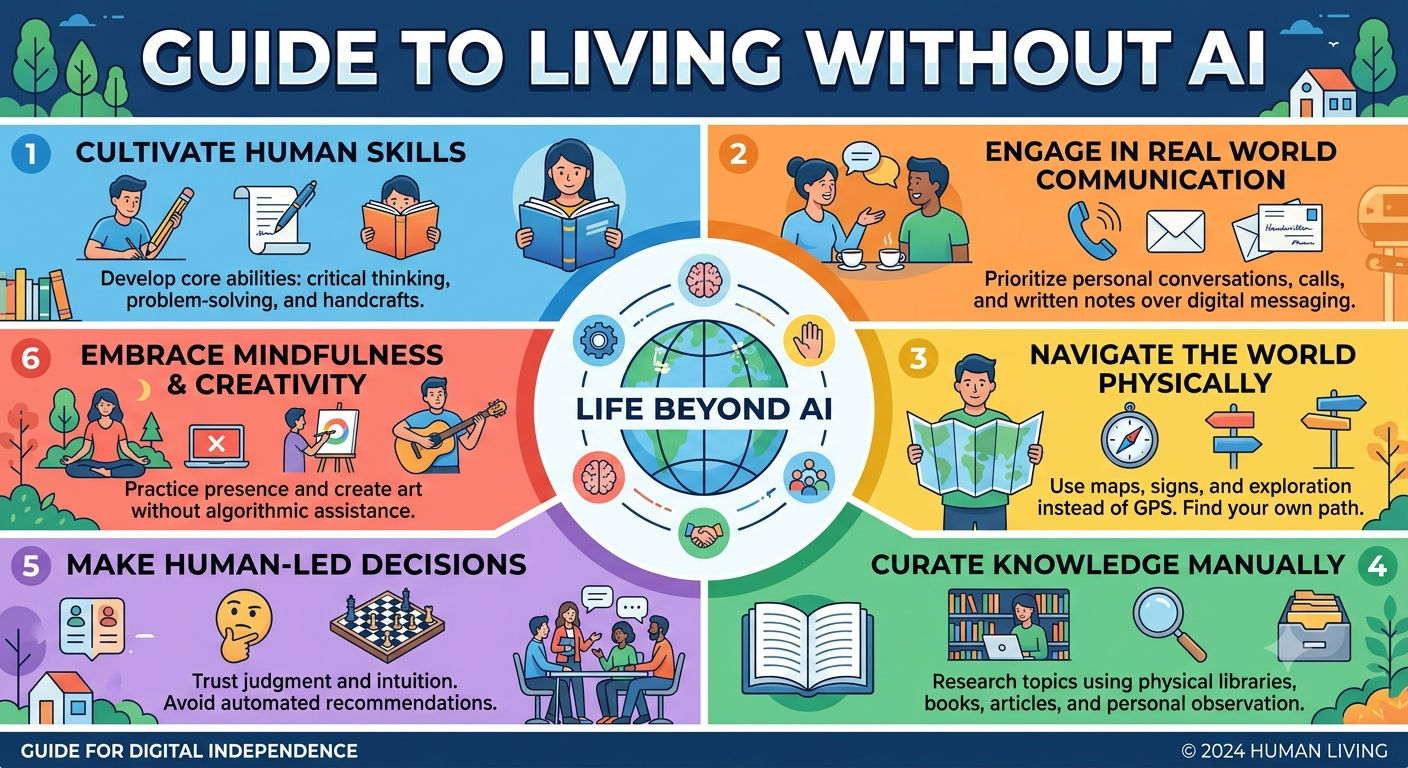
This article explores how to live without AI, why someone might deliberately reduce their dependence on artificial intelligence, what happens when you return to older methods, and a practical system for using technology without allowing it to replace your ability to think.
My 30-Day Experiment Without AI
Imagine a person who uses AI heavily every day.
Let’s call him Jackn.
Jack is a fictionalized composite based on a very ordinary modern knowledge worker—not a documented individual—but his experience represents a situation that many people can recognize.
He used AI for almost everything.
In the morning, he would ask an AI assistant to summarize news.
At work, he used AI to rewrite emails.
When he had an idea, he asked AI to expand it.
When he was stuck with writing, he generated a draft.
When he encountered a programming problem, he asked for code.
When he wanted to learn something, he asked for an explanation.
When he needed to make a decision, he sometimes asked an AI chatbot to list the advantages and disadvantages.
Nothing seemed wrong.
In fact, his productivity appeared to be improving.
Then one afternoon, something uncomfortable happened.
He was asked to write a short explanation of a project without using any AI assistance.
It should have been easy.
Instead, he stared at the blank document.
He knew the subject.
He had written about it many times.
But starting from a blank page suddenly felt strangely difficult.
The problem wasn’t that he had forgotten everything.
The problem was that he had become accustomed to starting with an answer.
AI had removed the uncomfortable part—the part where you struggle with the first sentence, organize your thoughts, reject bad ideas and gradually discover what you actually think.
That evening, Jack decided to conduct an experiment.
For the next 30 days, he would try to live without generative AI.
No AI-written emails.
No AI brainstorming.
No AI-generated articles.
No AI-created study notes.
No asking a chatbot to make decisions for him.
He would still use ordinary technology—Google Search, a calculator, maps, email, a smartphone and computer.
The experiment wasn’t about becoming anti-technology.
It was about answering one question:
How much of my thinking had I quietly outsourced?
Week One: Life Suddenly Becomes Slower
The first few days were surprisingly frustrating.
The smallest tasks became more difficult.
An email that previously took two minutes now took ten.
Finding an answer required opening multiple sources instead of asking one chatbot.
Writing an article required staring at a blank page.
Even brainstorming became uncomfortable.
Whenever Jack encountered a problem, his first instinct was to reach for AI.
Then he had to stop himself.
Something interesting happened.
The extra friction initially felt like wasted time.
But after several days, he began noticing something he hadn’t expected.
He was thinking more before acting.
Instead of asking an AI:
“What should I do?”
he began asking himself:
“What do I actually think?”
That distinction matters.
AI can produce a polished answer before you have completely formed your own opinion.
The answer may be useful. But it can also become an anchor.
Once you see the machine’s suggestion, your own thinking tends to happen around that suggestion.
Research involving 319 knowledge workers found that greater confidence in generative AI was associated with less reported critical-thinking effort during AI-assisted tasks. The researchers also found that AI shifted critical thinking toward activities such as verifying and integrating AI responses rather than doing the original problem-solving work.
This doesn’t mean AI automatically makes people less intelligent.
The important distinction is how the technology is used.
Using AI as a calculator for a task you already understand is very different from using it to perform the thinking required to learn the task.
Why Would Anyone Want to Live Without AI?
There are several reasons someone might intentionally reduce AI use.
Number one is to strengthen thinking.
Thinking is a skill.
Like writing, programming, mathematics or playing an instrument, it improves with practice.
If you never practice solving problems independently, you shouldn’t be surprised if independent problem-solving becomes uncomfortable.
This is one reason cognitive scientists are interested in something called cognitive offloading.
Cognitive offloading means transferring mental work to an external tool.
People have always done this.
We use calendars instead of remembering appointments.
We use calculators instead of performing long calculations.
We use GPS instead of memorizing every road.
This isn’t necessarily bad. Offloading can free mental resources and improve performance.
The concern with AI is that generative systems can potentially take over much broader cognitive activities—including planning, writing, reasoning and idea generation. The American Psychological Association notes that emerging evidence suggests heavy reliance on generative AI may reduce some critical-thinking and job-specific skills, although the effects depend significantly on how AI is used.
The goal, therefore, isn’t to eliminate every form of cognitive offloading.
It is to decide which mental abilities you don’t want to outsource.
Number two is to discover your own voice.
One of the strangest consequences of generative AI is that everything can start sounding polished.
Emails become polished.
Social media posts become polished.
Articles become polished.
Applications become polished.
Presentations become polished.
But polished doesn’t necessarily mean personal.
If you repeatedly ask AI to rewrite your thoughts, eventually you may become less familiar with your natural writing style.
Writing without AI forces you to confront your own vocabulary, rhythm, mistakes and personality.
Those imperfections are often part of what makes writing human.
A handwritten journal doesn’t need to sound like a professional marketing department.
A personal email doesn’t need to sound like corporate communications.
A teenager’s first essay doesn’t need to sound like an encyclopedia.
Sometimes the struggle is part of the learning.
Number three is to become better at learning.
Consider two students.
Student A asks:
“Explain photosynthesis and give me notes for my exam.”
Student B reads a textbook, struggles with the concept, writes an explanation in their own words and then tests themselves.
Student A may finish much faster.
But Student B has spent more time actively retrieving and organizing information.
That difference matters.
AI can be an excellent educational assistant—but there is a danger when the assistant becomes the student.
UNESCO’s guidance on generative AI emphasizes a human-centred approach and argues that AI should support human agency rather than displace it.
The lesson isn’t “never use AI for education.”
It is:
Don’t outsource the learning process and then mistake receiving information for learning.
The Most Difficult Part of Living Without AI
The hardest part isn’t finding information.
Google Search still exists.
Books exist.
Libraries exist.
Experts exist.
Teachers exist.
Documentation exists.
The difficult part is tolerating uncertainty.
AI has trained many users to expect an immediate response.
Ask a question.
Receive an answer.
Move on.
But meaningful thinking doesn’t always work like that.
Sometimes you need to sit with a problem for twenty minutes.
Sometimes you need to read three contradictory opinions.
Sometimes you need to make a bad first attempt.
Sometimes you need to discover that your original question was wrong.
This is where AI-free time can become surprisingly valuable.
You recover the ability to say:
“I don’t know yet.”
And then investigate.
Try to do yourself first before ai.
One of the most useful habits from our fictional 30-day experiment is simple:
You don’t have to ban AI forever.
Before asking AI for an answer:
- Write down what you already know.
- Define the actual problem.
- Make your best guess.
- Identify what you’re unsure about.
- Try one possible solution.
- Only then look for outside assistance.
This changes your relationship with technology.
Instead of:
AI → answer → acceptance
you create:
Human thinking → attempt → research → verification → decision
That extra step protects something extremely valuable:
your own reasoning process.
You don’t necessarily need to quit AI completely to experience the benefits of an AI-free lifestyle.
Instead, divide your work into three categories.
Category 1: Tasks you should probably do yourself
These include tasks where the objective is to develop or maintain your skills.
Examples:
- Learning a new concept
- Practicing writing
- Solving basic problems
- Developing your personal opinions
- Studying
- Brainstorming important original ideas
- Making decisions that require personal judgment
These activities benefit from mental effort.
Category 2: Tasks where traditional tools are enough
Examples include:
- Simple calculations
- Calendar management
- Basic spelling checks
- Finding a known website
- Reading documentation
- Looking up a phone number
- Organizing files
You don’t necessarily need generative AI for these.
Category 3: Tasks where AI can genuinely help
AI can be extremely useful when used deliberately.
Examples include:
- Generating alternative approaches
- Summarizing very long material after you’ve understood the context
- Finding potential mistakes in your work
- Automating repetitive processes
- Translating text
- Creating prototypes
- Exploring unfamiliar possibilities
The objective isn’t to put every activity into Category 1.
It’s to prevent Category 3 from swallowing Category 1.
Here’s a simple rule worth remembering:
Suppose you’re writing an article.
Don’t immediately ask AI:
“Write a 2,000-word article about fitness.”
Instead:
Step 1: Think
Write your own outline.
Step 2: Research
Read credible sources.
Step 3: Draft
Write your first version.
Step 4: Review
Identify weak arguments.
Step 5: Use AI if necessary
Ask AI to challenge your reasoning, identify missing perspectives or point out unclear sections.
Step 6: Decide
You—not the AI—make the final decision.
This preserves the most important part of the process.
Human judgment remains in charge.
What Happens When You Stop Asking AI for Every Answer?
After several weeks without constant AI assistance, the fictional Jack noticed another change.
He became less afraid of the blank page.
Previously, a blank document felt like a problem.
Now it felt like an invitation.
He would write something terrible.
Then improve it.
He would generate five bad ideas.
Then find a sixth.
He would make mistakes.
Then correct them.
And eventually he discovered something important:
AI had not taken away his ability to think. It had simply made thinking optional too often.
That distinction is powerful.
The human brain doesn’t become useless because a tool exists.
But skills that aren’t exercised can become rusty.
Research on AI and cognition is still developing, and experts caution against simplistic claims that AI inevitably makes people “dumber.” The evidence is more nuanced: AI can improve performance and creativity in some circumstances, while passive or excessive reliance can create risks around skill development and independent judgment.
That is why the most sensible goal isn’t “destroy AI.”
It’s “don’t become helpless without it.”
You don’t need to disappear from the modern world for a month.
Start with seven days.
Day one : No ai writing.
Write your emails, messages and notes yourself.
Don’t worry about perfection.
Day two : No ai answers
Whenever you have a question, research it using books, websites, documentation or people first.
DAy three: No ai brainstorming
Generate 20 ideas yourself.
The first five will probably be obvious.
The next five may be terrible.
The final ten may surprise you.
DAy four: No ai learning
Pick a subject and learn it from a book, course, documentary or expert.
Take handwritten or typed notes in your own words.
DAy five: Make one difficult decision yourself
Write down:
- The problem
- What you know
- What you don’t know
- Three possible choices
- The consequences of each
Then make your decision.
DAy 6: Create something
Write a short story.
Draw something.
Build a small program.
Cook something new.
Make a spreadsheet.
Create a business idea.
The goal isn’t quality.
The goal is creation without assistance.
Day seven: REview
Ask yourself:
- What became easier?
- What became harder?
- What did I learn?
- Which AI tools do I actually need?
- Which AI tools were simply convenient?
- Which skills do I want to keep practicing myself?
This final question may be the most important.
After completing an AI-free experiment, you don’t necessarily need to become completely AI-free.
A better long-term strategy may be an 80/20 rule.
Keep 20% of your activities deliberately AI-free if those activities protect important human skills.
For example:
Writing: Write important first drafts yourself.
Learning: Try solving problems before requesting explanations.
Decision-making: Make your own preliminary judgment.
Creativity: Generate your first ideas independently.
Memory: Don’t immediately look everything up.
Communication: Occasionally write personal messages without AI polishing.
Problem-solving: Struggle with a difficult problem before searching for the answer.
The remaining activities can use AI where it genuinely improves efficiency.
This gives you something better than an AI-free life:
an AI-independent life.
This distinction is essential.
Living without AI doesn’t mean going back to 1995.
You can still use:
- Smartphones
- Computers
- Search engines
- GPS
- Calculators
- Spreadsheets
- Digital cameras
- Online banking
- Cloud storage
- Traditional software
The goal is not technological purity.
The goal is intentional technology use.
A calculator performs arithmetic.
An AI system can potentially perform the reasoning surrounding the arithmetic.
A GPS tells you where to turn.
A generative AI system can potentially help decide where you should go and why.
The second category deserves more conscious attention because it overlaps with judgment.
Here’s the solution I would share with anyone worried about becoming too dependent on AI.
Don’t ask:
“How can I completely eliminate AI from my life?”
Ask:
“What must I remain capable of doing without AI?”
Create your own Human Skills List.
For example:
My essential skills
- I can write a clear email without AI.
- I can explain my work without AI.
- I can research a topic independently.
- I can solve basic problems myself.
- I can make important decisions without a chatbot.
- I can brainstorm original ideas.
- I can learn from books and traditional sources.
- I can communicate naturally.
- I can verify information independently.
- I can work for several hours without an AI assistant.
Then practice those skills every week.
That’s it.
You don’t need to fear AI.
You need to make sure AI never becomes the condition under which you are capable of functioning.
Before typing your next prompt, pause for five seconds.
Ask: Am I using AI for genuine purpose?
That question can change everything.
If AI is removing boring repetition, use it.
If AI is helping you explore possibilities, use it.
If AI is helping you check your work, use it.
If AI is helping you learn after you’ve attempted the problem yourself, use it.
But if you automatically ask AI to perform the thinking you actually want to become better at doing, stop for a moment.
Try yourself first.
You may discover that you know more than you thought.
After the 30-day experiment, our fictional Arjun didn’t delete every AI application.
That would miss the point.
He returned to some AI tools.
But his behavior changed.
He stopped asking AI to decide what he thought.
He stopped using it automatically whenever he encountered difficulty.
He stopped confusing a polished answer with understanding.
Most importantly, he regained confidence in his own ability to start with nothing.
That is the real lesson.
The future probably won’t belong to people who completely reject AI.
Nor will it necessarily belong to people who use AI for absolutely everything.
It will belong to people who understand the difference between assistance and dependence.
AI can make you faster.
But sometimes being slower is how you become better.
AI can give you an answer.
But sometimes struggling to find the answer is how you learn.
AI can write your first draft.
But sometimes staring at the blank page is how you discover what you actually think.
AI can give you ten ideas.
But sometimes the eleventh idea—the one you discover yourself—is the one worth building.
So don’t ask whether you can live without AI.
Ask something more useful:
If every AI system disappeared tomorrow, which abilities would you wish you had kept?
Then start practicing those abilities today.
Because the ultimate goal isn’t to become anti-AI.
It is to become AI-independent.
Use the machine when it makes you stronger.
Put it away when using it would make you weaker.
And never forget the most important rule:
| References and further reading American Psychological Association — How AI is reshaping human skills and thinking: The APA reviews research into cognitive offloading, critical thinking, learning and workplace skills. Read the APA article ACM CHI 2025 — The Impact of Generative AI on Critical Thinking: A study of 319 knowledge workers and 936 real-world AI-use examples examining how generative AI affects critical-thinking effort. Read the research paper Microsoft Research — AI and critical thinking: Microsoft Research’s summary of the same CHI 2025 research and its implications for knowledge work. Read Microsoft Research UNESCO — Guidance for Generative AI in Education and Research: Guidance emphasizing human agency and a human-centred approach to generative AI. Read the UNESCO guidance American Psychological Association — Navigating AI-generated advice: Practical guidance on questioning AI output, considering alternative perspectives and avoiding over-reliance on AI for major decisions. Read the APA guide |
A youtube video:
A useful pinterest pin:

Linkedin -- www.linkedin.com/in/shishir-bhargava-68a8b4257
- How to Organize Digital Receipts and Warranties | A Practical System That Works - October 11, 2026
- How to Live Without AI | 30-Day Experiment Taught Me to Think Again - October 8, 2026
- 2026 Lexus IS 350 F Sport: Shocking review - August 22, 2026
⚠️ Most People Discover Trends When It's Too Late
Join the Trends Goldmine Insider List and get emerging AI tools, future products, viral keywords, and hidden opportunities before they hit the mainstream.
While everyone else is chasing yesterday's trends, you'll be spotting tomorrow's opportunities first.
🚀 Free Weekly Trend Alerts • No Spam • Unsubscribe Anytime
SIGN UP NOW & RECEIVE A SHORT REPORT ON HOW TO MAKE FORTUNE WITH TRENDS.Trusted by readers who want to discover opportunities before the crowd.