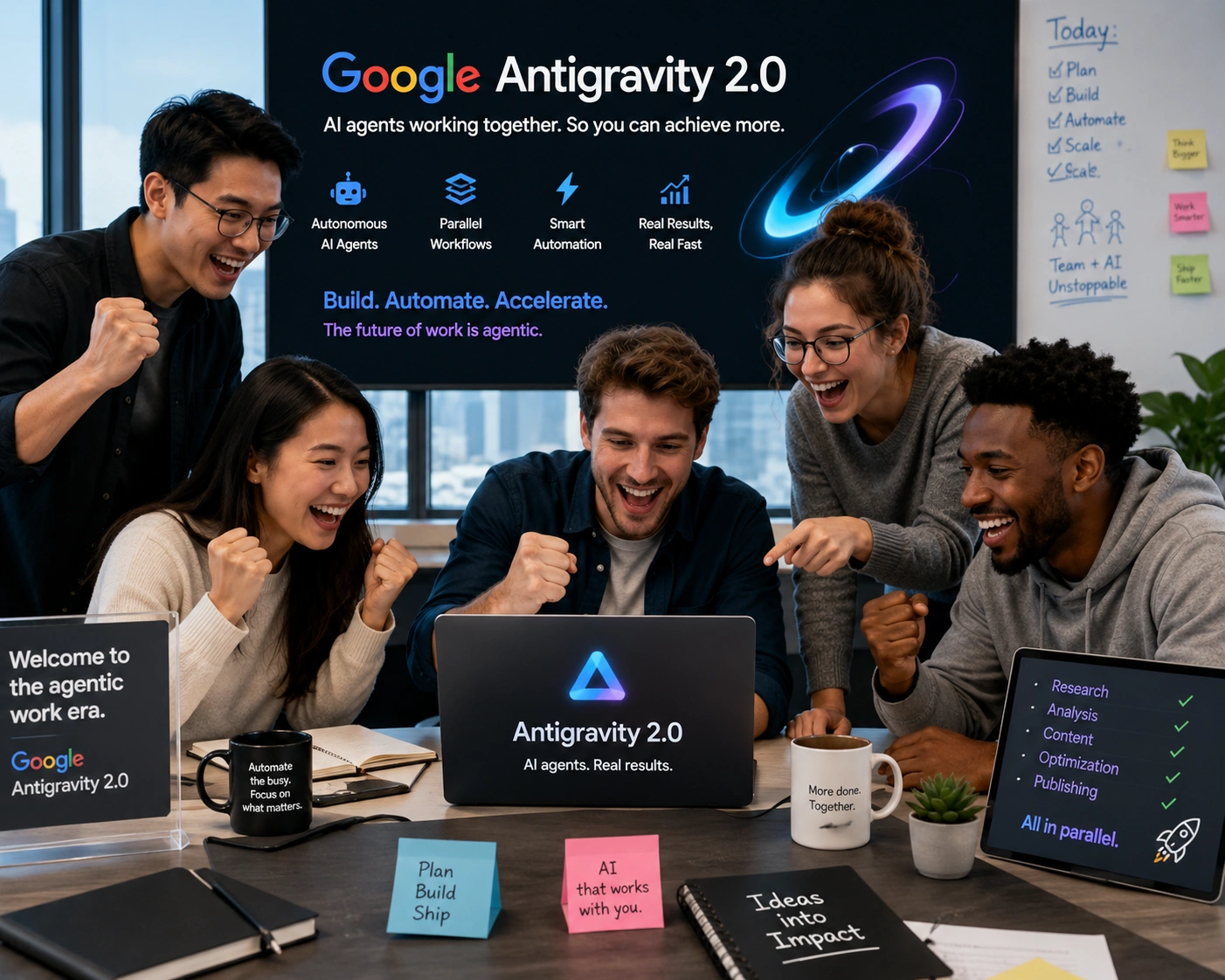
Image credit – AI image generated by Chatgpt
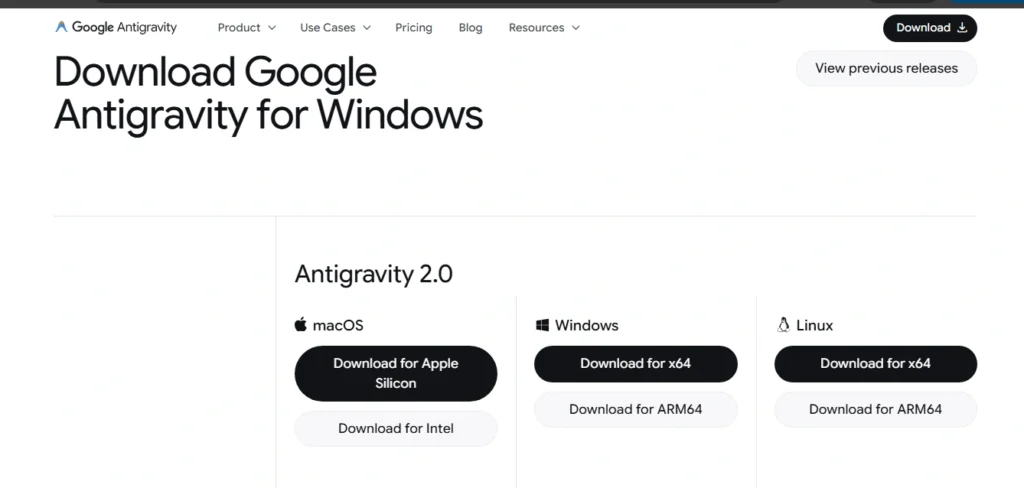
Image credit – official website google antigravity 2
The new breakthrough technology by Google antigravity 2.0
When hearing the word AI, most people commonly think as it is of some chatbots.
Something with whom they can chat with. A freind alike with whom they can express thoughts. A chatbot is nothing but a trained model by humans capable of giving answers to your queries.
But there is something very strange with artificial intelligence. Only few expert could see the tip of the iceberg.
The world of artificial intelligence is moving beyond simple chatbots. Instead of AI tools that only answer questions, a new generation of “agent-first” systems is emerging — software that can independently plan, execute tasks, manage workflows, and even collaborate with other AI agents. One of the newest and most talked-about examples is Google Antigravity 2.0.
I will define for you the AI agent first system since it is important now.
| An AI agent first system is a setup where an artificial intelligence agent is the primary actor, making decisions and taking actions autonomously rather than just assisting a human. It perceives its environment, processes information, and acts to achieve specific goals without constant human intervention. Essentially, the AI drives the system’s operation from the start. |
Now, you may ask why it is essential today? If you have seen that with the development in tech and modernization, there have been also an increase in graph of problems due to human led mistakes and errors.
Moreover, with the increased competition, humans need more time for activities that support productivity and well-being.
Can artificial intelligence help with this? Absolutely, A big yes.
If you know how to take work from AI, then your life will have more time to do the things that marks your true potential and hidden talents.
The Repetitive tasks can be done by giving the command to AI while activity like decision making, creativity, strategy design and other can be done by you.
This is what in context I spoke with respect to the new tool Google antigravity 2.0 .
At first glance, Antigravity 2.0 looks like a developer-focused platform. Google describes it as a command center for AI agents that can work in parallel across projects, automate tasks, interact with tools, and even create deliverables autonomously.
But then I decided to try myself. I downloaded it from official website. After spending time exploring its capabilities, it becomes clear that this technology is much bigger than coding. It hints at a future where AI quietly handles parts of our everyday lives in the background.
Very astonishing, right?
Unlike traditional assistants that wait for commands one by one, Antigravity 2.0 introduces a system where multiple AI agents can work simultaneously, each handling different subtasks while communicating with one another.
It’s just like AI is handling the whole office.
Google calls this an “agent-first” experience. The shift may sound technical, but its implications are surprisingly human.
Imagine waking up and your AI system has already organized your emails, researched market trends for your business, scheduled your meetings, summarized overnight news, compared product prices, drafted content ideas, and prepared your daily productivity report — all before your morning coffee.
That is the direction platforms like Antigravity 2.0 are pointing toward.
What Exactly Is Google Antigravity 2.0?
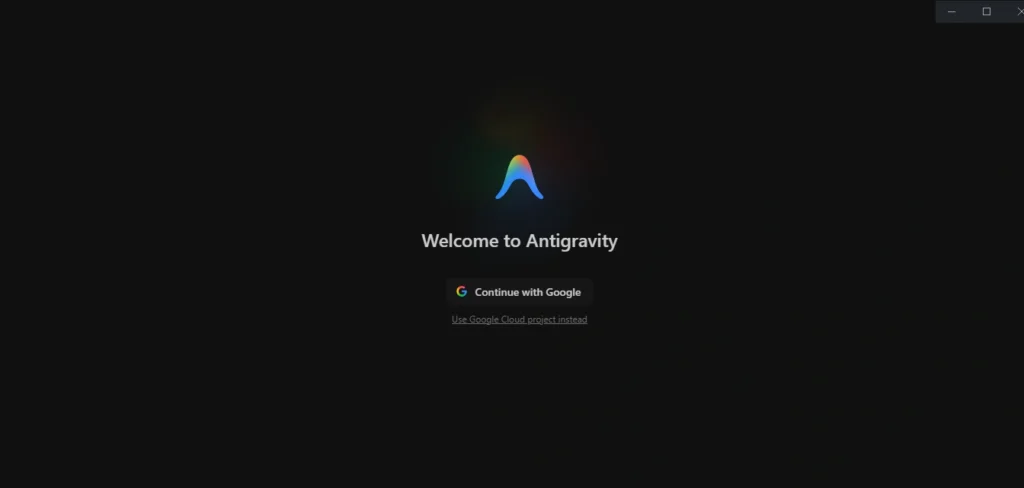
Google Antigravity 2.0 Official Product Page describes the platform as a standalone desktop application designed to orchestrate autonomous AI agents.
A standalone desktop application is a software program that runs directly on a computer without needing a web browser or constant internet connection. It is installed locally on the operating system and includes all the necessary components to function independently. Examples include word processors, video editors, and accounting software.
It is a proven concept that to complete a worthwhile tasks, everybody has to work by taking their piece of tasks and completing the responsibility.
If you have Know about Panchatantra tales, you may have heard of the story about how a single piece of wood was broken easily but breaking a bunch of it the five man had to wok together to finish the tasks successfully.
Same concept applied here.
Unlike a normal AI chatbot, Antigravity can manage multiple “subagents” working on separate parts of a larger task.
Some of its highlighted features include:
- Dynamic subagents for parallel work
- Scheduled background tasks
- Voice transcription powered by Gemini models
- Project-based workflow organization
- AI-generated artifacts and implementation plans
- Integration with external tools and workflows
- Autonomous coding and research capabilities
What makes the platform important is not just automation, but orchestration. Existing AI tools are often reactive. Antigravity aims to become proactive.
The thing I am trying to convey is Automation performs individual tasks automatically, while orchestration coordinates multiple automated tasks and systems into a complete workflow.
For example, instead of asking AI to “write an article,” users can create an entire publishing workflow:
- One AI agent researches trending topics.
- Another gathers data sources.
- Another drafts content.
- Another optimizes SEO.
- Another schedules publishing.
All of this can happen simultaneously.
Yes, true. Think like of AI employees. Simple as that.
That is a major leap from the AI assistants most people are familiar with today.
A big eyeopener.
Why Antigravity 2.0 Could Matter Beyond Developers
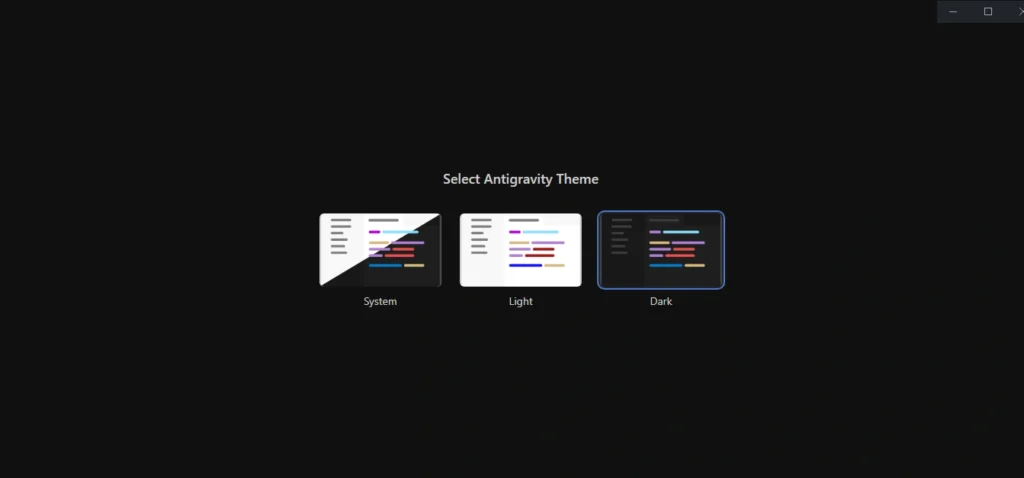
Image credit – Official source of google antigravity 2.0
Most people hear “AI coding platform” and assume it only matters to programmers. But many transformative technologies begin inside technical industries before reaching mainstream life.
AI tools are generally perceived as something technical which might hesitate the user to use.
Cloud computing, smartphones, voice assistants, and even social media platforms originally started with limited audiences. Antigravity 2.0 feels similar. Beneath the developer branding lies a framework for managing autonomous digital workers.
Here’s where its real-world potential becomes interesting.
- Personal Productivity Automation
It might be very frustrating to navigate from different activities here and there.
It not only dissipates the energy but loses the quality of the outcome of the work.
Instead of opening ten apps every day, users could eventually operate through a central AI orchestration layer.
Your AI could:
- Book travel
- Manage subscriptions
- Track budgets
- Organize files
- Generate reports
- Monitor investments
- Handle repetitive office tasks
The idea is not replacing humans entirely, but reducing “digital friction” — the small repetitive actions that consume hours every week.
Think about just like you eliminate yourself from the that do not require your presence.
2. Small Businesses Could Scale Faster
Small business owners often struggle because they lack teams. Antigravity-style systems may allow one person to perform the work of several assistants.
Team work is very essential and anything worthwhile in life is achieved through it. This is fundamental law of nature. .
A single entrepreneur could use AI agents for team work tasks like:
- Customer support
- Market research
- Inventory monitoring
- SEO optimization
- Social media management
- Competitor analysis
This could lower operational barriers dramatically.
3. Education and Learning
Education field has been revolutionized with the onset of AI?
But how? Long ago, there were very fewer options and sources to learn anything people desired of. Today in an instant of click, anything can be learned which you are desirous of.
AI agents could personalize study systems for students and learners:
- Creating schedules
- Explaining difficult concepts
- Tracking weak subjects
- Building quizzes
- Researching academic sources
Instead of generic learning apps, students may soon have entire AI-powered study ecosystems.
4. Healthcare Assistance
Although still early and requiring strict safety oversight, autonomous AI workflows could help manage:
- Appointment scheduling
- Medical reminders
- Symptom tracking
- Health record organization
- Preventive care monitoring
The ability for multiple AI systems to coordinate information could improve efficiency in healthcare systems.
How to Use Google Antigravity 2.0
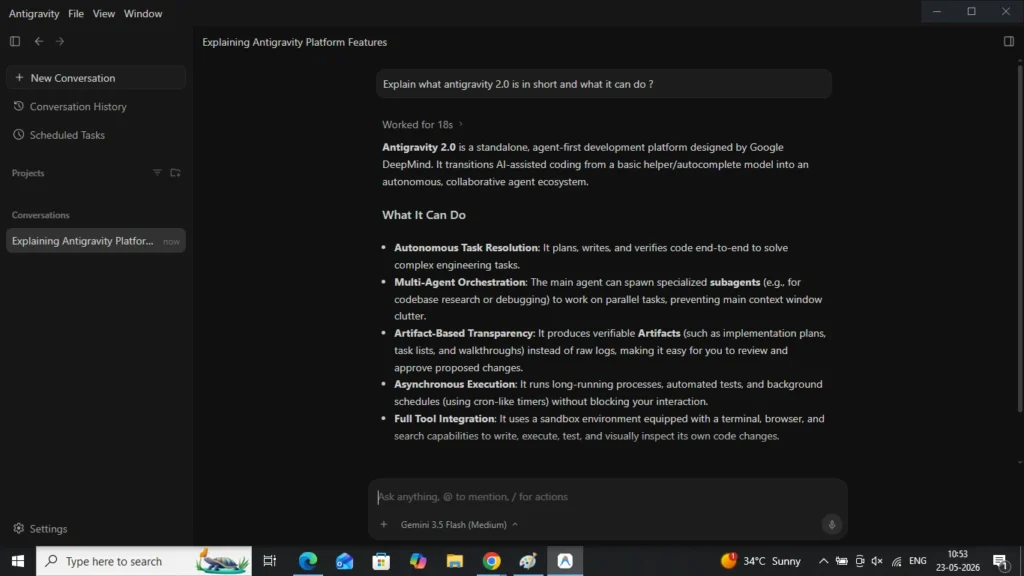

Image credit — google antigravity tool 2.0
I will now show how to use it since I have tried it myself and found very interesting. According to the official documentation, users can download the platform for Windows, Linux, and macOS.
I downloaded it and installed on my system. To just test, I literally entered a query “Explain google antigravity 2.0 in two three sentences ” and the results you can see in the another image.
You can start more than one project at a time and that’s a wonderful thing.
The setup process is relatively straightforward:
Step 1: Download the Platform
Visit the official website:
Google Antigravity Download Page
Step 2: Install the Application
The platform supports:
- Windows 10 (64-bit)
- Modern macOS systems
- Linux distributions including Ubuntu and Fedora
Step 3: Create a project
Projects act as controlled workspaces where AI agents operate. Users can connect local folders, repositories, or workflows.
A useful youtube video:
Step 4: Assign Tasks to Agents
Users can:
Organize multiple simultaneous operations
— Launch AI agents
— Create scheduled tasks
— Define custom workflows
Step 5: Monitor Results
Antigravity generates “artifacts,” which are outputs showing the AI’s progress, findings, and execution details.
The overall experience feels less like chatting with AI and more like supervising a team of digital workers.
Problems that I found
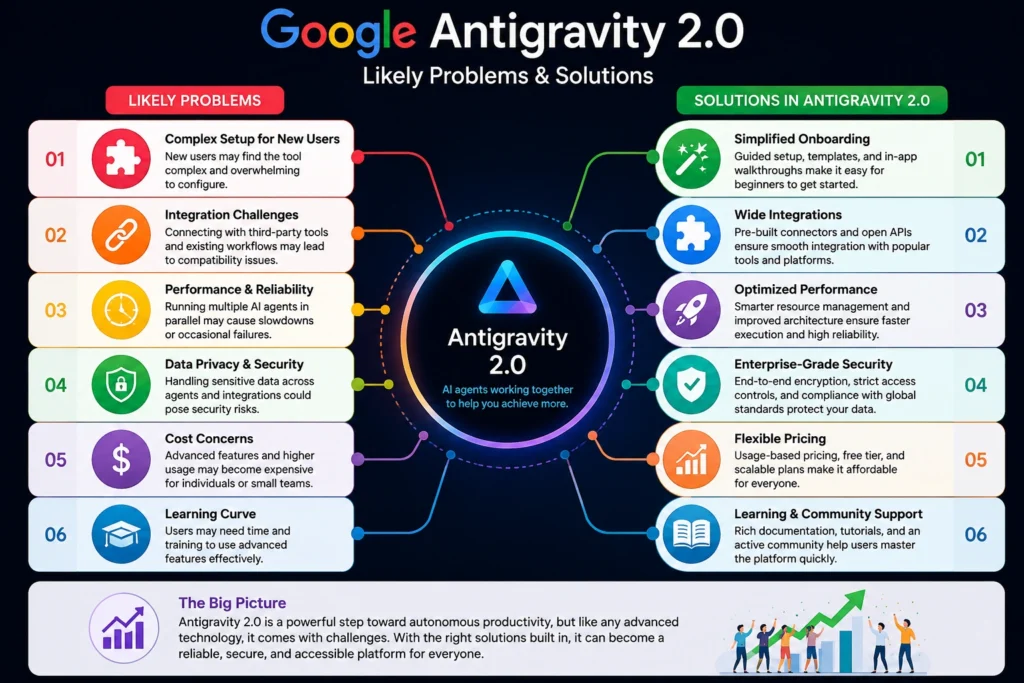
Image credit — Ai image by chatgpt
The infographic presents a colorful visual breakdown of the possible challenges and solutions associated with the emerging AI platform, Google Antigravity 2.0.
I will explain in detail about the likely problems and solutions. On the left side, the image highlights major concerns users may face, including complex setup procedures for beginners, integration issues with existing tools, performance slowdowns caused by multiple AI agents running simultaneously, privacy and security risks, higher operational costs, and the learning curve required to understand advanced AI workflows.
On the right side, the infographic balances these concerns by showing how Antigravity 2.0 aims to solve them through simplified onboarding systems, broader third-party integrations, optimized performance architecture, enterprise-grade security protections, flexible pricing models, and strong educational resources with community support.
At the center of the image is the Antigravity 2.0 logo, symbolizing AI agents working together in parallel to improve productivity and automation. The overall design emphasizes that while the technology introduces new complexities, its long-term potential lies in creating a more efficient, intelligent, and automated digital work environment for businesses, creators, and everyday users.
Research: The Rise of Agentic AI
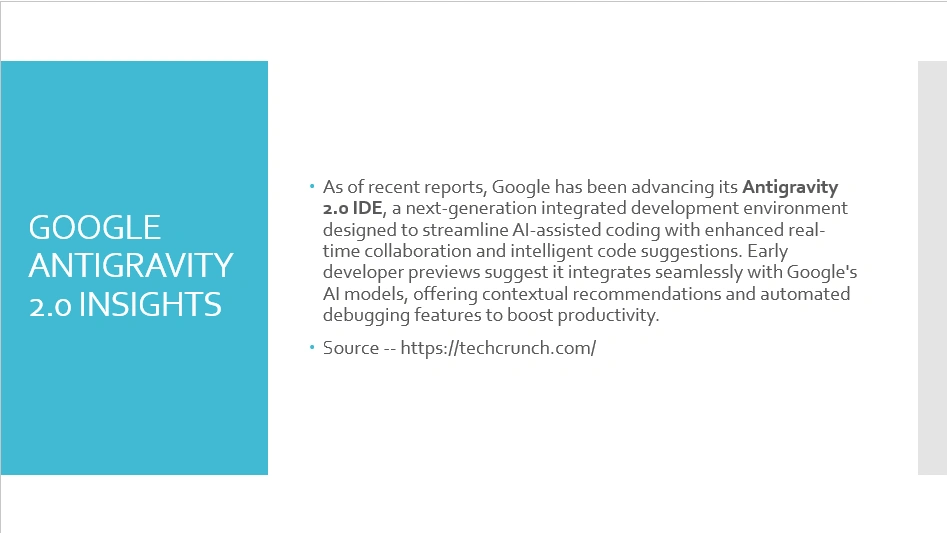
The release of Antigravity 2.0 aligns with a broader industry trend toward “agentic AI.” This refers to systems capable of independently performing sequences of actions rather than merely responding to prompts.
Yes, this is a huge milestone achieved by the humans today. Scientist have just made a thing that have a human like characteristics.
I mean to say it can talk, understand, reply, analyze and other things.
And humans are now having more time to work on doing things that actually matters.
The only flaw I see here is that AI after all is a machine coded and trained with set of instructions. So, inspite of making it work, human monitoring is very essential.
At Google I/O 2026, Google heavily emphasized autonomous workflows, multimodal AI systems, and parallel agent operations across its ecosystem.
I will define these terms for you.
| Understand these terms: Autonomous workflows are self-operating processes driven by AI with minimal human input, multimodal AI systems can understand and process multiple data types like text, images, audio, and video, and parallel agent operations across its ecosystem refers to multiple AI agents working simultaneously across interconnected systems to complete tasks efficiently. |
Industry analysts believe the next phase of AI competition will not simply be about which chatbot is smarter, but which ecosystem can coordinate AI agents most effectively.
Think of a machine. How all the different parts connected work with coordination with each other. Else the machine will stuck.
Several trends support this idea:
- Businesses increasingly demand workflow automation
- AI models are becoming cheaper and faster
- Multimodal systems can process text, voice, images, and files together
- Companies want AI systems that save time, not just generate responses
According to reports surrounding the launch, Google’s Antigravity platform was even used internally to help build other AI products. That suggests Google sees agentic workflows as foundational infrastructure for future AI systems.
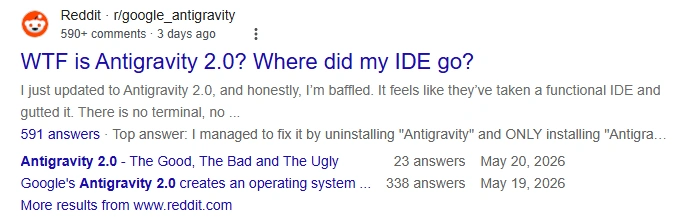
Community discussions on Reddit also reveal strong curiosity around the platform, though users have reported mixed experiences during the early rollout. Some developers praised the speed and automation capabilities, while others criticized migration issues and UI changes.
That tension is common with emerging technology. Early versions are rarely perfect, but they often reveal where the industry is heading.
A Realistic Case Study
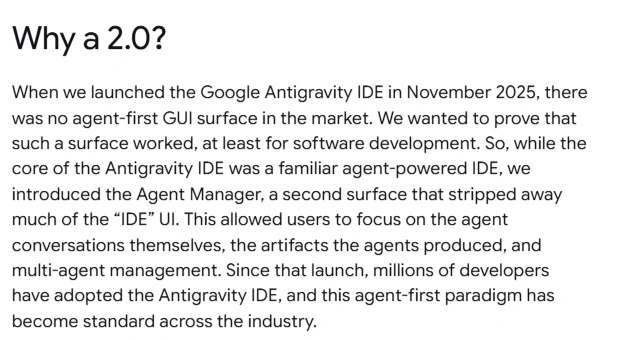
Image credit : official website of google antigravity 2.0
A useful pinterest pin:
To understand the practical impact, consider a freelance content creator running a small online business.
Before Antigravity 2.0
The creator manually:
- Searches trending topics
- Writes articles
- Optimizes SEO
- Schedules posts
- Replies to emails
- Creates research summaries
This could take 8–10 hours daily.
With an Agentic Workflow
One AI agent researches trends.
Another drafts outlines.
Another checks SEO keywords.
Another monitors analytics.
Another schedules publishing.
The creator shifts from performing repetitive execution to supervising strategy and creativity.
This transition mirrors how automation transformed manufacturing decades ago.
MY UNIQUE INSIGHTS AND TWISTED CONCLUSION
I was exploring more on google antigravity 2.0 . I found that Most discussions around AI focus on replacement — replacing jobs, replacing tasks, replacing human effort.
But after exploring Antigravity 2.0, the more fascinating possibility may actually be cognitive delegation.
Humans already delegate physical tasks to machines:
- Cars reduce walking
- Washing machines reduce manual cleaning
- Calculators reduce arithmetic effort
SO, I think the biggest takeaway could be the Agentic AI could become the first large-scale delegation of routine thinking.
Not intelligence itself, but cognitive maintenance:
- Organizing
- Scheduling
- Monitoring
- Researching
- Coordinating
- Filtering information
In a world overloaded with notifications, tabs, emails, and digital clutter, the most valuable resource is no longer information. It is mental bandwidth. Time is limited and work is increasing.
Platforms like Antigravity 2.0 hint at a future where AI becomes an invisible cognitive operating layer running quietly beneath daily life.
The surprising part is that the biggest winners may not be the most technical users. They may be ordinary people who simply want fewer repetitive decisions in their day.
And that is where the true disruption begins.
REFERENCES:
Other reads:

Linkedin -- www.linkedin.com/in/shishir-bhargava-68a8b4257
- 2026 Lexus IS 350 F Sport: Shocking review - August 22, 2026
- Why Global Markets Can Turn Nervous Overnight | How to prepare for it - July 9, 2026
- Why Countries Are Competing for Rare Earth Minerals | Shocking Details Revealed - July 6, 2026
⚠️ Most People Discover Trends When It's Too Late
Join the Trends Goldmine Insider List and get emerging AI tools, future products, viral keywords, and hidden opportunities before they hit the mainstream.
While everyone else is chasing yesterday's trends, you'll be spotting tomorrow's opportunities first.
🚀 Free Weekly Trend Alerts • No Spam • Unsubscribe Anytime
SIGN UP NOW & RECEIVE A SHORT REPORT ON HOW TO MAKE FORTUNE WITH TRENDS.Trusted by readers who want to discover opportunities before the crowd.