
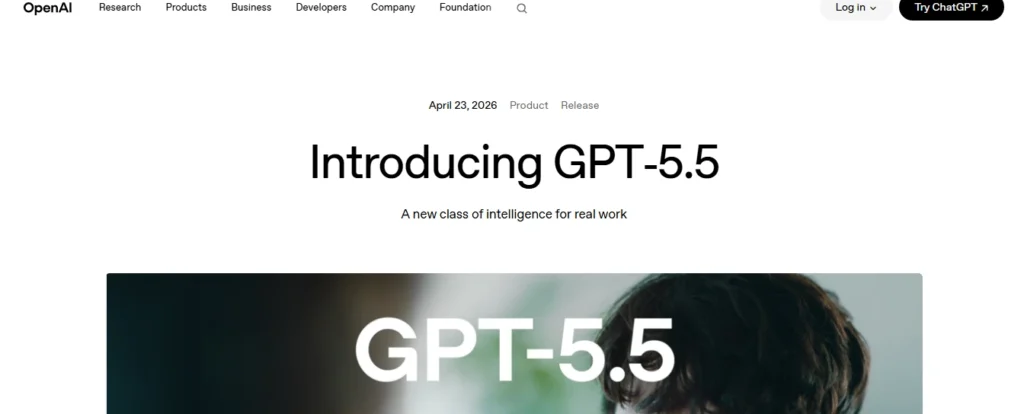
Image credit – official source website of gpt
Have you heard this?
I was having a look at my laptop various online and offline tools. I could even picture the earlier software and utilities that came in cd and floppy disk. I still have it is as the vintage collection.
The new software’s and other utilities are so easy to access just with an instant of click. Think of all the new facilities that have come into existence today.
This is only possible when there is a desire to transformation. A feel to bring the change in our lives. It’s applicable in all areas of life. It’s a human born desire to move forward.
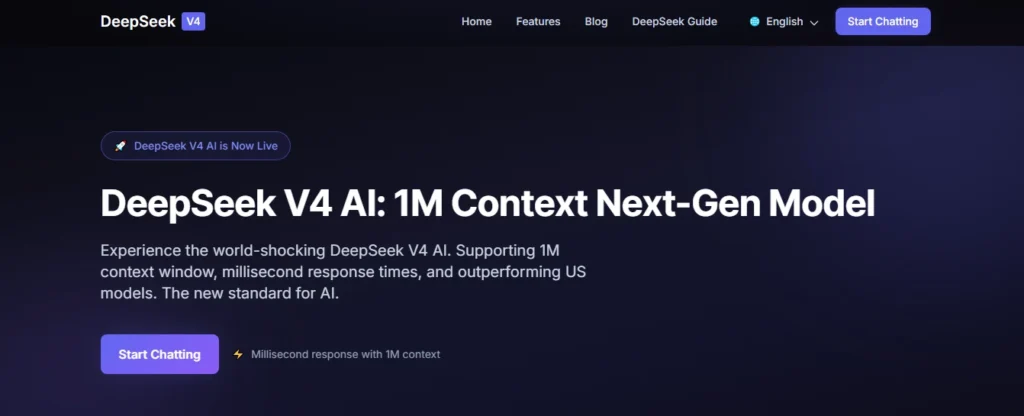
So, Likewise Today morning, I was expecting something new release while scrolling the google new feed. Then, an advertisement drew my attention, which was about chatgpt 5.5 and deepseek v4.
It was something talking about so revolutionary, that I opened my google chrome browser and decided to test it. It all started with a simple task.
I am a developer and content creator sat down on my easy sofa set looking at the clock time. I was thinking about the both releases ChatGPT 5.5 and DeepSeek V4.
So, Today freinds, we are likely to discuss about the two new ai tools releases today. Let’s have a glimpse over what problems do users might have to face with their innovative solutions as well.
A question came in my mind, why and which tool will perform better? I decided to gave same prompt. And I was having the same expectation.
Two very different failures.
One gave a polished answer—wrong in a subtle way. The other gave a technically correct answer—hard to use.
This morning explained me everything. Let’s deep dive into it.
The First issue: No data
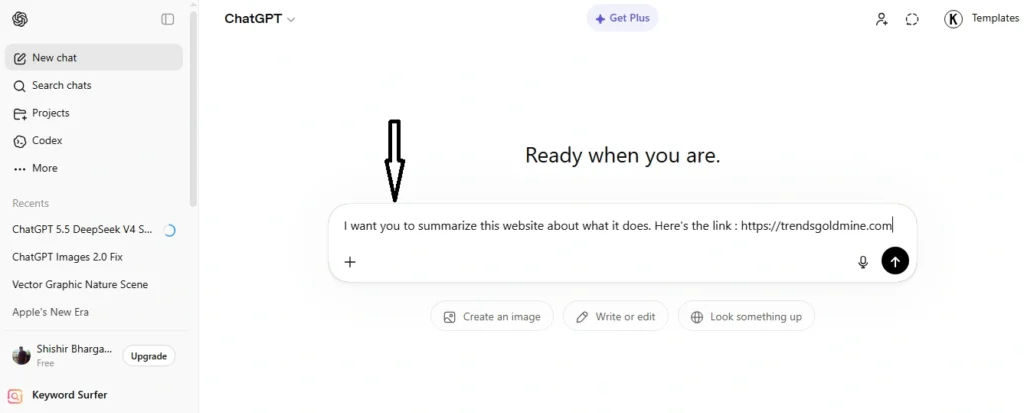
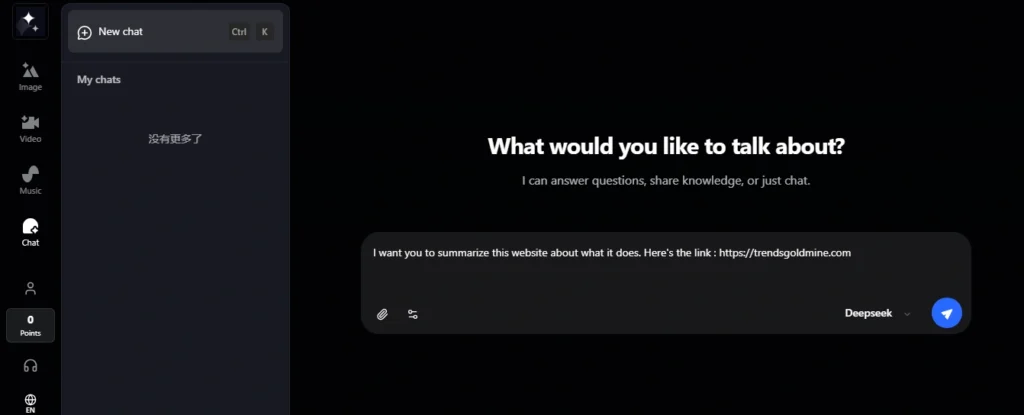
Image credit – official website of gpt
I daily write prompts to ai tools. So, I was on little light mode. So I asked both models to summarize a website.
To my surprise, the result were shocking. ChatGPT 5.5 responded fast. Clean language. Convincing tone. But the data was mismatched.
The one which did not match the website.
DeepSeek V4? A littleSlower. Structured. Slightly robotic. But closer to reality.
This is not rare. First of let’s have a glance over chatgpt generalization. Suppose the user ask the following prompt in the chatgpt.
User:
“How do I grow my SaaS?”
Overgeneralized Answer:
“Focus on product-market fit and SEO.”
Problem:
That advice is repeated everywhere and may not apply if:
- enterprise sales matter more
- product already has PMF
- retention is the real issue
Studies show AI models like ChatGPT and DeepSeek can overgeneralize or misrepresent facts, sometimes in the majority of outputs.
The Fix (Pro-Level)
I will seriously suggest you to Stop trusting outputs. Start verifying the results by yourself. A human monitoring is absolutely essential for proper success.
Use this workflow. This will help and clarify a lot:
- Ask: “Cite exact sources or uncertainty levels.”
- Force step reasoning: “Show assumptions before final answer.”
- Cross-check with a second model
Best prompt:
“Give answer + list 3 possible errors + confidence score.”
This reduces the improper usage of the ai tools and saves your time.
The Second problem: General vs Specialized Intelligence
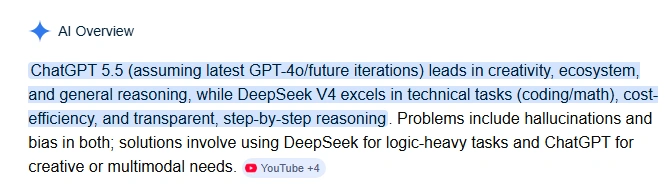
When I was looking at the readers comments in reddit, most of them were saying that ChatGPT 5.5 feels like a smart generalist and DeepSeek V4 behaves like a sharp engineer.
That’s by design. According to users
- ChatGPT performs better in deep technical precision due to its broad training
- DeepSeek excels in math/coding
The developer noticed it instantly:
- ChatGPT → great explanation, strong edge-case logic
- DeepSeek → perfect logic, strong adaptability
I will also describe you what is actually AI model training looks like. AI model training is the process of teaching a model to recognize patterns by showing it large amounts of data. The model makes predictions, compares them to the correct answers, and adjusts its internal parameters to reduce mistakes. This adjustment happens repeatedly over many cycles, called training iterations. Over time, the model learns statistical relationships in the data so it can make useful predictions on new, unseen inputs.
The Fix (Pro-Level)
I will suggest you to Use them together. Why? There is not a single tool which has all the features you will be looking for.
Hybrid workflow:
- Use DeepSeek → generate raw technical solution
- Feed into ChatGPT → refine, explain, humanize
- Re-validate with DeepSeek
This “AI chaining” is how professionals extract accuracy + usability.
The Third issue: Prompt Sensitivity
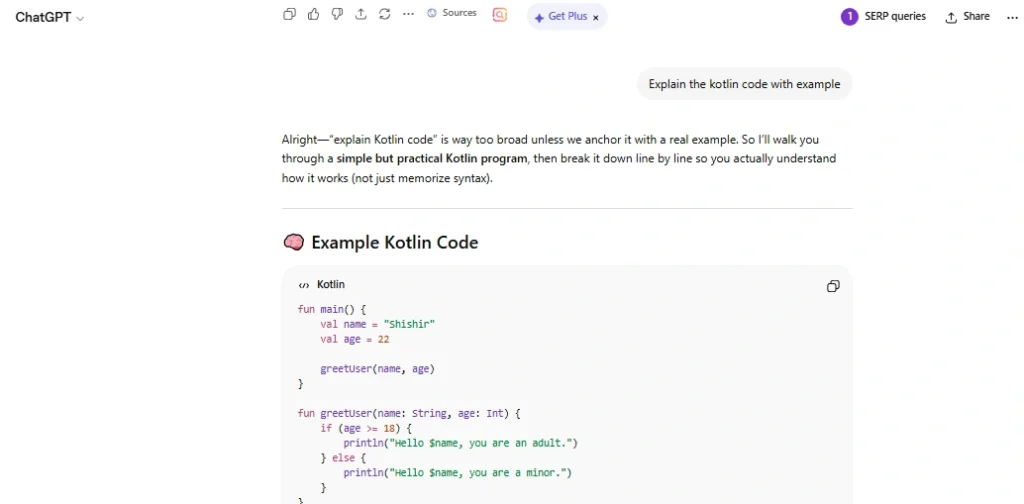
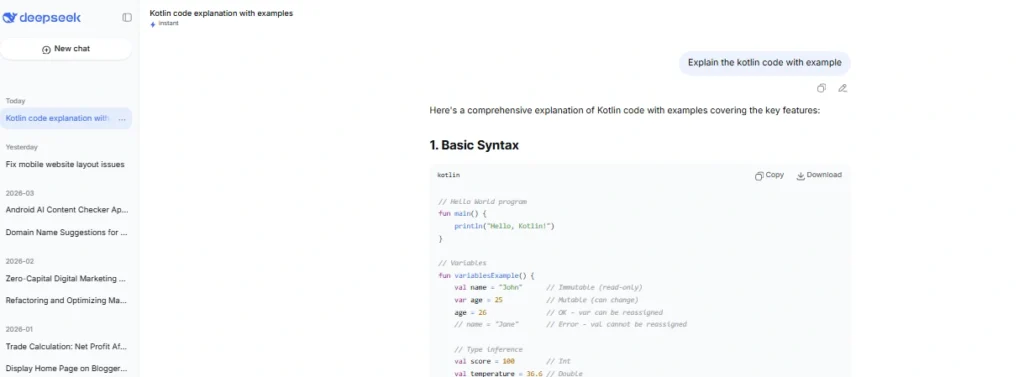
I decided to give a try using both the tools chatgpt 5.5 as well as deepseek v4:
“Explain this kotlin code.”
ChatGPT gave something decent.
DeepSeek also gave some useful info.
Then I suddenly changed the prompt:
“Step-by-step breakdown, include variable flow, edge cases, and final output.”
MY BEST PROMPT PRACTICES
| “Good prompting is about being clear, specific, and giving enough context for the model to avoid guessing. Instead of vague requests, include the goal, constraints, and desired format (e.g., “in 5 bullet points” or “with examples”). If accuracy matters, provide background information or examples of what you want. Break complex tasks into steps rather than asking everything at once. And if the output isn’t right, refine your prompt iteratively instead of starting over.” |
DeepSeek and chatgpt both became suddenly became brilliant.
Because they are highly prompt-sensitive. They work exactly as per you give instructions in the prompts.
So, be specific with whatever you want the outcome from them.
The Fix (Pro-Level)
Keep this point in mind and you will definitely make wonders with the ai tools. Write structured prompts, not casual ones.
Use this formula:
- Role
- Task
- Constraints
- Output format
Example:
“Act as senior software engineer. Analyze code. Show logic steps. Output in bullet points.”
This unlocks DeepSeek’s, chatgpt and other AI tools real power.
The Fourth issue: Cost vs Performance Tradeoff
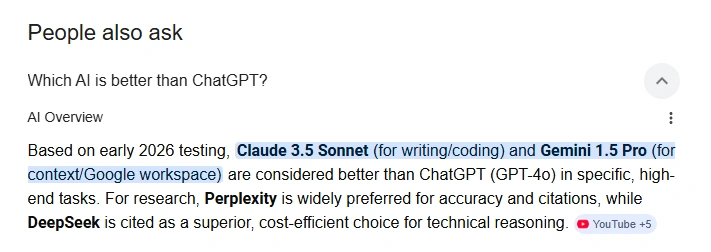
The developers also checked API costs. This made them somewhat worry.
That’s where things flipped.
- ChatGPT → powerful
- DeepSeek → optimized
The Fix (Pro-Level)
Before diving into the fix, I want you to know following terms:
| UX (User Experience) is how a product feels and behaves for the user — how easy, smooth, and intuitive it is to use, including layout, flow, and interactions. Backend logic is the behind-the-scenes system that handles data processing, rules, and decisions — like validating a login, calculating results, or fetching data from a database. Bulk processing is when a system handles large amounts of data at once instead of one-by-one, such as sending thousands of emails, processing large datasets, or updating many records in a single batch to improve efficiency. |
The best solution for this I found was is to Use cost-tier architecture:
- ChatGPT → final outputs, UX, content
- DeepSeek → backend logic, bulk processing
This cuts cost without losing quality.
The Fifth Crack: Stability & Real-World Behavior
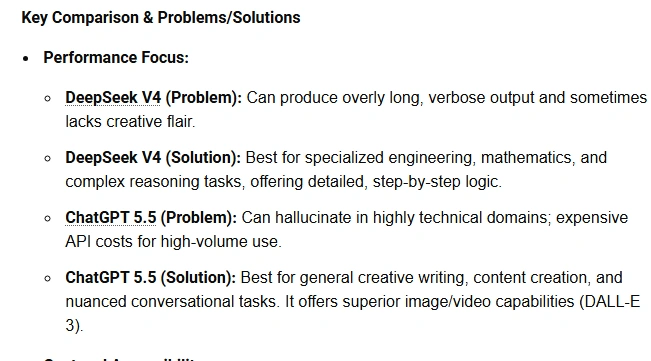
The one thing which a user commented was really made to think about the performance again.
It was like the Same prompt was given to chatgpt 5.5 and deepseek v4. But on different day, different answer were suggested by them
It improved the answer and evolved with new insights daily.
AI systems performed well with:
- Data quality
- Bias
- Context consistency
Let’s understand this terms in detail.
| Data quality refers to how accurate, complete, and reliable the data is. High-quality data is clean, consistent, and relevant, while poor-quality data may contain errors, missing values, or outdated information that can lead to wrong outputs. Bias is when the data or model produces skewed results that unfairly favor or disadvantage certain groups or outcomes. It usually happens because the training data is not balanced or reflects real-world inequalities. Context consistency means the model or system maintains logical and stable understanding across different parts of a conversation or dataset. If context consistency is weak, the system may give contradictory or unrelated answers when the same topic appears in different ways. |
Even users of newer GPT versions have experienced this in the responses.
The Fix (Pro-Level)
For better performance like winning a car race in a video game, Create repeatable systems, not one-time prompts.
- Save “winning prompts”
- Use templates
- Add constraints every time
Consistency comes from structure and proper systems.
MY UNIQUE INSIGHTS:
| ChatGPT 5.5 vs DeepSeek V4 — Core Insight 1. Thinking style ChatGPT 5.5: I found that it is More structured, stable, and “guided reasoning” — tends to organize answers cleanly and avoid risky assumptions. DeepSeek V4: I tested it and observed it as More aggressive reasoning style — often more direct, faster at problem-solving, but sometimes less cautious or polished. Insight: One is like a careful consultant, the other like a fast problem solver. 2. Performance trade-off ChatGPT 5.5: This one area it is Stronger in complex agent workflows, multimodal tasks, and consistency across long reasoning chains. DeepSeek V4: I also expereinced it as a Very competitive in coding, math, and long-context tasks, often close to ChatGPT but cheaper and more flexible (open-weight). Insight: The gap is not “intelligence vs intelligence” — it’s reliability vs efficiency. 3. Cost and accessibility ChatGPT 5.5: I visited the official website . It has Closed ecosystem, higher cost, controlled usage environment DeepSeek V4: It has Much cheaper, open-weight, can be self-hosted 👉 Insight: DeepSeek wins on freedom and cost, ChatGPT wins on managed quality control. 4. Real-world behavior difference ChatGPT 5.5 = better at: structured explanations multi-step planning reducing hallucination risk DeepSeek V4 = better at: fast reasoning heavy coding/math throughput cost-efficient scaling 🧠 Final deeper insight (the part most comparisons miss) This is not a “which is smarter” battle — it’s a control vs flexibility trade-off. ChatGPT 5.5 = controlled intelligence (safer, refined, predictable) DeepSeek V4 = unbounded intelligence (cheaper, flexible, sometimes rough edges) |
The Final Realization
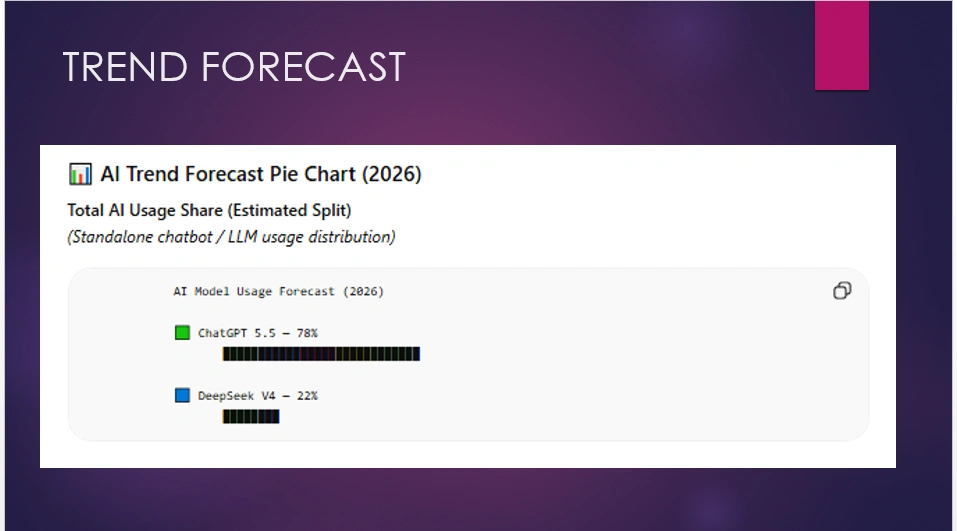
Data source in the image – chatgpt
By afternoon, I stopped comparing both the tools chatgpt 5.5 and deepseek v4 with other ai tools like google gemini, notebook, claude, copilot etc.
I started combining all of them. That’s the real shift.
- All tools have some speciality and combining them gives an ultra edge.
Together, they give best performance and results. You can use deepseek v4 for thinking, chatgpt 5.5 for communicating, claude for outputs and other ai tools for structuring prompts.
A useful youtube video:
You can know about us here and contact here.
A useful pinterest image:
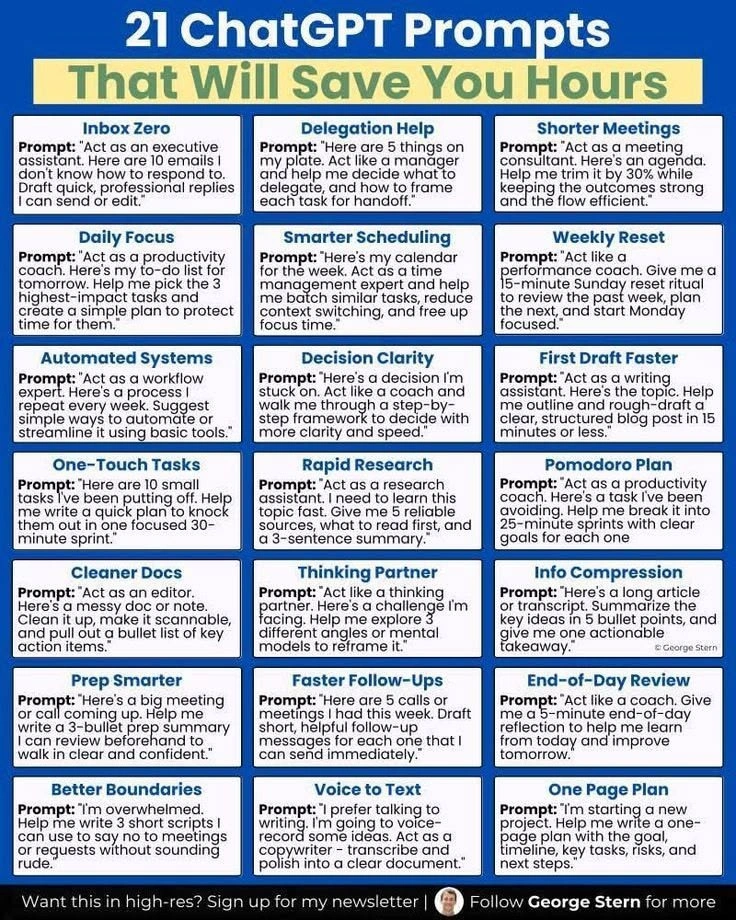

Linkedin -- www.linkedin.com/in/shishir-bhargava-68a8b4257
- 2026 Lexus IS 350 F Sport: Shocking review - August 22, 2026
- Why Global Markets Can Turn Nervous Overnight | How to prepare for it - July 9, 2026
- Why Countries Are Competing for Rare Earth Minerals | Shocking Details Revealed - July 6, 2026
⚠️ Most People Discover Trends When It's Too Late
Join the Trends Goldmine Insider List and get emerging AI tools, future products, viral keywords, and hidden opportunities before they hit the mainstream.
While everyone else is chasing yesterday's trends, you'll be spotting tomorrow's opportunities first.
🚀 Free Weekly Trend Alerts • No Spam • Unsubscribe Anytime
SIGN UP NOW & RECEIVE A SHORT REPORT ON HOW TO MAKE FORTUNE WITH TRENDS.Trusted by readers who want to discover opportunities before the crowd.